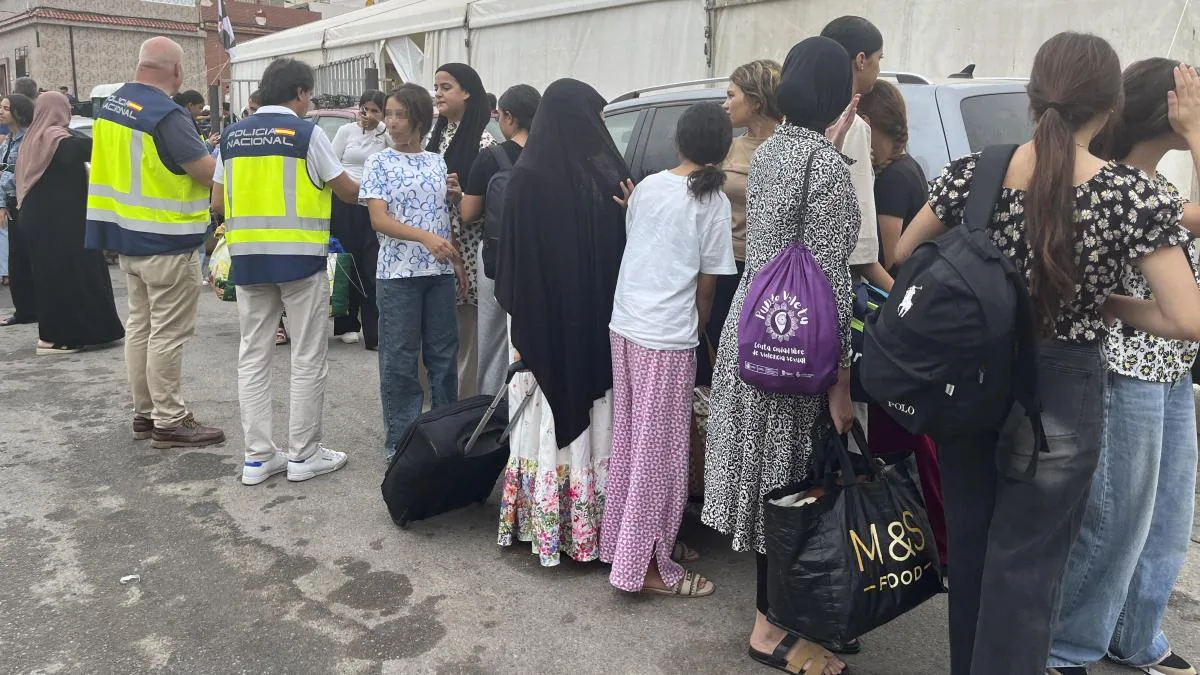
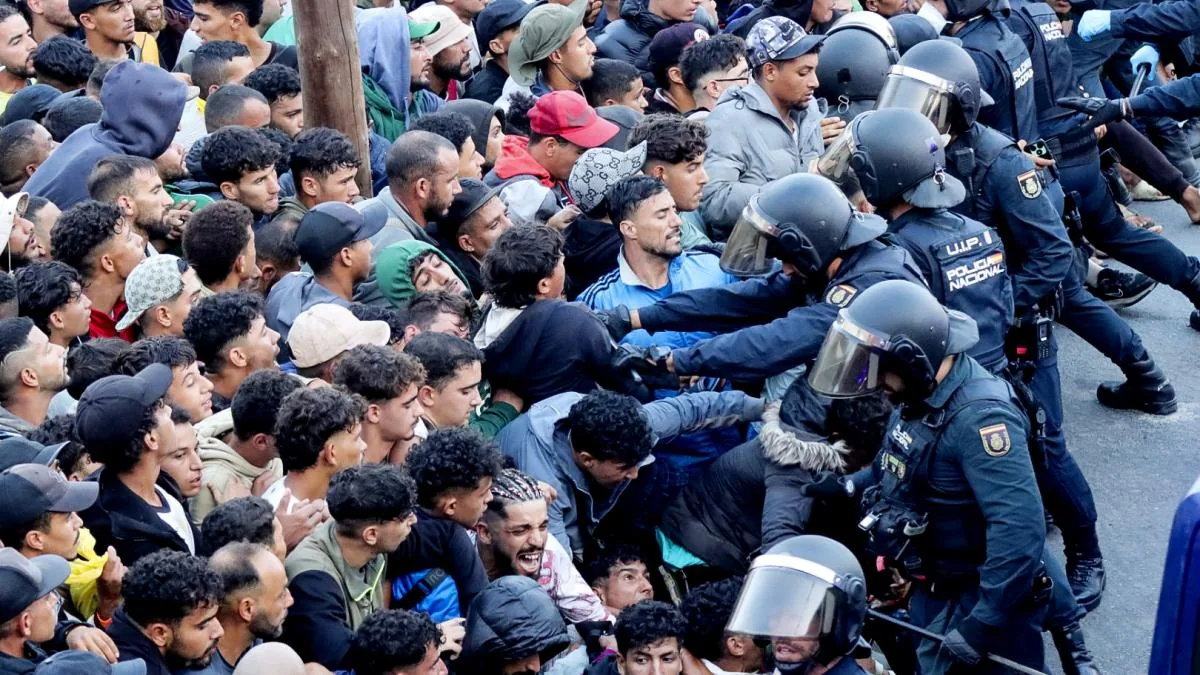
One month after the breach of the Tarajal border, through which more than 80,000 people entered in just 48 hours, Ceuta is a city with spirits down. The deep feeling of institutional abandonment, combined with high doses of indignation, fear, and uncertainty, has taken over the streets. The same streets where thousands of immigrants continue to wander. The locals, whose August (their peace, their freedom) has been stolen with confinements not decreed by the BOE but by the lack of security, fear that the tension emanating from indignation will break their historic multicultural coexistence. That the crack at the border with Morocco will irreversibly fracture a population whose patience is at its limit due to unfulfilled promises.
Read more Sánchez’s bad summer
Manolo Fernández is known in Ceuta as Manolo Estanco. For the four decades he has been running the kiosk in Plaza de la Constitución, right in the city center, where – at first glance – the pulse has recovered the most. But one phrase shatters that thesis. “I sell more than double the tobacco than a month ago: in packs, rolling tobacco, nicotine pouches. Bags of snacks, none, but cigarettes at all hours. Look at the line,” he says while pointing to the sidewalk, with a group of immigrants waiting but not a single child in sight. The scarce presence of children in the streets is one of the clearest symptoms of collective fear. “My six-year-old granddaughter is still locked up at home. No beaches, no parks,” laments Fernández, who invites “anyone who talks about normality” to walk through the public spaces of the neighborhoods, arguing that the “uncontrolled situation” is still evident. A walk that does not take much time: the city covers no more than 20 square kilometers, but its 84,000 inhabitants are concentrated in seven square kilometers.

In the last four weeks, Manolo Estanco has placed newspapers on the shelf of his kiosk with front pages stating that the Government would expel “all” the people who entered irregularly. And that promise has caused a lot of uproar among the people of Ceuta. First, as Fernández says, because it is false. The population in these days has taken an accelerated course in migration policy: they have learned that sub-Saharan Africans are potential asylum seekers who cannot be immediately returned, nor can minor immigrants. The vast majority returned on their own feet the first weekend of August, but then the flow was cut off. “The whole town is outraged. The message launched from minute one about returns has not been fulfilled. To the feeling of widespread abandonment is added the deception,” analyzes Fátima Hamed, the first Muslim woman leading a political party in Spain. The leader of the Movement for Dignity and Citizenship thinks that if the Executive had explained well that returns would not be carried out outside the law, “so they will be delayed two, three, or six months,” it probably would have caused a different reaction.
She refers to the episodes of hostility that have broken out, such as the blocking of food distributed by the Red Cross or the burning of huts in an immigrant settlement, in which Hamed suspects radicals may have infiltrated to fuel more “the frustration of the people” who see no light at the end of the tunnel. Also the ambushes on soldiers; the latest yesterday, with a sergeant injured and four Moroccans arrested. “These are the cracks through which hate speeches slip,” says the leader of the Muslim left. The protests that have led to several incidents have been evolving these days. The first could well reflect Ceuta’s society, with half the population of Christian origin and around 40% Muslim. In them, some – the fewest – protesters heckled other citizens, also from Ceuta but Muslim, whom they confused with immigrants. In the latest, veils were barely seen. Abdellah Mustafa, president of the Sidi Embarek neighborhood, believes “dangerous speeches” are taking hold due to “the lack of government responses,” so he refuses to attend the demonstration because he does not want “to end up fighting with any compatriot of mine.” “This city is being taken to an unprecedented rupture,” warns the spokesperson of the peripheral neighborhood. Hamed, on the other hand, considers that the situation is not at that point: “I only hope that coexistence and living together do not fragment under any circumstances.”

What both do agree on is the need to focus on the urgent: unity and coexistence, which Ceuta has always boasted. Until before the avalanche. Quino Blanco, a purebred Ceuta restaurateur, expresses that he barely recognizes his city: “In July this was a happy city, where people filled the beaches, queued in restaurants. Now? We have no freedom, exhaustion, anger, and fear prevail.” When Blanco speaks as president of the Ceuta Hospitality Business Association, he analyzes the economic impact derived from the crisis in the city with a drop in turnover in bars and restaurants of around 60%, so he calls for urgent aid to sustain businesses and preserve jobs. He also says that the cancellation of the Ceuta fair deprived many merchants, “with refrigerators full of merchandise,” of the oxygen tank needed to pay salaries and taxes. When Blanco speaks as a purebred local, he expresses his deep pain over political passivity. He joins the also quite widespread feeling that if this crisis had happened elsewhere in Spain, it would not have been managed the same way.
Read more Pogacar’s medical report makes it clear: surgery and goodbye to the season
Blanco is one of many Ceutans who during August have separated from their family or close ones, who crossed to their second homes on the Peninsula. “My wife left with my three grandchildren. She was terrified, but the final straw was when in the days after the jump we went to buy bread, and saw that purchases were being rationed to a maximum of two loaves. Like in wartime,” he recalls. And in Ceuta, to talk about the crisis, which dominates every conversation, a certain warlike language is used. It has become popular to call immigrants “invaders.” Beyond the dictionary meaning, Yasmina Bachir sums up that feeling: “It hurts to say it, but yes, it has been an invasion. They have invaded our lives, our daily life.” Her mother Hayat, whose voice breaks and eyes fill with tears when asked if she thinks Ceuta is breaking apart, thinks that “nothing is the same anymore.” She has not gone to the market for a month, as she used to every Saturday. Nor anywhere else. What she has done this atypical August, for the first time, is take a taxi, which came to pick her up at her own door to take her to the doctor.

Both live, wall to wall, in Hadú, a neighborhood on the outskirts where the impact of the crisis becomes more severe – and visible. Another crack that widens: center and periphery. There, dozens, maybe hundreds, of Maghrebis remain in the streets or in abandoned plots. Like everyone in the city: they are either lying on the ground sleeping or walking nonstop. The mix of smells along the building facades is indescribable. Nor can they find adjectives to describe the nights that go by. These things led the family to confine themselves at home, as during the pandemic. “Worse,” they clarify, because this time with the shutters down. Until the father, Abdelmalik, the family grandfather, decided to pack some suitcases and put some distance for a few days in August. On Friday, when they boarded the ferry back from Algeciras, where only the hardships in the autonomous city were heard again, Hayat says she experienced a feeling until now unknown: not wanting to return to her own home. “They have sunk our life overnight,” the family states from the living room of their home, which the father built with Muslim aesthetics.

The family, like the rest in the city, has its eyes on the next stage of the crisis that will come with September: the return to schools. It will undoubtedly be the most uncertain school year start, with a high risk of absenteeism, despite political authorities insisting on presenting it as normal. To begin with, the first image students will see upon arriving at their schools will be police or military at the doors. But first, they will have to get there. Aaron, Yasmina Bachir’s son, who if he has to choose between Language or Math says he prefers Physical Education, will start the second year of ESO. At 13 years old, he shows the way from his house door to the institute. Just outside, three people under blankets; two others collect cardboard in garbage bags among which they have slept. Turning the street, another group wandering. On the main avenue, under construction for half a year, the sidewalks have narrowed. His mother does not intend to let him go alone. And that, safety inside and outside schools, is just one of the concerns of families, who are gathering from the federation of parents’ associations of Ceuta Cuatro Culturas, which also focuses on measures planned to ensure students’ emotional well-being, especially those with special needs, and a calm school climate.

The same peace that all Ceutans long for their city. They do not want Ceuta to make headlines for the latest violent acts. In fact, yesterday, after several consecutive days of taking to the streets, the marches were stopped for fear that ultra groups from the Peninsula might infiltrate. They already have the city upside down. They do not want more turmoil, although they expect rough waters in the coming days when the Government makes public the places where more beds will be enabled to accommodate immigrants, since the idea that the government plan is to “turn Ceuta into a CETI” is increasingly widespread. Quino Blanco, who now speaks as a neighbor as well as a spokesperson for restaurateurs, warns that Ceutans who “love their land,” whether Christian, Muslim, Hebrew, or Hindu, will not allow more disregard. And he does so with a very clear message: “If anyone from Madrid thinks they will sell our land, they are totally wrong.” The local feeling, he predicts, will prevail over any attempt to break Ceuta.
Read more Haakon VIII confirms that he will share with Queen Mette-Marit his commitment to Norway