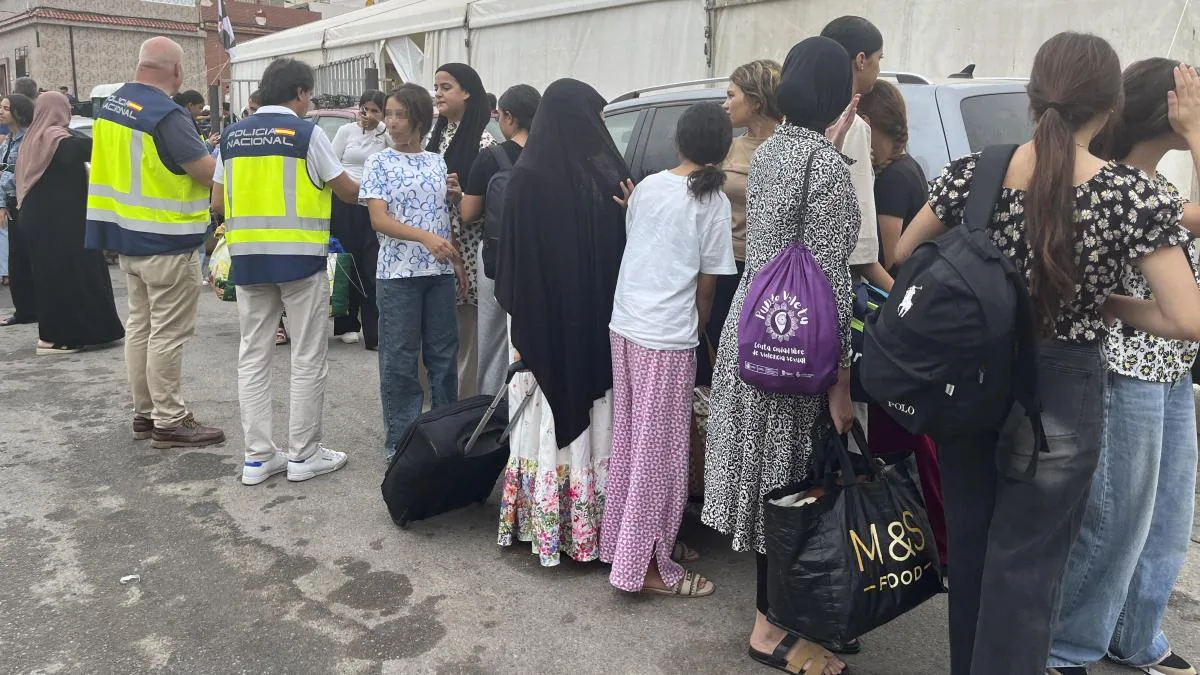
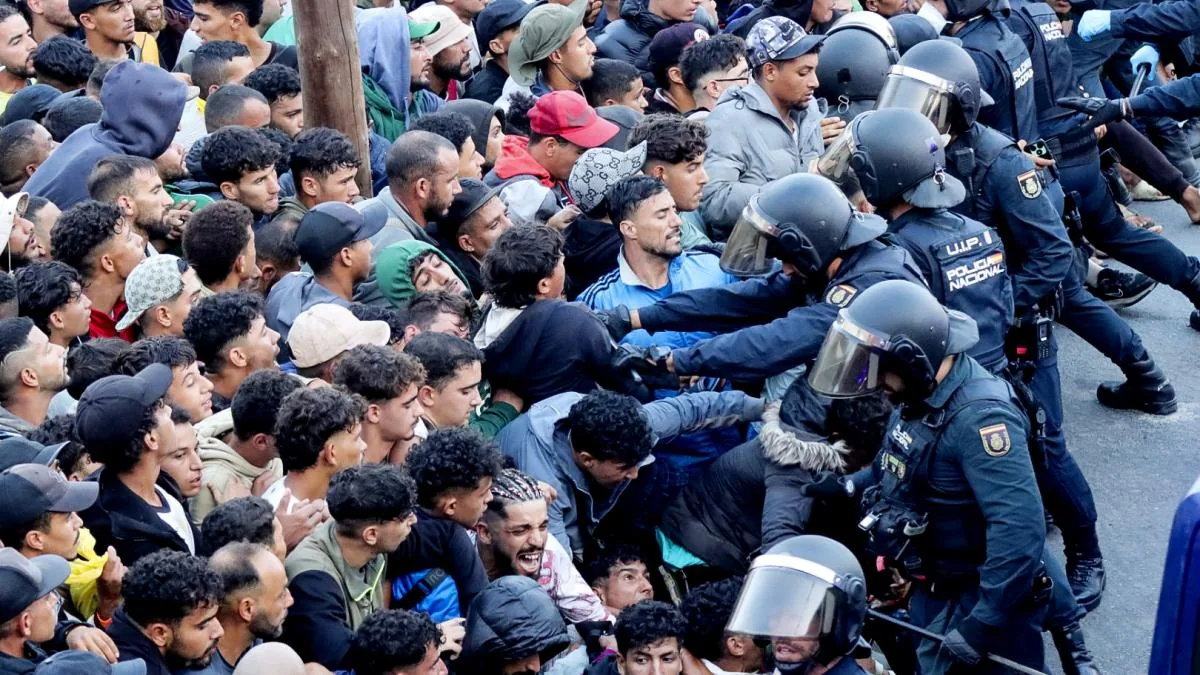
The diplomatic clash and rising tension between Rome and Madrid over the Ceuta migration crisis has led to an exceptional situation in the middle of summer, with the suspension of the Schengen area between the two countries and the reintroduction of border controls. The Government established them yesterday randomly at some air and sea border posts for travelers coming from Italy. This is the response to the refusal of Giorgia Meloni’s Executive to lift the suspension it decreed a few days ago of the Schengen area with Spain.
Read more Three communities refuse to host minors from Ceuta
Despite the obvious differences in the political color of Rome and Madrid, the argument used by Pedro Sánchez’s Government is the same as that used by the far-right leader: migrants crossing a European border can pose a security risk. The Interior order states that the temporary reinstatement of controls aims to respond “to the serious threat” to public order and internal security arising from migratory pressure on the Central Mediterranean route, destined for Italy. In addition, the ministry led by Fernando Grande-Marlaska, which sent the new instruction to European authorities yesterday, highlights the use of these migratory routes by criminal organizations and includes the terrorist threat.
Despite the severity of these words and the controls carried out, the situation yesterday at airports such as Barcelona and Madrid, the first places where they were established, was completely normal and most travelers landing were unaware of the new scenario.
Also read
During the morning, control was extended to the airports of Málaga, Seville, Bilbao, Alicante, and Valencia. The next will be those of the Balearic and Canary Islands. The controlled origin airports are Fiumicino and Ciampino (Rome), Malpensa (Milan), Naples, Venice, and Florence. But the Government warns that the list will grow in the coming days.
In total, about 260 flights from Italy arrived in Spain yesterday, of which about 60 were concentrated in Barcelona, according to Aena. In total, there were checks on twelve, two at El Prat, one in Madrid, one in Bilbao, two in Seville, and three in Alicante and Valencia, respectively, according to data provided by the National Police Corps late yesterday.
It should be noted that last year 5.6 million Italian tourists visited Spain and according to Corriere della Sera the transit between Spain and Italy in August is about 86,000 people per day. As for the ports, only the arrival and control of a cruise ship from Italy in Barcelona was scheduled yesterday.
The majority of Italian tourists arriving for their holidays are unaware of the diplomatic situation
Controls were carried out immediately upon leaving the plane, on the tarmac or at the exit of the access gangway to the aircraft, before stepping into the terminal. Up to a hundred National Police officers were dedicated to this, with between two and four agents per plane, according to Interior. Specifically, the documentation of between 5% and 10% of the passengers on each checked plane was verified, as the controls are random and on third-country passengers. It is checked whether they have a valid passport and if their documentation is in order.
Read more Europe sinks in the Strait
The Government intends that EU citizens be exempt from inspection, to allow greater agility in passengers leaving the plane, although anyone can be identified upon landing.
Also read
From Rome, the measures adopted by Spain were described as “reprisal” and a consular reinforcement was enabled to assist their travelers’ questions, although most come to Spain to spend their holidays unaware of the situation and diplomatic tension. This is not the case for Andrea and Chiara, a young couple from Venice who arrived yesterday in the Catalan capital. They were informed but traveled as usual, with total normality. Carla, an Italian living in Genoa, also explained that her trip went without incident. “We’ll see what happens on the way back, when boarding today they didn’t even ask me for documentation,” she said. Tourists from Bologna found themselves in the same situation.
Thus, the situation at El Prat was normal on the second Saturday of August and in the morning there were barely any controls on a couple of flights, one from Rome and another from Milan. Alessandro landed with the second along with his wife and two small children. He explained at the arrivals terminal that he went through an identity check upon landing, but everything went smoothly. He was unaware that Spain had adopted this measure in response to Meloni and when he found out, his wife added: “Well done!”. “We have an excellent Government,” he said ironically.
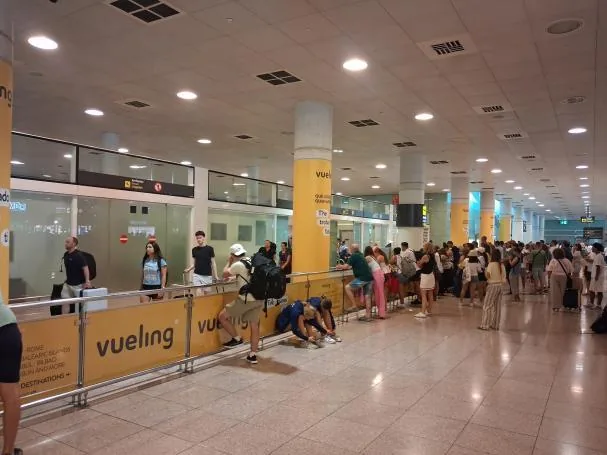
For passengers coming from Sardinia, there were no surprises either. The most worried were about twenty shaved young men coming from a bachelor party – all dressed alike, with a black t-shirt with the groom’s face, who stood out with a pink t-shirt and an identifier: Lo sposo–. Their unease was not due to the controls, which they had not noticed, but because they could not find their bus driver.
Rome calls Pedro Sánchez’s Government’s measure a “reprisal” and enables consular reinforcement
On the other side of the Mediterranean, there have indeed been more annoying than usual controls and queues for Spanish passengers. But not for everyone. Ramon and Mònica spent a few days in Naples and when they flew the inspections in Italy were already in force. In their case, there was no impact there, nor was there yesterday. They traveled with their two teenage daughters, eager to leave the airport and get home.
The truth is that what disturbed the normality yesterday at the arrivals terminal of El Prat was the presence of cameras… and some attributed it to the arrival of a Barça signing. “Rodri must be about to arrive,” speculated a Catalan family.
Read more United States, a more strategic ally than ever for Morocco