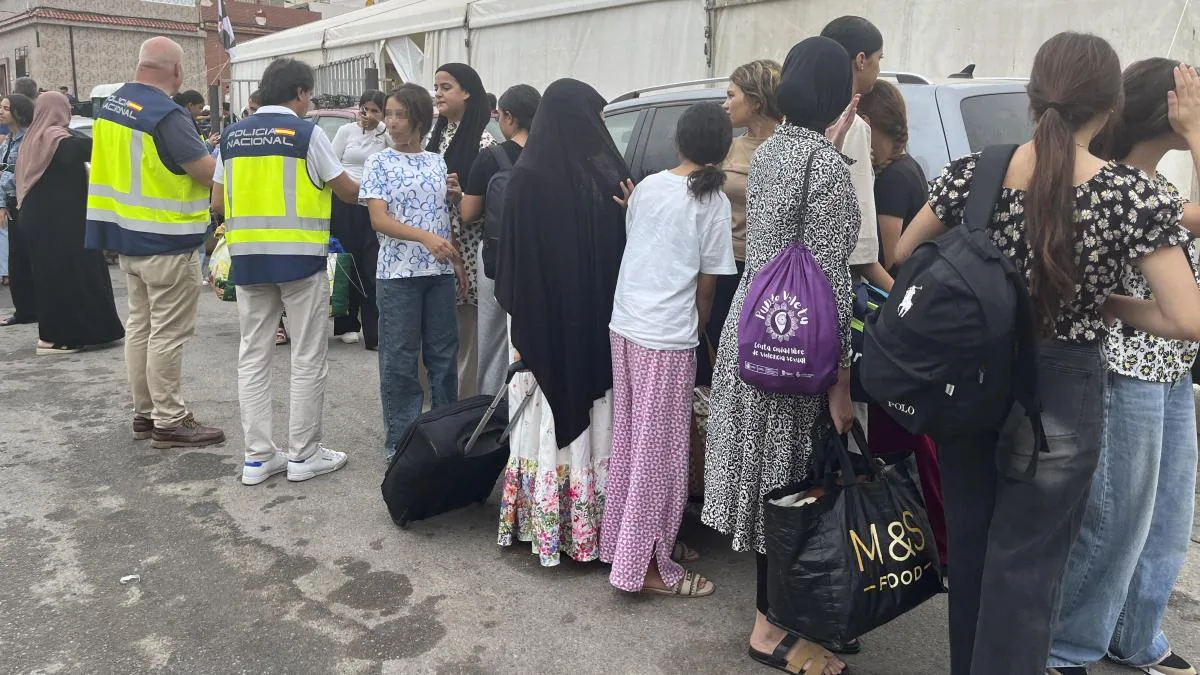
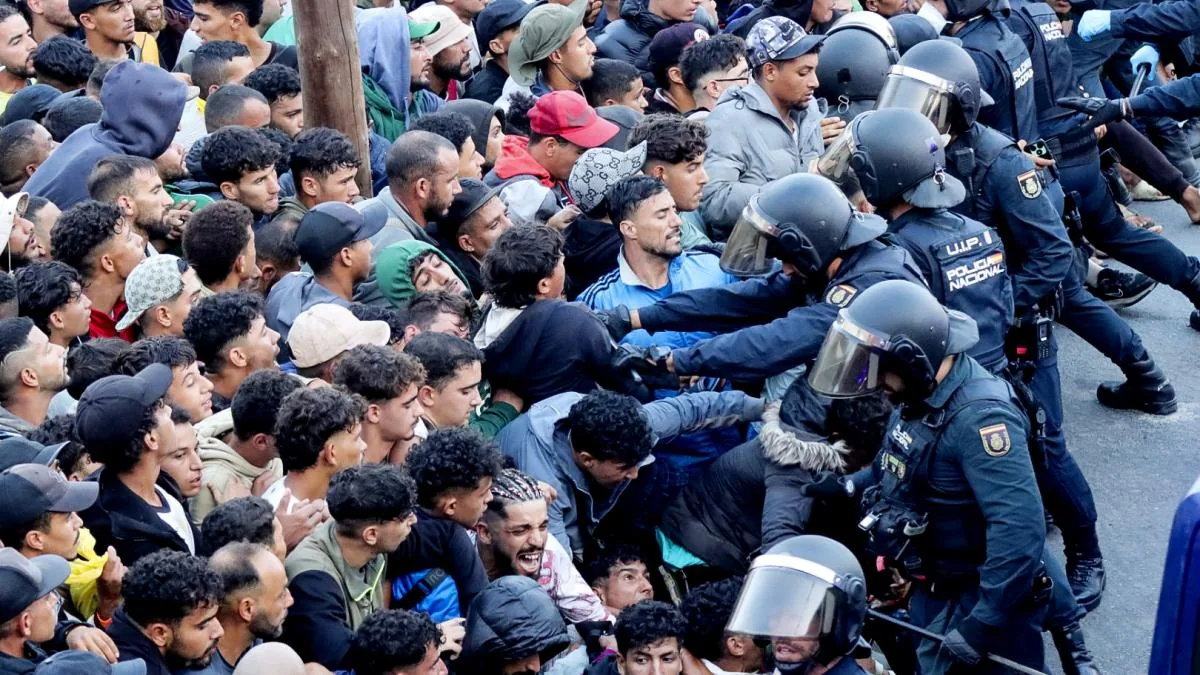
Pedro Sánchez appeared this Thursday before the plenary session of the Congress of Deputies to provide explanations about the management of the Ceuta crisis following the massive entry of 72,000 people from Morocco and a day after a police report emerged pointing to possible involvement of Moroccan agents in the development of the assault. Facing a chamber awaiting the responsibilities of the neighboring country for the events that occurred on July 30 and 31 and the possible warnings received by the Executive, the Prime Minister defended that “it cannot be concluded” that the massive entry was “designed by Morocco,” although he admitted that it will be necessary to investigate whether there was “inaction or incapacity” on the part of the Moroccan authorities.
Read more Three Civil Guards injured after being rammed by a narco speedboat in Águilas (Murcia)
A nuance after which he revealed that the Government summoned the Moroccan ambassador in Madrid on August 21, after two Moroccan ministers referred to the “sacred fight to liberate the occupied cities.” “Two statements, ladies and gentlemen, that, of course, we have categorically rejected,” he stated firmly.
Sánchez thus turned his intervention into a political defense of the autonomous city, of the actions of the Spanish agents during those two days, and of the response given by the Government. His speech, he explained, aimed to answer “the three questions that the public demands” in the face of the crisis: “Could this crisis have been avoided? Who or what caused it? And what is the Government doing and will do from now on?”

The socialist leader wanted to set that framework from the first minute. To do so, he resorted to a symbol of the Congress itself to claim the Spanishness of Ceuta and Melilla. By recalling the origin of the lions that flank the Lower House, cast with cannons captured after the African war, he evoked the Treaty of Wad-Ras, which ended the conflict and helped to “consolidate Spain’s sovereignty over Ceuta and Melilla in perpetuity.” “For centuries, these two cities have been Spanish. Since that treaty, they have been so by diplomatic agreement. And I assure you they will remain so until the end of time,” he proclaimed before the chamber. “Ceuta is not Spain’s border. Ceuta is Spain at the border,” he emphasized minutes later.
That claim, and the condemnation of the statements by two Moroccan ministers, did not, however, lead the president to question the need to maintain cooperation with Rabat. Sánchez defended that Spain must “continue cooperating with Morocco” and maintain “a good neighborly relationship” because it serves the general interest. But he introduced a qualification: “After what happened, that cooperation must be different.”
Regarding Morocco’s responsibility in the massive entry, Sánchez maintained the position the Government has defended since the beginning of the crisis. After the investigations carried out so far, he said, “it cannot be concluded” that the assault was “designed by Morocco.” Sánchez explained that if evidence of Rabat’s participation appeared, the Government would act accordingly. “This Government is not afraid to confront other foreign powers. But we will work based on proven facts,” he assured, before recalling that other Governments led Spain “to a war with false evidence,” referring to José María Aznar’s Government and the Iraq war.
The president did acknowledge that the Moroccan gendarmerie initially allowed the border crossing and later controlled it. “What caused the lack of control? Was there incapacity or inaction?” he asked, assuring that intelligence services will investigate what happened and announced: “We will make all reports public.”
In his second intervention, Sánchez qualified his position and warned that prudence in attributing responsibilities does not mean renouncing a firm response if evidence against Morocco appears. “That does not mean we cannot act with due force,” he pointed out. The president defended that “prudence is not incompatible with forcefulness” and insisted that the Government will respond if investigations prove Rabat’s involvement.
The president did admit, however, that both the central Government and Ceuta’s government and the State institutions as a whole had detected an increase in arrivals and had coordinated to face it. According to his version, it was a “significant but by no means unprecedented or exceptional” surge.
The difference Sánchez established is, therefore, between detecting an increase in entries and receiving an alert that would allow foreseeing the scale of what finally happened. He assured that the Government has examined “all reports, all messages, verbal notes” from the State Security Forces and Bodies and the National Intelligence Center sent to political authorities and the Government Delegation in Ceuta, and that none “predicted either the scale or the probability of what finally occurred.”
“The answer is clear: it did not, it did not,” he insisted. According to Sánchez, those communications did not go beyond “the description of the data” and “the routine warning.”
The president placed the change of scenario on the morning of July 30. “The situation changes radically and also suddenly,” he maintained. According to his reconstruction, social networks then began to fill with messages and videos encouraging crossing the border, sometimes under the argument that a Supreme Court ruling prevented so-called hot returns.
Sánchez took advantage of this episode to accuse the far right of contributing to the spread of hoaxes during the crisis, in a strategy he compared to the one, in his view, already used during the covid pandemic and the DANA (intense rain event).
But the president’s account found one of its most delicate points precisely in the actions of CENIF, the National Immigration and Borders Center of the National Police. Sánchez demanded explanations about why an informative note prepared on July 29 was not sent to any superior in the Police chain of command nor to the Ministry of the Interior. The agency’s actions, he assured, “will have to be explained.”
The question is especially relevant because the report later prepared by CENIF and sent to the National Court points to a planned entry and describes the participation of members of the Moroccan security forces in “guiding” migrants toward the border.
Sánchez’s intervention thus left on the table not only the question of what information existed before the massive entry but also what its path was within the chain of command. The Government maintains that it did not receive any extraordinary alert that anticipated the magnitude of the crisis, while the president demanded explanations about the circulation of an informative note prepared the previous day.

Sánchez’s account also did not find full support among his parliamentary partners. Enrique Santiago, general secretary of the PCE and leader of United Left, maintained that “Morocco organized this with Israel” and demanded that the president officially summon the Moroccan ambassador and that Felipe VI call Mohamed VI. Santiago also reproached the Government for acting late and “without measuring the humanitarian crisis.”
The actions of the agents during the avalanche occupied another focus of Sánchez’s intervention. When the swimming crossing became massive, he explained, the police had to make “an operational decision in minutes”: to momentarily let those reaching the border pass or try to contain them by force, with the risk of causing an even greater tragedy.
The president unequivocally defended the first option. “The Spanish agents decided to momentarily let the migrants pass. I think they did the right thing,” he stated. Sánchez recalled the 141 deaths and maintained that the alternative could have raised the number of victims even more. “Faced with the threat, they responded with humanity,” he insisted, admitting that no State can guarantee the security of a border “100%.” Hence, he argued, the need to maintain cooperation with Morocco, even if it must change after what happened.
Sánchez maintains that “there were no extraordinary alerts or warnings,” but admitted, however, that “the institutions had detected an increase in arrivals and had coordinated to face it”
The defense of the agents was accompanied by a claim for the rule of law. “You cannot grab a human being by the arm and throw them over the border as if they were a sack of earth,” he pointed out. And he warned: “A democracy is not stronger by breaking the law to solve a problem.”
In the chapter of measures, Sánchez announced that Spain will request a “permanent presence” of Frontex at the port of Ceuta and at the El Tarajal breakwater, the scene of the massive entry. He also advanced that he will offer the governments of Ceuta and Melilla a permanent seat on the European Union Committee of the Regions and that he will propose their integration into the customs union, “seeking a favorable tax regime.”

The president also announced that Felipe VI will visit Ceuta and Melilla “in the coming weeks,” after recalling that the head of State has not traveled to the two autonomous cities in 20 years. Sánchez justified the initiative because “Ceuta needs more than ever to be supported by the State” and defended that the King conveys the “absolute commitment of the State” to both cities.
Sánchez finally presented the Government’s actions as a combination of humanitarian response, border defense, and institutional reinforcement, and called for “unity and institutional loyalty” to face the consequences of the crisis. “It is the recipe to get out of the crisis. Everything else will bring nothing good,” he assured. After his intervention, almost all the ministers present in the chamber applauded the president enthusiastically, although the Defense Minister, Margarita Robles, was the first to sit down and stop applauding.
The reply
Sánchez to Feijóo: “Would you have ordered to shoot the civilian population?”
In the reply, Sánchez responded to the harsh intervention of the opposition leader and president of the PP, Alberto Núñez Feijóo, who demanded his resignation over his management of the Ceuta crisis and warned him that “he will pay for it in the courts and the polls.” The president tried to return the blow by accusing him of taking advantage of any crisis to gain political profit and prevent voters from fleeing to Santiago Abascal.
Sánchez maintained that, had the PP’s proposed recipes been applied, Feijóo would have “expelled all migrants without even processing asylum requests.” “It is illegal, ladies and gentlemen, it would force officials to break the law and to prevaricate,” he retorted. And he took the reproach to the extreme by demanding that the PP leader explain what he would have done during the Ceuta crisis: “Would you have ordered to shoot the civilian population?”
Read more The victim from Manresa mediated hours before his death between two groups that were fighting