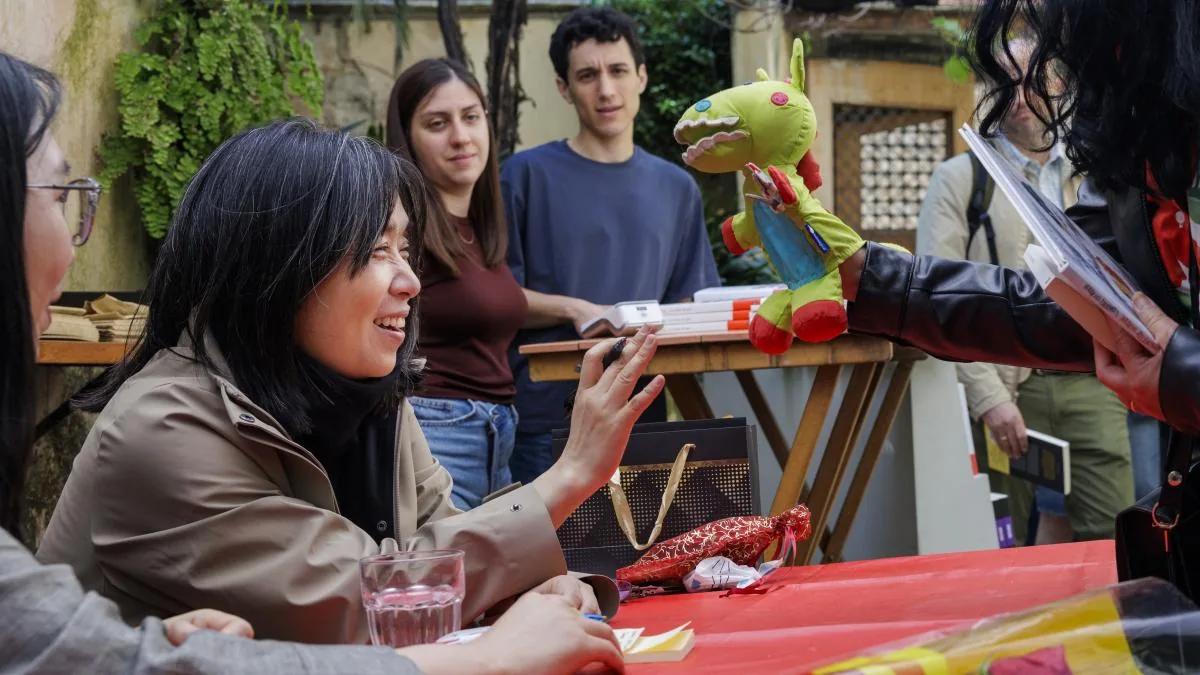
The instructions to get a copy signed by Nobel laureate Han Kang were clear: she would only hold one signing session, at La Central del Raval, and would sign one hundred copies, one per reader. The monumental queue that formed on Tuesday at the CCCB, where the author held a Sant Jordi Dialogue, foreshadowed that it would not be easy.
Read more Regina Rodríguez Sirvent and Eduardo Mendoza, the best-selling authors of this Sant Jordi
Although the signing was not scheduled until 11:30, by eight in the morning there were already readers queuing to get a number. Oriol and David, well-positioned, began their pilgrimage at dawn in Torelló, taking two trains and a bus. “I feel as if she is speaking directly to me,” said Oriol, who started reading her after the Nobel. His journey to get the signature would sound heroic if it weren’t for Alba, who lives in Ferrol and bought a flight to Barcelona to experience Sant Jordi and get the signatures of Han Kang and Amelie Nothomb, being ahead of them in the queue.
Alba came from Ferrol to experience Sant Jordi and get the signatures of Han Kang and Amelie Nothomb
At the front of the queue, her editor at Literatura Random House, Albert Puigdueta, acted almost like a bodyguard, ensuring that no one overwhelmed his author, who suffers from migraines and is not a fan of crowds. Both editor and author have known each other for years. They were in Jeju, the Korean island that is the focus of Han Kang’s book Impossible to Say Goodbye . Her publishers – in Catalan, La Magrana publishes her – have an infrequent combo in her: an author of enormous prestige, with loyal readers, and also a bestseller. Of The Vegetarian , winner of the Booker, more than 80,000 copies have been sold in Spanish in Spain.
In the queue at La Central along Elisabets street – after the hundred lucky ones with a number, another 200 had the vain hope of getting a signature – Han Kang’s books were seen in all languages. Tünde carried The Greek Lesson in Hungarian. Qianqian, The Vegetarian in Chinese. She is studying a PhD in Linguistics at UPF and Han Kang’s literature generates a familiar warmth for her. “It reminds me of my country. In China, there are also stories we could tell, but the government doesn’t allow it. Reading her, I see that we can use our power to become better people.”
Read more Spain has four months to award 13 billion of European funds
In the book Human Acts , Han Kang focuses on the Gwangju massacre, her hometown, which took place in 1980 and resulted in 2,000 civilian deaths, a brutal spasm of student repression by the military government of Chun Doo-hwan. This is how the Nobel laureate has established herself as the historical conscience of a country, South Korea, which now presents itself to the world as an explosion of turbocapitalist optimism.
Many of the readers who queued to meet Han Kang followed the Korean custom of bringing small gifts for the author. Plush dragons, a calligraphy poem, or embroidered earrings, brought by Valentina, a Mexican follower. With numbers 60 and 61 were Roser and Luna. Roser, 80 years old, is from Sant Gervasi. Luna, 46, from Seoul. They form a linguistic pair and have become friends from speaking so much in Spanish and Korean. For Roser, who studied the language at the Sejong Institute at UAB, Han Kang’s books “convey empathy with the victims of History.”
Read more Putin justifies mobile internet restrictions in Russia for security reasons