With great caution to avoid any misstep, such as the publication in the Official State Gazette (BOE) of the list of Ceuta sports centers that could be transformed into reception centers, the Government is moving forward to remove all immigrants who continue to sleep on the streets a month after the border assault. The ministries involved in managing the crisis perceive that the population has given a truce – largely due to fear that their legitimate protest might be linked to ultra-violence – so the plan has been accelerated before any spark can again bring Ceuta to the brink of social unrest. The strategy, which remains firm, involves enabling up to 6,000 beds in various locations around the city, so the transfer of adults to the Peninsula is ruled out at this stage. With it, according to those convinced in Moncloa, three priorities would be achieved: providing a humanitarian response, reducing neighborhood discontent, and speeding up return processes. It remains to be seen if the time to complete the plan matches Ceuta’s patience. And that of the immigrants.
Read more The Supreme Court gives the green light to Trump to build a ballroom in the White House
The plan to remove all people from the street aims to reduce social tension and speed up returns
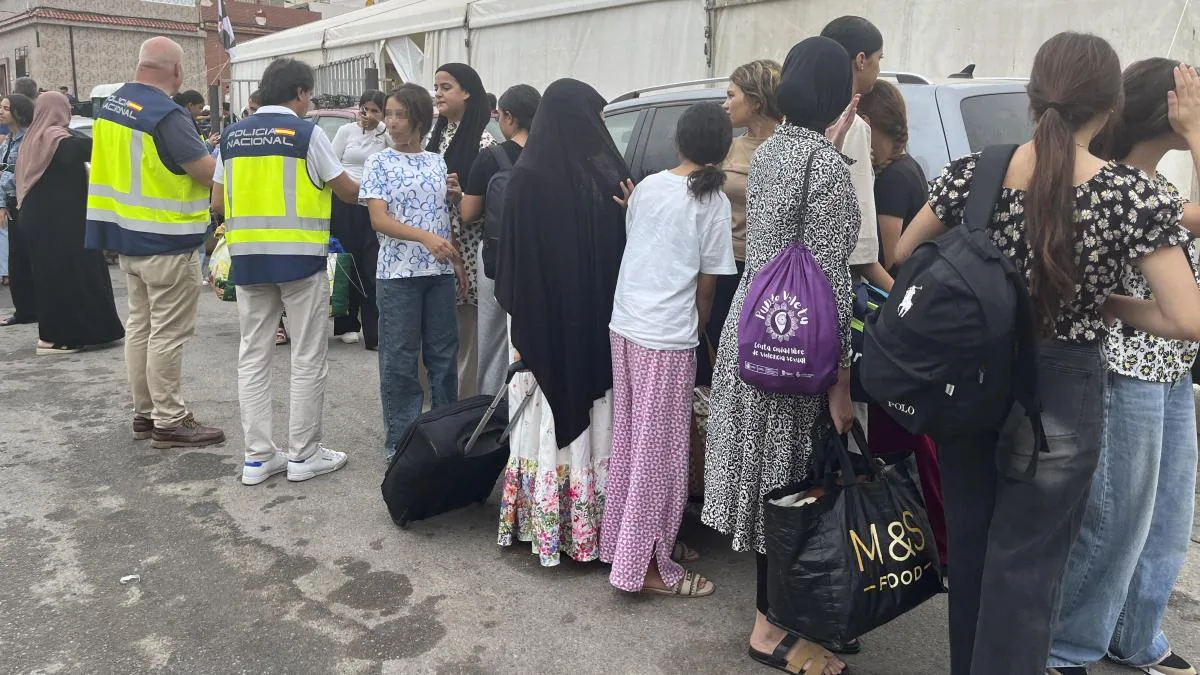
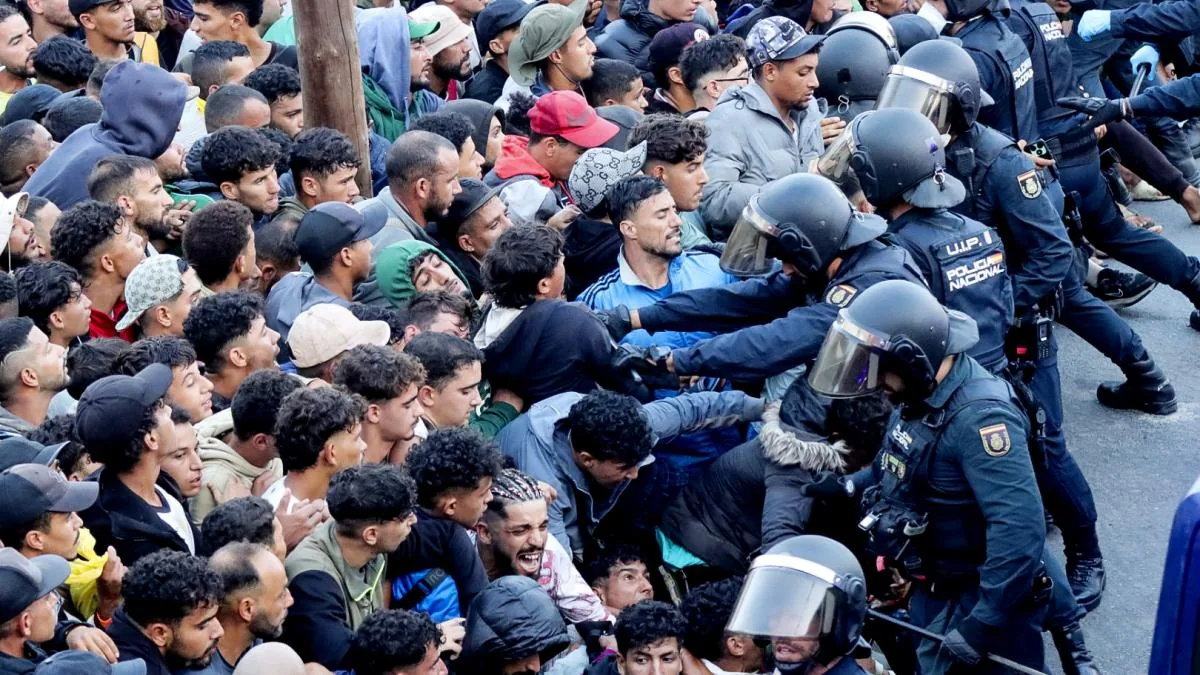
Yesterday, the hundreds of Maghrebis who had been lining up for more than 10 days near one of the first temporary centers enabled by the Government, in Loma Colmenar, woke up surprised to find the doors opening to allow the next lucky ones a provisional roof. The news spread like wildfire among the foreigners still sleeping in the city’s nooks and crannies. The Ministry of Migrations had managed to expand that parking lot to 1,200 places. The problem is that only the first 500 would enter, to the despair of the rest. The Government quietly managed the opening to avoid, precisely, the inevitable avalanche that finally took place. About fifty riot police were deployed in the area to stop the immigrants, even firing warning shots into the air, emboldening some against others.
The Police fire warning shots to control the situation at the doors of a center that has expanded its places
Rachid, who says he is “very desperate,” for all the nights he has been sleeping on the ground, did not manage to get in. He had not been queuing for days, but the four hours had served to touch the temporary place. Then reality overwhelmed him. Ali, also Moroccan, did not enter the facility either, but his anger was immense. According to his account, the Police told him days before that he could camp near the parking lot while waiting for new places to be enabled. “And now they throw me out like a dog, after many nights in the cold; without showering,” he recounted with fear still in his body. Both share the same profile of economic immigrant: adult males struggling to survive who move to another country seeking a better quality of life. They are subject to return, unlike refugees, who move forcibly to save their lives. That is the theory. But in practice, neither of them, with greater or lesser indignation, can explain why Sudanese, Malians, or Yemenis who also crossed massively are serious candidates for international protection. Rachid confesses that if the “suffocation” he suffers in Ceuta lasts “a few more days,” he will return to Morocco on his own. Ali, on the other hand, plans to fight.
The Prosecutor’s Office counts 23 sexual assaults in Ceuta and investigates Moroccans, Spaniards, and a Belgian
The reception center in Loma Margarita, where the sub-Saharan Africans who populated Playa del Trampolín were moved, was also expanded by another 200 places, reaching 1,300. In addition, 320 beds have been set up at the La Hípica facilities, reserved for migrant women with minors in their care. Also, a group of about 250 women and girls who had been sleeping for weeks in the sports center of the Príncipe neighborhood, under plastic roofs, was relocated to a new reception center. The neighbors set up this camp to “protect them” as they fit the most vulnerable profile. The Prosecutor’s Office already counts 23 sexual assaults and is investigating Moroccans, Spaniards, and a Belgian.
Read more Putin plays cat and mouse
Yesterday’s receptions are the kinder face of the crisis, but many people continue to be on the streets in Ceuta. They keep accumulating at Playa del Trampolín and, again yesterday afternoon, near Loma Colmenar, from where they were evicted. And although the Government acknowledges that this image is harmful, they also admit that these pockets of people in one place are the most conducive to continuing the three phases of the plan: concentrate, locate, expel.
Solidarity with Ceuta
Tomorrow’s gatherings divide political parties
On the 2nd, that is, tomorrow, at 8 p.m., in front of all town halls, the Federation of Municipalities and Provinces, Spain’s main municipal organization, has called gatherings in support of Ceuta and against immigration. The call, which has not been agreed upon with the other parties that are also part of the Federation of Municipalities, has caused controversy.
There are parties, particularly the PSOE, United Left, and most nationalist formations, who consider the call a trick by the PP and Vox to transfer protests about Ceuta’s situation to the Peninsula. In the end, they believe these demonstrations will be mobilizations against the Government. However, there are socialist municipalities that have chosen to call their own solidarity gatherings with Ceuta and socialist councilors who have decided to join those called by the Federation of Municipalities, albeit reluctantly. It should not be forgotten that the current term will culminate in the May 28 elections and that now any gesture can be misinterpreted or become an electoral argument against the opponent. Ceuta is a special case. The Regional Executive Committee of the PSOE has conveyed to its members its decision to participate in the demonstration called for tomorrow, considering that they must be “by the people’s side.” In a statement yesterday, the socialist formation defended that the reality of Ceuta “is lived here, day by day,” and that the political action of the Ceuta PSOE must respond to the city’s needs.
Read more Meloni’s standoff with Spain over border controls causes friction in her government