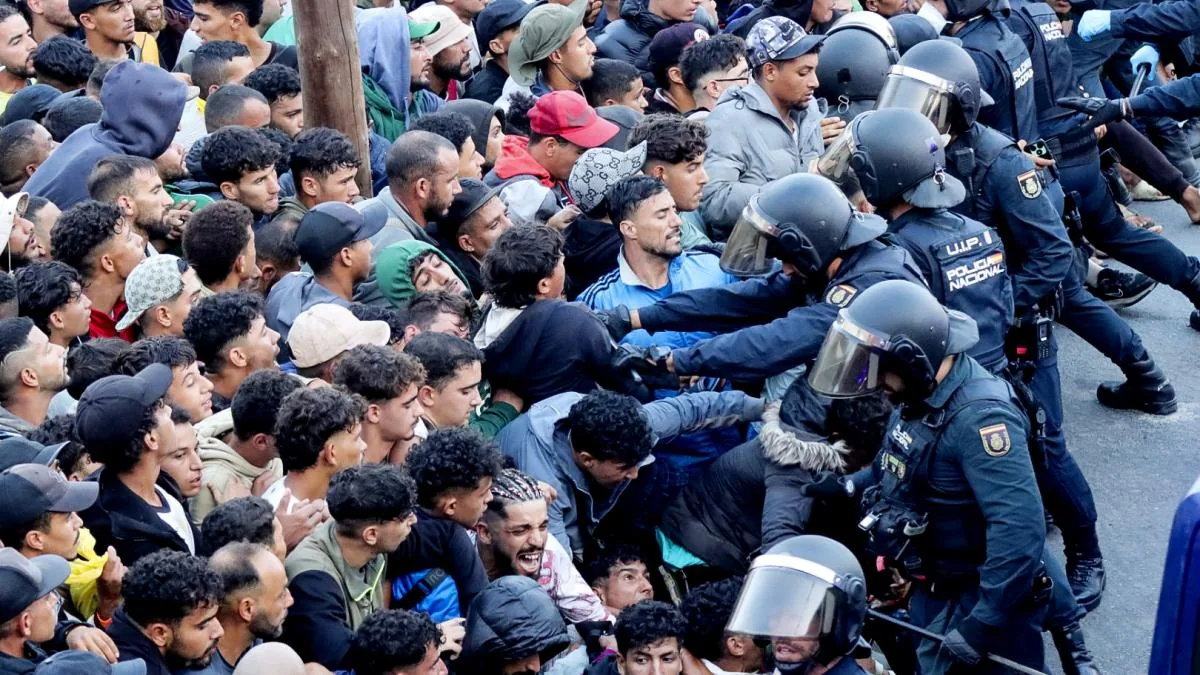
Italy decided yesterday to extend border controls for another 15 days on passengers arriving by plane and ship from Spain. The temporary suspension of Schengen between the two countries, introduced on August 1 due to the Ceuta migration crisis, was set to expire this Monday, August 31, but Giorgia Meloni’s government ultimately chose to maintain the measure until September 15. The Executive’s initial intention was to extend the controls for another month, but a two-week extension was finally chosen for technical reasons.
Read more Lamine is sad, they said (well, thank goodness)
Italy’s decision, reported by La Vanguardia, came after several days of uncertainty about Rome’s intentions and is also the result of an internal debate within the Executive. Against the supporters of a softer line, led by the Interior Minister, Matteo Piantedosi, who advocated lifting the measure, the will to maintain controls expressed by Foreign Minister Antonio Tajani and Meloni herself prevailed. After mediation in a meeting between the three held yesterday, the intermediate solution of extending the suspension for only two weeks was reached.
Interior Minister Piantedosi advocates a more cautious line and lifting the controls
Formally, the Italian Ministry of the Interior justified the decision due to the “persistence of the assessment elements that led to its reintroduction on August 1,” while also taking into account “initiatives already undertaken by Spain, together with the European Union, so that the situation in that area can move towards a forthcoming normalization.” Piantedosi communicated the reasons for the extension to his Spanish counterpart, Fernando Grande-Marlaska, during what the Italian ministry described as a “constructive telephone conversation.” Piantedosi himself, a career prefect with a technical profile and no political affiliation, openly expressed his hope that this will be “the last extension.”
Spain’s response was immediate and equivalent. The Spanish Ministry of the Interior announced that it will also extend for fifteen days the controls on passengers arriving by sea or air from Italy. Madrid had established these checks on August 8, following Italy’s decision, in a reaction that Meloni interpreted as retaliation. According to the Interior Ministry, 12,885 travelers from 1,111 flights have been checked at airports throughout Spain, in a measure that required 1,885 officials, in a report closed at 1 p.m. yesterday.
Meloni and Foreign Minister Tajani advocate maintaining pressure on Madrid
Rome has also reviewed its first month of controls. Since August 1, passenger lists of nearly 500,000 people have been checked, and more than 180,000 travelers from Spain have been identified upon entering Italy. The result was 31 border refusals – eight Moroccan citizens – and six arrests. None of those intercepted came from Ceuta.
However, Piantedosi’s conciliatory tone contrasts with that maintained by sectors closest to Meloni. Carlo Fidanza, head of the Brothers of Italy delegation in the European Parliament and very close to Vox, has denounced the existence of “traffickers organizing transfers to mainland Spain” and the “risk of jihadist infiltrations.” “In this context, Italy has the duty to defend its borders,” he argues.
Read more Lamine Yamal’s smile empowers Raphinha’s Barça in the thrashing of Rayo Vallecano
For now, the Italian government clings to a formal element: as long as the “situation of interest for National Security” remains in force in Ceuta, the so-called “single command” decreed by Sánchez’s government, Rome considers that the exceptional conditions justifying the controls persist. The problem is that this figure will initially be in effect until December 31. Therefore, the two-week extension will hardly resolve the conflict on its own.
The Spanish Ministry of the Interior also announced it will extend inspections for fifteen days
In Meloni’s Executive, there is also the temptation to keep the standoff open at least until the next European Council, scheduled for October 15 and 16. There, Rome could try to isolate Sánchez again on migration matters, relying on the initiative promoted by Italy and Denmark after the massive entry into Ceuta and supported by twenty other European leaders, who called for a coordinated European response.
But sources from the Spanish government warn that this strategy could become a double-edged sword. In Brussels, Italy has another migration front open: the so-called dublinantes, asylum seekers who, according to European rules on which State should handle an application, can be transferred to the country responsible for processing it, often the first country of entry into the Union. There Italy has everything to lose. Countries like Germany and Austria began this summer to reactivate these transfers to Italy. Spain, on the other hand, despite also being in a position to request these transfers, has so far decided not to do so, an attitude that even Piantedosi has recognized as a gesture of détente. Spanish sources warn that this position could change if Meloni maintains the confrontation with Madrid over the Ceuta crisis.
These are signs that the game between Rome and Madrid is far from over in fifteen days.
Read more Poland intercepts a Russian reconnaissance plane over the Baltic Sea