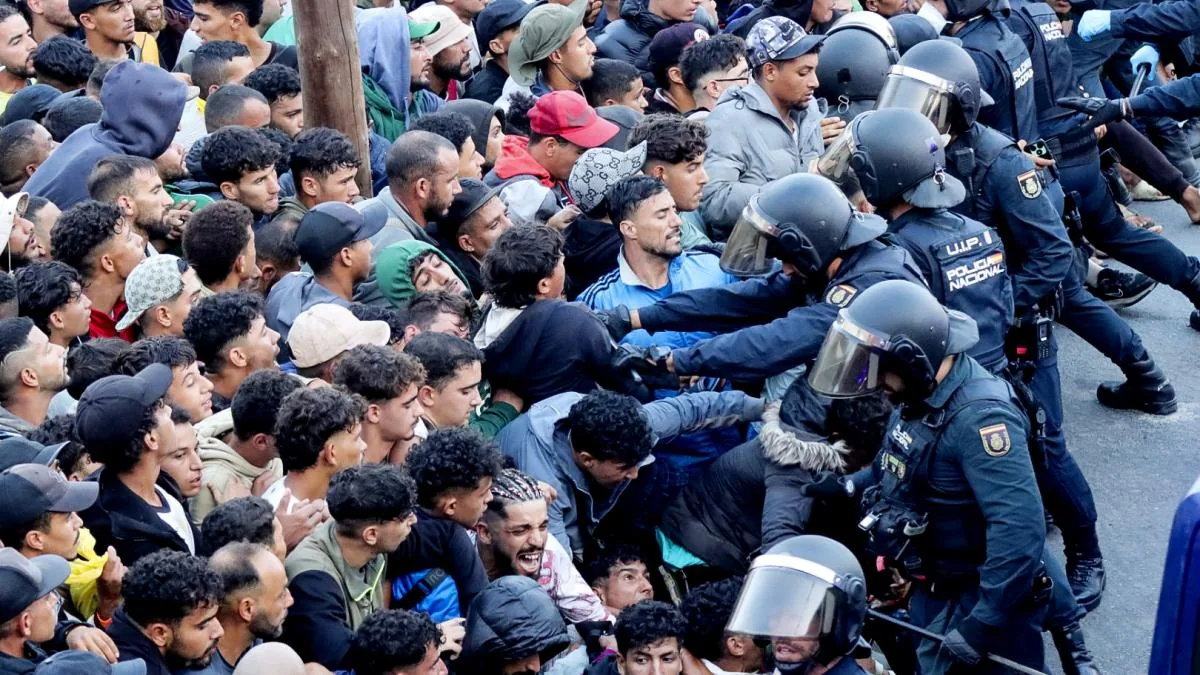
Ceuta, which was overwhelmed yesterday after the entry of up to 60,000 young migrants with the permissiveness of Morocco, is gradually recovering normality in its streets. Although there are still hundreds of Moroccans wandering its streets after spending a second night outdoors, more are continuing to make their way back to their country, through the same place they entered amid chants: the El Tarajal border breakwater, where containment barriers – 500 meters long – have begun to be installed to deter further arrivals.
Read more Morocco probes, its allies punish
Now, as the autonomous city begins to open the shutters of its shops, the question arises whether this crisis, which has claimed at least 67 lives, could have been avoided, focusing on whether the intelligence and information services failed to notice that thousands of Moroccans, from various cities in the country, were approaching the border looking for the right moment to jump to Spain.
Grande-Marlaska reaffirms that Morocco is not only not a threat, but is a “genuinely reliable partner”
The Interior Minister, Fernando Grande-Marlaska, was clear in a press conference held this morning at the Government Delegation headquarters in Ceuta, after meeting with police commanders in charge of the operation. “No, there is no report regarding the situation that occurred,” said the Interior Minister when asked if the secret services warned that the massive assault could happen.
Within the Government, the idea is spreading that the crisis could have been minimized if information from the National Intelligence Center (CNI) had been available, which at least did not reach the Ministry of the Interior, which is responsible for border custody. “It caught us by surprise,” admit government sources, explaining that Interior was focused earlier in the week on the fires ravaging the center of the peninsula.
The same sources refer to Monday, in a live broadcast with La Sexta, when Grande-Marlaska was asked about the situation in Ceuta, which until then was limited to the continuous arrival of immigrants swimming, encouraged by a recent Supreme Court ruling that determined that hot returns are not allowed for immigrants intercepted at sea. Until then, it was a migratory upturn with a clear impact on Ceuta’s saturated reception system.
It was on Thursday at noon when the situation took a qualitative leap, with hundreds of people entering by swimming, but also on foot, into the autonomous city, while Moroccan gendarmes looked the other way. The Government, however, publicly maintains that Morocco has collaborated at all times. In fact, Grande-Marlaska has once again lavished praise on the neighboring country, stating that Rabat is not only not a threat, but is a “genuinely reliable partner.”
Police sources put this statement into question. A Civil Guard commander has no doubts that the arrival of buses in Fnideq (Castillejos) was detected by Moroccan authorities before they decided to turn a blind eye to the massive entry, which this Saturday the Interior Minister raised to 60,000 people. “If Morocco is a reliable partner, why didn’t it share that information with Spain?” ask the same sources, who believe that with that data the Government could have anticipated the crisis, reducing its impact.