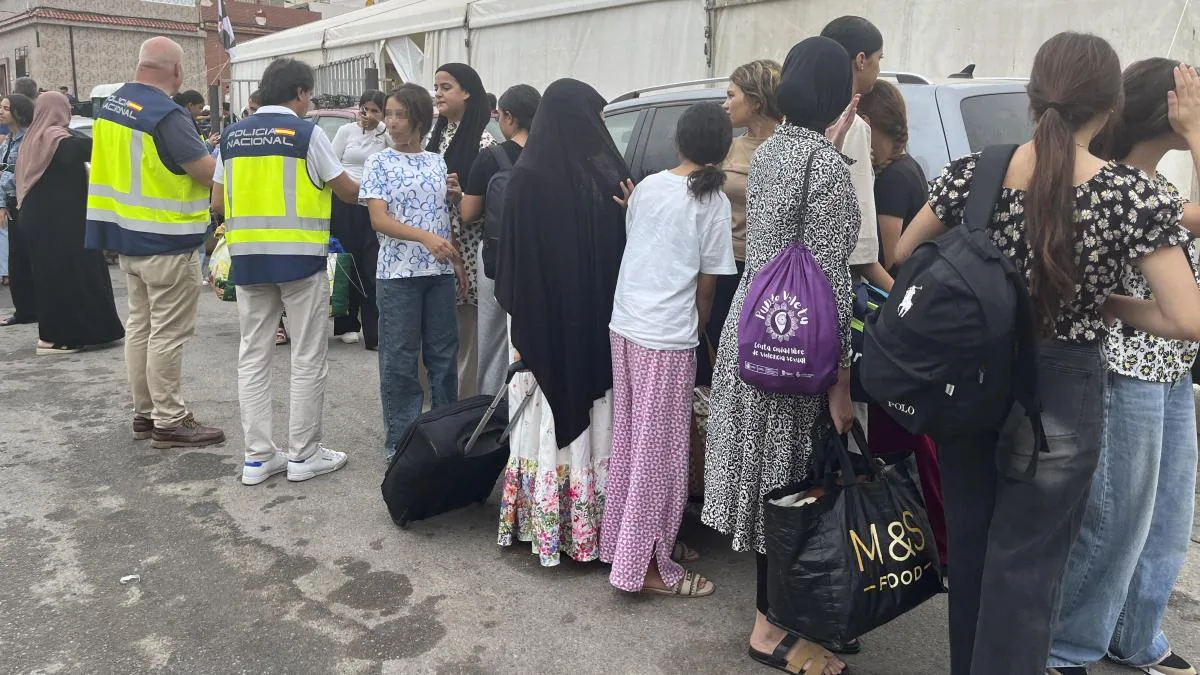
At the entrance of the Embolsamiento parking lot, an asphalted area to ease traffic congestion in Ceuta, a huge sign welcomes all vehicles that usually wait for hours before crossing to Morocco: “No honking, hospital zone.” But there, around the esplanade, equipped with military tents to accommodate immigrants, no honking has been heard for weeks. From the vehicles, police or medical, passing through the Loma Colmenar neighborhood, only siren sounds come out. Also the sound of some shots fired into the air. The noise that drives the neighbors crazy is the constant shouting of hundreds of Moroccans who have settled at the foot of their homes waiting to enter the enclosure to get a bed to sleep.
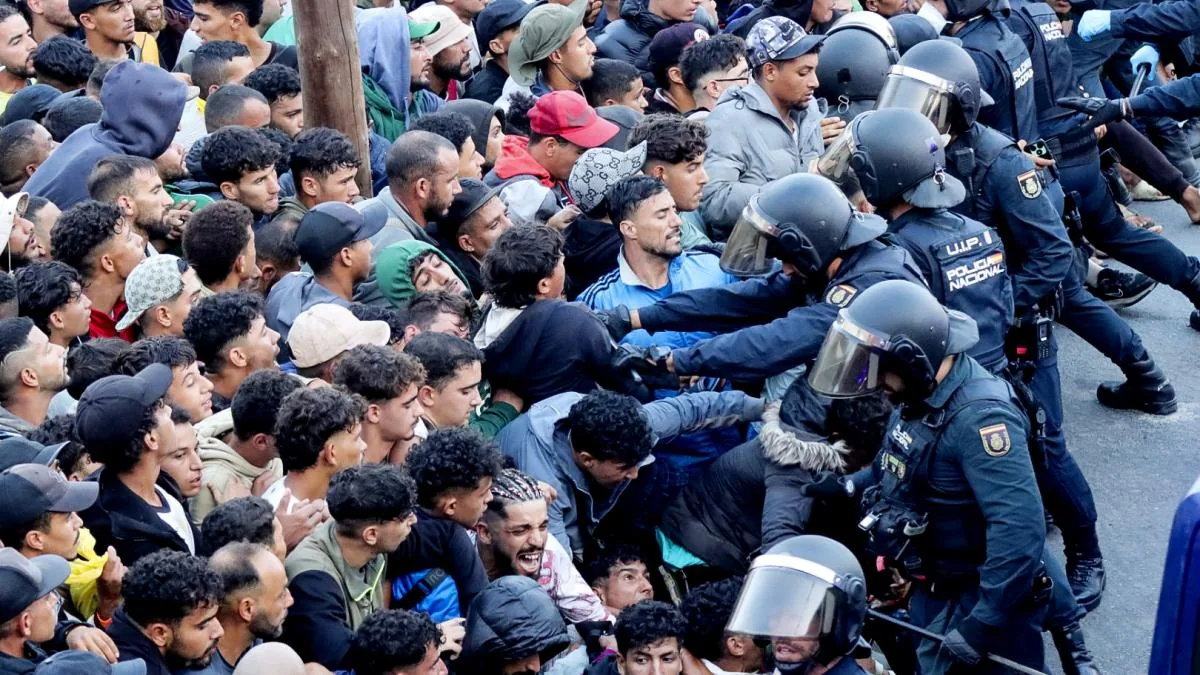
Abdelwahed lives on the first floor of one of the buildings on Cadí Iyad Avenue with open arcades, where surveillance cameras have been installed due to the insecurity they feel. Leaning on the railing, he narrates in a description that swings from indignation to despair what he now sees every time he leaves his house: in front, workers deploying more beds in the provisional reception center; to the right, riot police containing hundreds of immigrants crowding at the gates of the Embolsamiento; to the left, more foreigners raising tents with tarps and wood to cover themselves at night because rain is threatening; and below, the plastic cordon with which they have delimited his facade. And inside his home, the news reports that the Government has enabled 3,300 places to attend to migrants in Ceuta. But another 3,000 are being prepared. “We can’t sleep. It’s 2:00 a.m. and they keep singing, dancing, fighting, because they have nothing else to do,” he details while pointing out how the people gathered below look into infinity.

One floor above lives a Muslim woman from Ceuta who asks not to be identified. She wears a mask, but not because of the smell invading the building. Nor out of fear of contagion. For ten days she has added the face mask to her usual veil so that no immigrant photographs her face. The woman, born in Ceuta more than five decades ago, denounces that Muslims who refuse to help Moroccans still on the street are being victims of targeting campaigns on social media. Blacklists. “On top of having invaded our coexistence, they record us to spread that we are traitors. If my face comes out, I can’t set foot in Morocco again,” laments the mother, who wonders “where the military are when they are needed.” “I pay all my taxes, but on the outskirts we feel like second-class Ceutans and Spaniards,” she denounces.
The residents of the neighboring blocks, fed up with the chaos under their houses, say they feel like “second-class Ceutans”
Both neighbors agree that rest has become nonexistent, that they drag fatigue that causes nightmares. Another owner, from the same floor, approaches, having come out to the hallway to see what was happening on the street, where the decibels have risen. The Police had to assert authority when several migrants tried to cut in line, amid the shouts of others. Fátima, who doesn’t mind giving her first name but not her last, explains that she had to take advantage of early hours, when migrants were still wrapped in blankets on the ground, to run some errands. “I have to hide, like a rat, in my neighborhood. It’s not right. We can’t have a life like before,” she says. The three understand “before” as their life prior to the avalanche in El Tarajal, when they lived in a block where children played in the street. Now none are seen. But, above all, in their lives there is a “before” and “after” when the Government announced, through its spokesperson, that the Embolsamiento in front of them would host hundreds of immigrants.

The Government confirms it is willing to enable 6,000 places to get all people off the streets
The Ministry of Migrations does not confirm if the parking lot will be expanded, despite neighborhood discontent. But yesterday’s movements inside the enclosure pointed to the evidence: dozens of green cots were being stacked in front of the metal structure of a tent on which white awnings were being placed at full speed. The arrival of new logistics has caused a call effect among migrants who, until now, remained in other parts of the city. Some have come from the other end, Playa del Trampolín, which yesterday also kept adding lines of huts. They are increasingly reluctant to talk to the press. Those in line do not move an inch to avoid losing their place; those on the opposite sidewalk, assuming their turn will not come soon, keep an eye on their phone screens, through which they receive rumors that new places will soon open in other spaces. Rumors sneak into their mobiles. Karim, a Ceutan taxi driver who speaks Arabic, translates a video in which a young man claims that entering a temporary center is the pass to cross to the Peninsula. The reality is different: the reception of adult Moroccans, with almost no chance of qualifying for international protection, will be the prior step to their return to their country.
Read more The G-20 clouds over Donald Trump’s invitation to Russia
The Moroccans who accumulate in the settlement that seems like a pressure cooker also denounce the harassment they suffer every night. A group points on the ground to broken eggshells that were thrown at them from balconies last night. There are also broken bottles. Last weekend, a minor, medical report in hand, showed the wound caused by a puncture. Another said the bruises on his arms were from kicks he received while sleeping.

What Ceutans and immigrants agree on is that the situation would take another turn if the Government removed those who still spend their days on the streets. Yesterday, the designated single command, the Minister of Territorial Policy, Ángel Víctor Torres, confirmed that the Government will enable up to 6,000 places in Ceuta. A figure that does not match the numbers offered by the Interior Ministry, which insists that 5,000 people remain homeless. After days of secrecy, yesterday the location of the new spaces for centers was revealed: several plots in the port of Ceuta, Ministry of Housing lands, and the K-8 barracks. It was not disclosed when they will open to avoid another call effect among immigrants, but the mere announcement already caused unrest among neighbors. Several associations threatened with protests.
In Ceuta, the idea circulates that crisis management increasingly resembles a barge sinking from water entering through its holes. When authorities focus on plugging one, another appears. Or two more.
214 Moroccans expelled since July 31
Since the mass crossing during July 30 and 31, when more than 70,000 people entered Ceuta, 214 immigrants have been expelled to Morocco for committing crimes, according to a report from the Ministry of the Interior. This figure excludes those who returned voluntarily. Police sources detail that three of the expelled had records for crimes related to jihadist terrorism. Also, between August 10 and 31, 3,519 people have voluntarily returned to Morocco, which still keeps the door open at the Tarajal crossing. These voluntary returns would be the continuous trickle after the wave of returns the first weekend.
Read more Speak clearly in Ceuta