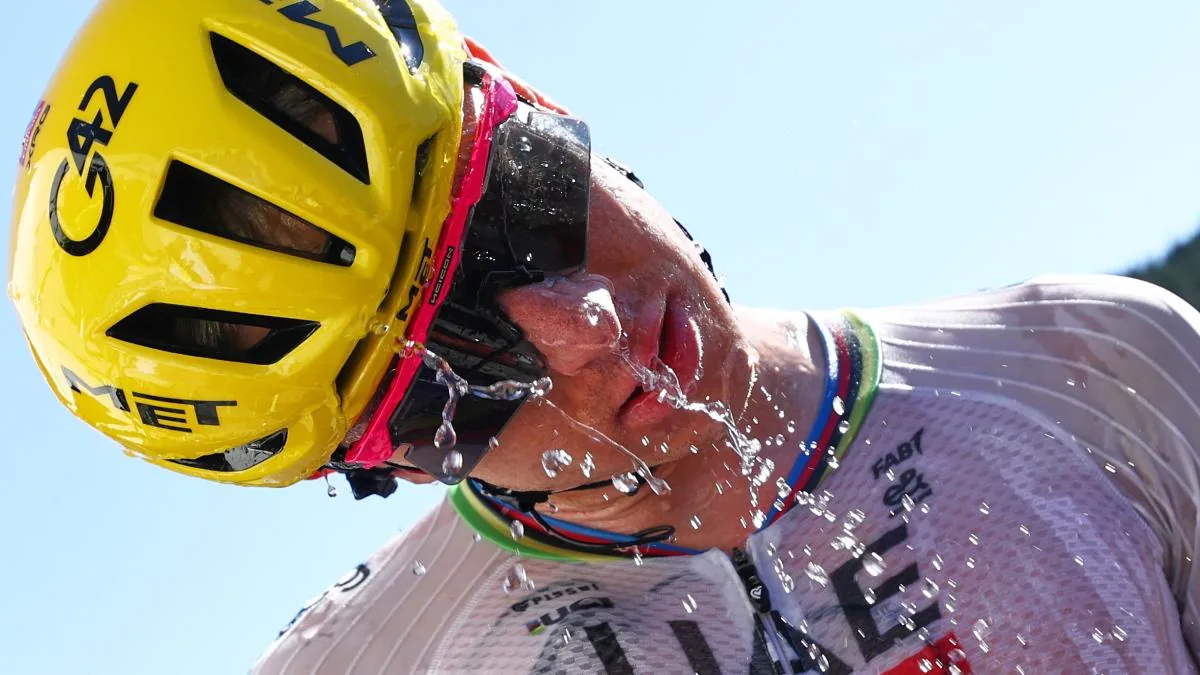
The Tour de France stages a race every summer against the clock, the mountains, and physical wear. This year, it is also competing against the heat. The organization decided yesterday to cut the first 30 kilometers of today’s stage after French authorities activated a red alert for high temperatures in the Corrèze department, where thermometers can approach 40 degrees. The route modification reflects how much the heat is affecting modern cycling. Hydration, physiological adaptation to high temperatures, and nutrition occupy as important a space as physical preparation or strategy. Riders consume more carbohydrates than ever, monitor their temperature, and look for any detail that allows them to delay fatigue.
Read more The Flick 3.0 era is already underway: this is how Barça’s preseason will start
In this context, a gel developed by the Basque company From Lab to Field has appeared, which incorporates exogenous lactate and is already being used in the Tour even before hitting the market.
For decades, lactate was the great enemy of athletes. It was associated with fatigue and muscle pain. However, research over the last two decades, driven by American physiologist George Brooks, has changed that view. Today it is considered a molecule that also acts as fuel and participates in key metabolic processes. “It has been dubbed the Phoenix of metabolism,” summarizes Aitor Viribay, physiologist and one of the project’s promoters, to explain the turnaround science has had regarding this substance. “Lactate allows the body to make the most of the energy provided by the carbohydrates ingested during intense effort,” he explains.
“Lactate allows the body to make the most of the energy provided by the carbohydrates ingested during intense effort”
Aitor Viribay
Physiologist and performance head of the Salomon team
His obsession for seven years was to make that lactate ingestible. “What we have achieved is to tame it,” he summarizes. Together with physical-chemist Juan Carlos Arboleya, researcher at the Basque Culinary Center, and gastronomic researcher Daniel Lasa Echegoyen, former head of the creativity department at the Mugaritz restaurant, he developed a formula that allows lactate to be consumed “safely, with good taste, and in sufficient quantities to produce a physiological effect.”
Read more U.S. and Iran reignite the war escalation with a new wave of attacks
The result is ExoLactate, a gel that combines glucose, fructose, and lactate. Although it is not yet on sale, it has already sparked enormous interest in professional cycling. There is a rumor circulating in the Tour that a single team has bought the first tens of thousands of gels manufactured to prevent their rivals from using them. Viribay does not confirm it, but neither does he deny it. “I can’t comment on it, but I also can’t say it’s false.”
“The data is very promising, but it needs to be confirmed. There is a long road ahead as a scientific community”
Aitor Viribay
Physiologist and performance head of the Salomon team
What can lactate contribute? The researcher urges caution. “This science is still very young.” The first studies carried out by his group point to a reduction close to 10% in perceived effort and improvements of 3 or 4% in performance in efforts lasting 20 or 30 minutes. “The data is very promising, but it needs to be confirmed. There is a long road ahead as a scientific community,” he notes.
Its texture, flavor, and pH are designed to facilitate continuous intake during hours of extreme heat and reduce digestive and oral problems suffered by many riders. Moreover, and perhaps most importantly, it is not doping, as it has all the certifications required for elite sport. A revolution that, besides combating the heat, could even decide stage victories in the Tour de France.
Read more No bail bond for the alleged rapist arrested during the Sanfermines