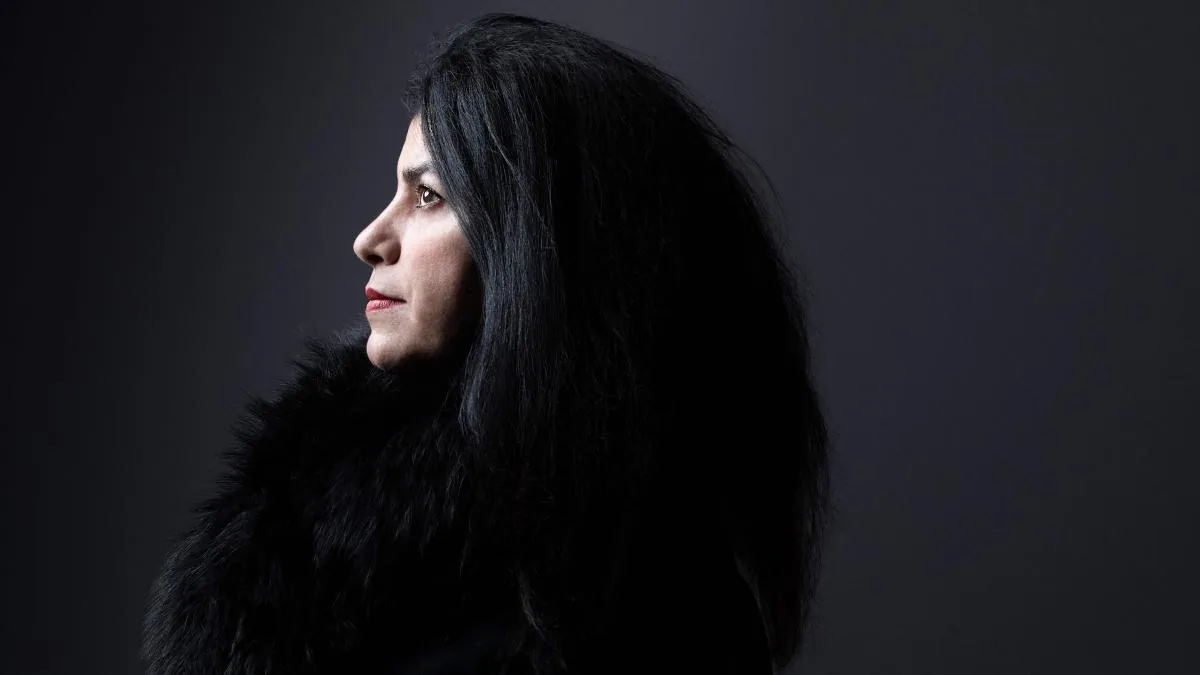
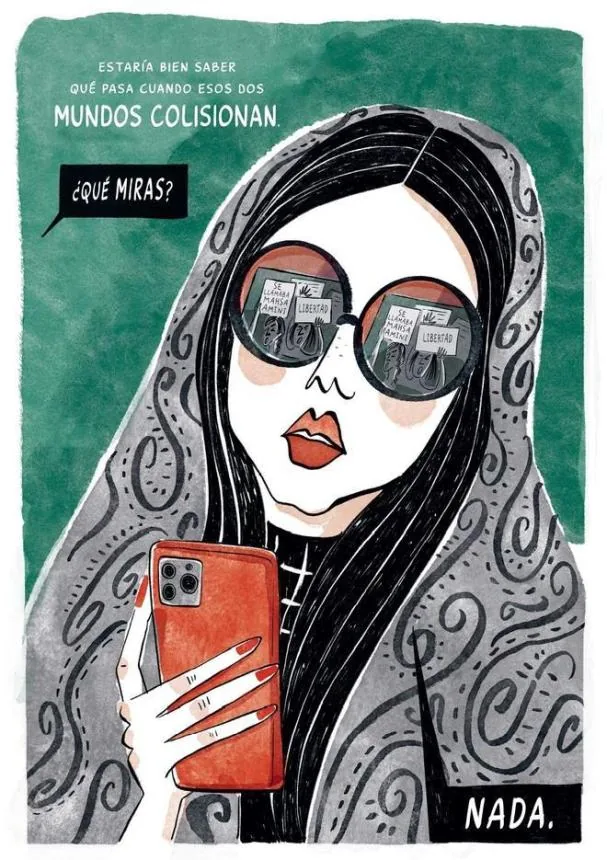
A black and white drawing went viral on social media at the end of 2025, due to the recent protests in Iran over the country’s growing economic crisis. It was a girl dancing as if there were no tomorrow while dreaming of the end of the dictatorship. Today, this drawing has returned to many users’ profiles, but for a different reason: the death of its author, Marjane Satrapi, at 56 years old.
The news has shocked the cultural and cartoon world, not only because of her early departure, but also because of the reasons her family gave after announcing the news: “She died of sadness,” they told the French news agency AFP.
Marjane died of sadness”
Artist’s family
For now, no further details have emerged, but her close circle indicates that this sorrow arose after the death of her husband, actor Mattias Ripa, just over a year ago. From that moment on, the cartoonist deleted all content from her various social media accounts and uploaded photos of Ripa and messages to him, remembering that he was “the love of my life.”
Although the artist has since withdrawn from public life, her art has not. The aforementioned drawing belongs to the autobiographical Persepolis (Reservoir Books, 2000), one of the most widely read graphic novels in history, which tells the Iranian Islamic revolution seen through the eyes of a child. The work was awarded at the Angoulême International Comics Festival in 2001. Six years later, in 2007, Satrapi herself adapted it to the big screen alongside filmmaker Vincent Paronnaud. The film won the Jury Prize at the Cannes Film Festival that same year. “Although this film is universal, I want to dedicate it to all Iranians,” she declared then.
This was not her only foray into cinema, as she also co-directed in 2011 the adaptation of her comic Chicken with Plums (Reservoir Books, 2004), which follows a musician who doesn’t get out of bed even to eat his favorite dish, as he feels unwell since his wife broke his favorite instrument, a tar, during an angry argument. The film starred Mathieu Amalric, Edouard Baer, and Maria de Medeiros.
Her most recent work was the comic Woman, Life, Freedom (Reservoir Books, Finestres in Catalan), a collective non-fiction work commemorating the beginning of the veil revolution in Iran after the death of Mahsa Amini, an Iranian woman of Kurdish origin who was arrested and tortured by the Islamic religious police for not wearing her hijab correctly.
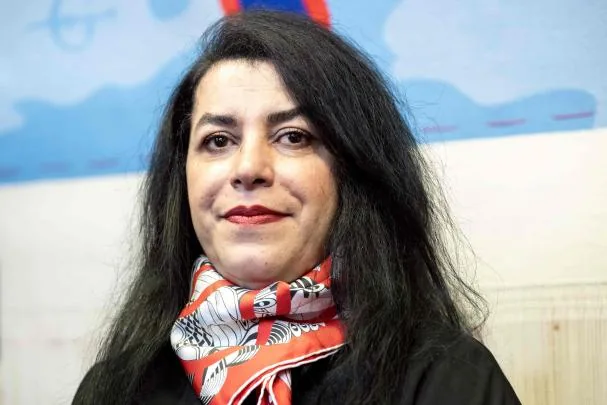
Her demands were always heard because, as highlighted by the Princess of Asturias jury, which awarded her in 2024 in the Communication and Humanities category, she was “an essential voice for the defense of human rights and freedom,” as well as “a symbol of women’s civic commitment.” In her speech, she took the opportunity to once again denounce what is happening in her country of origin, Iran: “The situation has worsened, the dictatorship is even more violent, with 85% of the population wanting a secular democracy and 65% living below the poverty line.” It was one of her last public appearances.
She accepted the Princess of Asturias award despite admitting that “I am not made for receiving awards, it is something that makes me uncomfortable, but I believe that the projection of this award will have a real impact and that is why I accept it.” She did, however, renounce the French Legion of Honor in 2015, as she wanted to denounce “France’s hypocritical attitude towards Iran,” which was then experiencing a new wave of repression. And she clarified: “Rejecting the Legion of Honor is by no means an action or a thought against France. On the contrary, I love this country, which is mine.”
Reactions to her death have been swift. French President Emmanuel Macron paid tribute to the artist, who “transformed an Iranian childhood into a universal fable” and created a “moving universe.” For her part, Culture Minister Catherine Pégard highlighted her career, emphasizing that she “knew how to turn her story into art, intimacy into strength, and political and family dramas into a call for freedom.”
Her publishers around the globe have also felt this loss. The general director of Norma Editorial, Óscar Valiente, for example, highlighted her ability to bring “new sensibilities.” For her part, the director of the Princess of Asturias Foundation, Teresa Sanjurjo, noted that Satrapi was an example “of humanity, compassion, struggle against adversity, integrity, and strength” and expressed her conviction that “her light will continue to shine continuously, through her exceptional work and her words.”
Read more The director of the Civil Guard met three times with Leire Díez