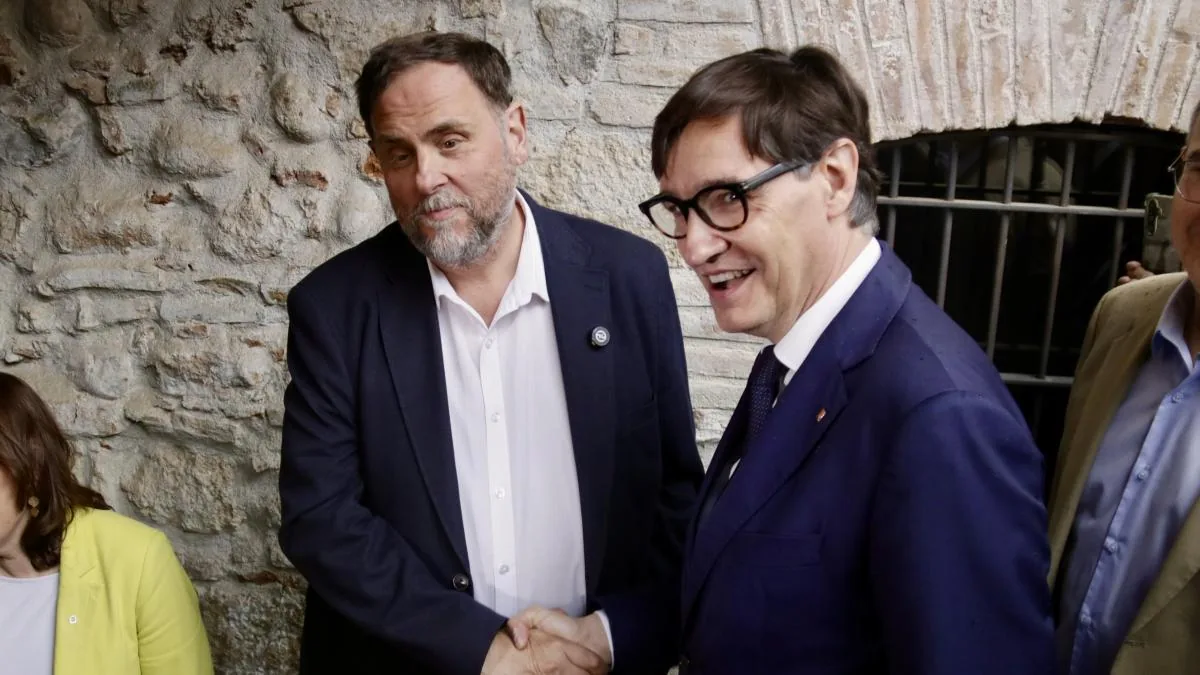
The president of the Generalitat, Salvador Illa, and the leader of Esquerra Republicana, Oriol Junqueras, led this Monday the presentation event of the orbital railway line in Sant Sadurní d’Anoia. This is the network project that will run from Vilanova i la Geltrú to Mataró without passing through Barcelona and will have an investment from the State of 5.2 billion euros. This pact between socialists and republicans represents the first step to stage a budget agreement that, if everything is fulfilled, will be signed tomorrow.
Both leaders have highlighted the importance of this project because it represents a “central and decisive” commitment for the whole of Catalonia. In the words of the head of the Catalan Executive, it represents a decisive step towards the “future” of a country that “decides to move forward with ambition and determination to lead.”
For his part, the president of ERC, Oriol Junqueras, has described this initiative – which must be carried out until 2041 – as “more than just a train line.” “It is the will to change the country’s model, its economic, demographic, industrial model and access to housing,” the republican emphasized.
Also read
The presentation of the orbital line marks the starting gun for a week that will be marked by the approval of the Generalitat’s budgets. Hence, a broad representation of the Govern attended this Monday’s event, with consellers Albert Dalmau and Sílvia Paneque, as well as the top leadership of the PSC and ERC. In his speech, Illa thanked the republicans multiple times for their “sense of country” and claimed the “necessity” of reaching agreements: “With demanding collaboration we move forward and we all win.”
The president’s speech was preceded by that of Oriol Junqueras, who also made a banner of his party’s “full commitment” to wanting to “address the day-to-day challenges and difficulties” of Catalonia. “This railway network favors the growth and prosperity of society, and in this commitment we will be with all fullness and all conviction,” he reaffirmed.
Also read
The Minister of Territory, Sílvia Paneque, has also defended the orbital line as a project “compatible” with the “maximum demand” to invest in the improvement of the entire Rodalies network, as well as the “structuring and connectivity” character that the project will give to the second metropolitan belt.
Several mayors of the towns through which this new line will pass also attended the event. They were mainly from the PSC and Esquerra Republicana, but the mayor of Martorell, Xavier Fonollosa (Junts), also attended.
The launch event of the orbital line coincides with the same day on which ERC will convene its national council to report on the commitments it has reached with the Govern in exchange for agreeing on the budgets. Among these ‘extra-budgetary’ points is the creation of the infrastructure company, that Catalonia assumes the majority governance of the Consorci de la Zona Franca de Barcelona, or a strengthening of the Catalan Tax Agency with an investment of 527 million.
Project details
The orbital line is a 120-kilometer-long infrastructure in total, from Vilanova i la Geltrú to Mataró passing through Penedès, northern Baix Llobregat, and Vallès. While in some sections such as from Vilafranca to Martorell the existing infrastructure would be used, in others such as from Vilafranca to Vilanova or from Martorell to Terrassa new tracks would have to be built. Specifically, 68 kilometers would be newly constructed, incorporating 23 new stations along the route. Considering the complicated terrain orography, this will require building tunnels and viaducts of some complexity. This aspect is what raises the estimated investment bill, which reaches 5.2 billion euros and which the Generalitat wants to promote using public-private collaboration formulas through concessions like in the endless works of metro line L9. The deadline for this project, according to the Generalitat, is set for 2041 to have everything finished. A real exercise in optimism, like the forecast of users, more than 30 million annual travelers, a figure close to those moved by consolidated lines in much more populated areas such as R2 or R4.
In any case, since seeing all this become reality will take at least two decades, Generalitat sources insist on talking in sections, even incorporating a zero phase that would be almost immediate, focused on strengthening the current R8 line, which runs from Granollers to Martorell. It is an underused section, with only one train per hour, but at the same time with serious problems due to the state of the infrastructure, as demonstrated by the urgent works being carried out in the Rubí tunnel that have kept the line closed since January, leaving these tracks exclusively for freight trains. In that area, there is already a prior agreement between ERC and PSC that commits the Ministry of Transport to finance the construction of two interchanges in Sant Cugat to facilitate the shared use of Rodalies and Ferrocarrils de la Generalitat (FGC).
The new railway route is somewhat parallel to the also old project of the fourth belt, now known as B-40. The road between Terrassa, Sabadell, and Granollers is the one that has caused the most clashes between socialists and republicans, who always demanded the railway alternative instead of the road. The orbital line comes to cover that deficit in a way. That is why it has been marked as the first phase of works, considered the initial core of the orbital system to connect Vallès Oriental and Vallès Occidental by doubling the R3 between Granollers and Santa Perpètua and quadrupling the tracks of the R8 in that city to separate Rodalies and freight traffic, whose increase threatens to collapse other sections of the Rodalies network such as the R4 in Penedès due to the implementation of the third rail. Govern sources confirm that they will comply with what was agreed in the investiture agreement and that the road project will advance on the northern ring between Terrassa and Sabadell but during this legislature will not go further.
The second phase that the project would address would be from Mataró to Granollers, 23 kilometers of new route to connect Maresme and Vallès, as was once done by road. This is one of the most complicated sections in terms of construction, as it will require significant tunnels to overcome the orographic difficulties. The same challenge will occur between Vilafranca and Vilanova, the connection between Penedès and Garraf, which is left for the fourth phase of the project. Before that, the third phase will cover from Terrassa to Vilafranca to connect the corridors of Penedès, Baix Llobregat, and Vallès.
Read more Mourinho reaches a verbal agreement with Real Madrid for two years