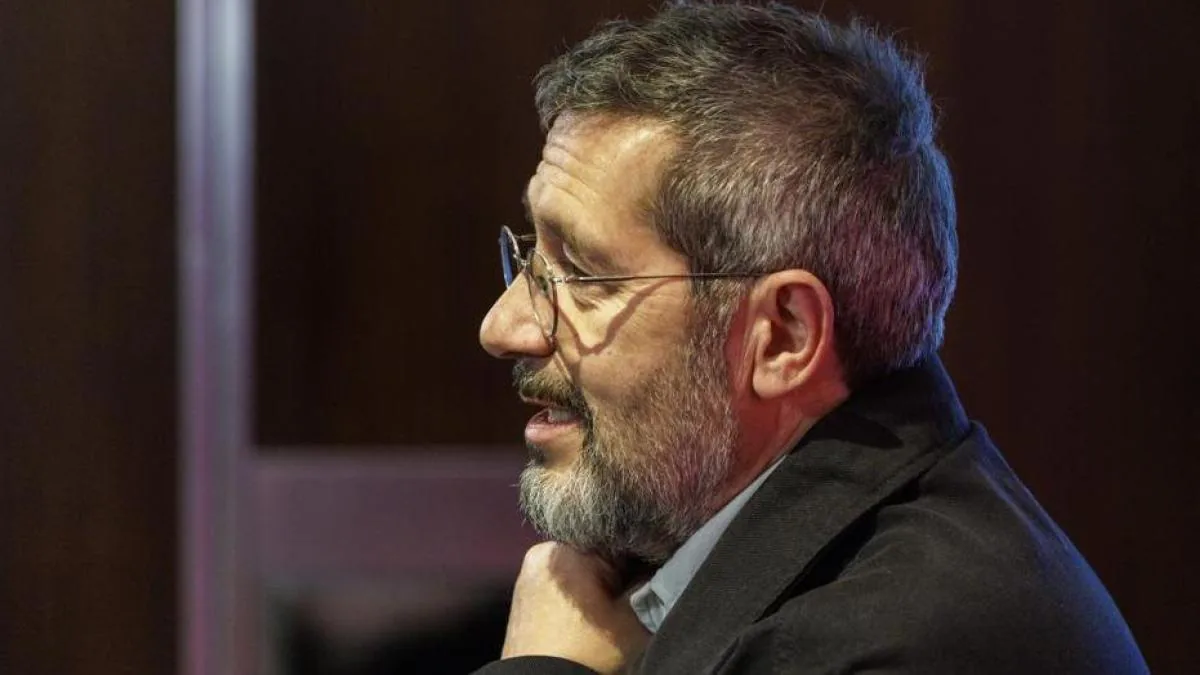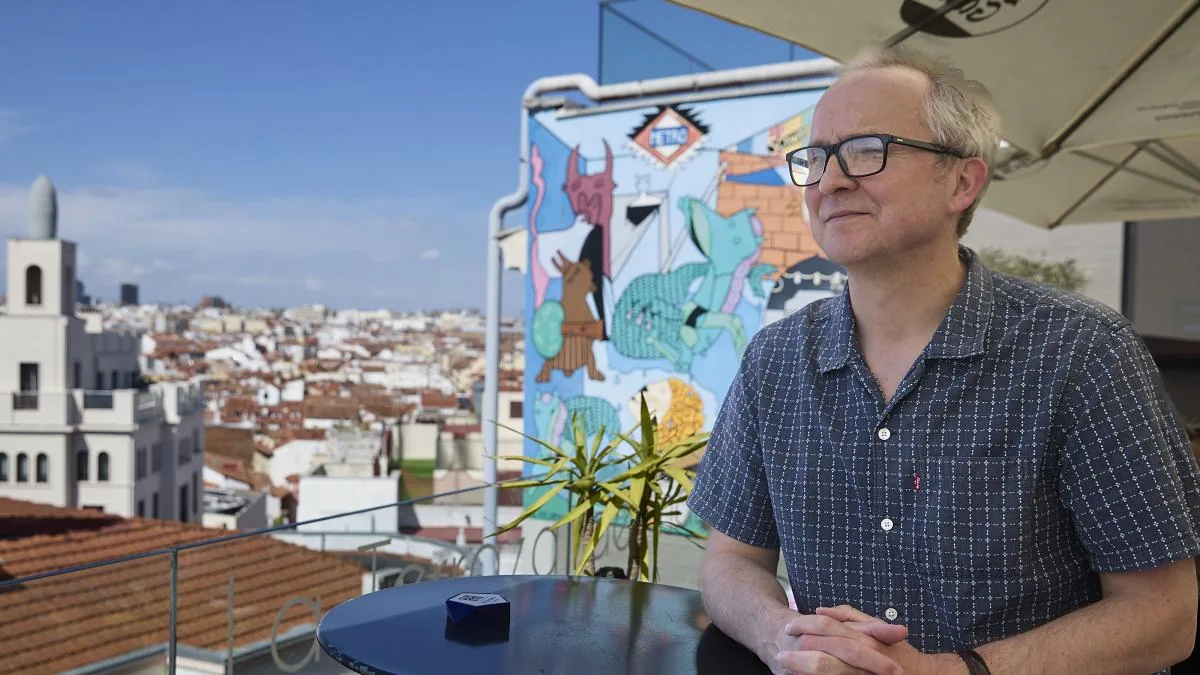
Iain MacGregor follows the British tradition and narrates the story with the suspense of fiction: “I wrote it almost like a movie, with four key characters driving the action,” he says about The Men of Hiroshima (Ático de los Libros). “I didn’t want an academic work, but a reading that would captivate you,” he adds in a conversation about the end of the Second World War, the race to build the atomic bomb, and the fateful decision to use it, intertwining parallels with the contemporary world: “There are similarities in the choice of right-wing populists and I am worried about having someone like Trump in power, who has a two-second attention span and with whom you cannot build international relations,” he maintains. However, he does not fear that the President of the United States will press the nuclear button: “That would be reckless,” he points out. “And fortunately, there are sane people in the military leadership who would not give him the codes,” he concludes.
Read more Begoña Gómez will report Vito Quiles “for assault” in a café
‘Oppenheimer’
Nolan’s movie is Hollywood: that portrayal of immediate guilt is not true”
How was the atomic bomb achieved so quickly?
Because of the war. Roosevelt understood, persuaded by scientists like Einstein, that the Nazis were enriching uranium and feared that Hitler would use the weapon without hesitation. That accelerated the Manhattan Project. After Japan’s attack on Pearl Harbor in December 1941, a lot of money was invested.
And not only in the bomb, you say in your book, but also in the bombers.
Yes, ironically, what they spent the most on was designing and building the plane that would carry the bomb: the B-29. What makes the Manhattan Project unique is the synergy between the power of American industry and science, because the US military feared being late, as had happened in the First World War, when British and French forces had to lend them all the weapons and uniforms because they simply were not prepared.
They had learned the lesson.
Yes. Washington was clear that if the United States returned to a world war, industry and the military would unite instantly. And that is exactly what happened, and that is why the Manhattan Project was such a success: it employed about one hundred thousand people. There was not a single state that did not have something connected to that top-secret program, but most of those people did not know what the others were doing. It was like a web converging towards Los Alamos, the weapons laboratory led by Robert Oppenheimer.
Since you mention it, what did you think of Christopher Nolan’s movie?
It’s Hollywood. Most of it is not true. The chronology is off. Important characters are ignored or minimized, like General Groves, without whom there would have been no Manhattan Project; he ran everything and hired Oppenheimer. I was bothered by the plot that he was instantly filled with guilt. I don’t think that’s true: he was very interested in getting that job, he knew exactly what he was building and the dangers of radiation. Portraying him saying “I have blood on my hands” makes no sense, because he persuaded many scientists to keep working when Germany had already been defeated and many wanted to stop. And above all, in a movie about the atomic bomb there are no Japanese voices. You don’t see the aftermath: what happens to the city, how the survivors react.
You include the moving testimony of Michiko Kodama, who narrates the stigma suffered by the hibakusha after surviving. Why did her compatriots treat them so badly?
Giving voice to her and to ordinary people caught in extraordinary events is what satisfies me most about the book. It was the first interview I did, the most emotional. It was supposed to last an hour, but it ended up lasting the whole morning. Her story was very powerful. When we said goodbye, she asked me if I didn’t want to know what happened afterward, and for the next two hours she told me her life carrying the burden of being an atomic survivor and how Japanese society rejected her for being considered impure. Japan was a traditional society and, most importantly, no one understood radiation poisoning. When the Americans occupied the country, they suppressed all information about Hiroshima and Nagasaki. There was censorship. I would say the Japanese reaction was ignorance: they saw healthy people suddenly die and feared it was contagious. It was a human reaction, like with COVID: “Don’t come near.”
Read more Operation save Pujol: his seven children isolate the president from the Andorran inheritance
The ‘hibakusha’ stigma
“Survivors were rejected as impure by other Japanese”
Your book reveals the British contribution to the creation of the bomb. How important was it?
To the point of handing over all their secrets before the United States entered the war. In 1940, during the Battle of Britain, Churchill begged Roosevelt for help to increase arms supplies. It was like a poker game: in exchange for 50 ships for the Navy, he agreed to send a team of scientists to give all the plans and data on radar and, crucially, on nuclear technology: the foundations of the Manhattan Project were British.
The British factor
“Churchill handed over all scientific knowledge about nuclear technology to Roosevelt”
Has contemporary society learned from Hiroshima, especially considering the current nuclear threat?
There is the atomic club (United States, Russia, China, United Kingdom, France, Israel, Pakistan, and India), in which all seem to think they have the right to have weapons and anyone outside is a pariah state. The younger generation no longer remembers the Cold War atmosphere, with missiles ready to launch in a minute. That danger has faded in public consciousness, but the missiles are still there. It is logical that regimes like Iran look at Libya and Iraq, which agreed to give up their nuclear weapons and ended up overthrown, while North Korea kept them and is still there.
Another nuclear clash?
“I would look at Pakistan and India: we will see exchanges in small wars”
Do you fear the atomic bomb will be used again? In Iran? In Ukraine?
We will see nuclear exchanges in small wars; I would look at Pakistan and India, which have been politically and religiously opposed since the 1940s. Putin’s conflict with Ukraine is the same as Libya and Iraq. Ukraine agreed to give up its nuclear weapons with the promise of protection from NATO and the United States, and look what happened. Small countries feel they need nuclear weapons to protect themselves from bullies. About Trump, he decapitated the Iranian leadership, eliminating the moderates and leaving the Revolutionary Guards in command, who are fanatics. Trump would have to backtrack to achieve peace, and I don’t think he will. Also, Netanyahu will not back down because that keeps him in power. I don’t see Trump launching a nuclear bomb; it would make China go for Taiwan and Putin for Kiev.
Read more Azcón, sworn in as president of Aragón with the votes of Vox