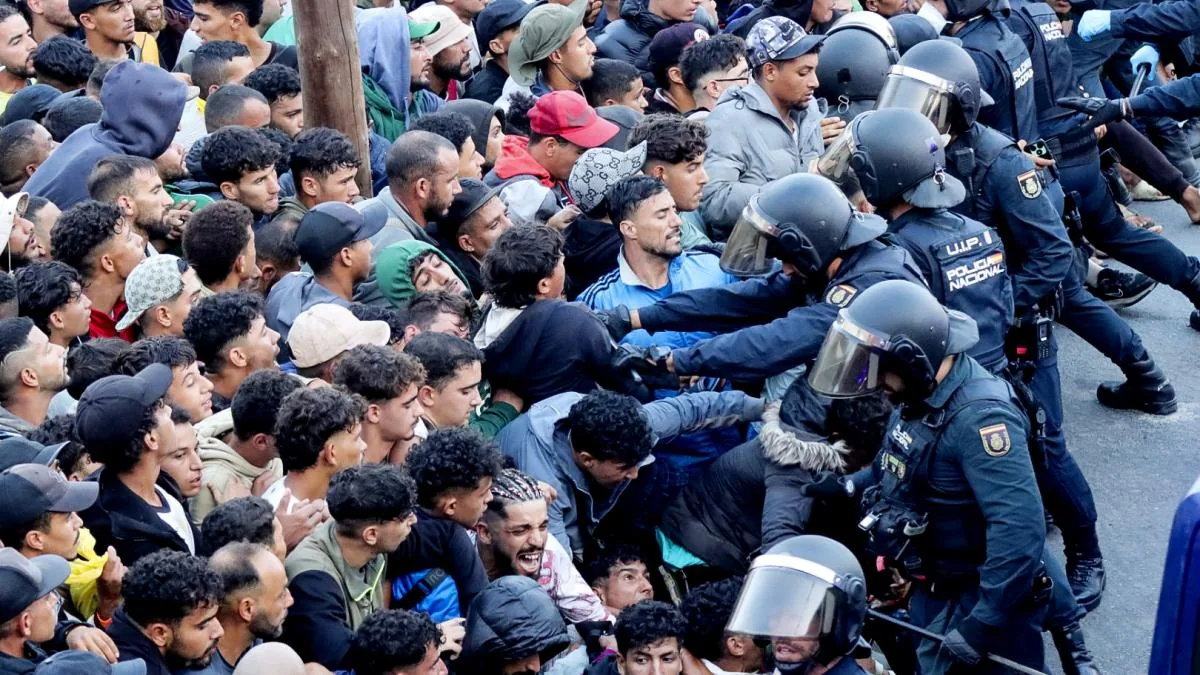
Alberto Núñez Feijóo returned to Ceuta yesterday, for the second time in just over fifteen days, to demand the voluntary return or expulsion of “all” immigrants who entered the autonomous city irregularly in the mass entry that overwhelmed the city’s border.
Read more The transfer of immigrants from Trampolín beach to two temporary centers with 1,800 beds begins
The leader of the PP called the Government’s action “irresponsible” three weeks after the start of the crisis and, positioning himself as a government alternative, set his party’s stance. A position based on the idea that Spain will not act “under blackmail or threat” because “the Spanishness of Ceuta and Melilla is non-negotiable.”
“Neither adults nor minors. They all must return,” warns the leader of the Popular Party
The Popular Party has accelerated its offensive following the explicit support of the European Commission, which on Tuesday endorsed the EU directive on returns and border management. A framework that, according to sources from Génova, provides the legal coverage and institutional backing necessary to carry out returns whether adults or minors.
The president of the PP insisted that all people who crossed the border on the 30th and 31st “must return to their country” and warned against the “perverse precedent of granting rights to those who participated in an illegal invasion.” “Neither adults nor minors. They all must return,” he reiterated, demanding the Government immediately activate the repatriation process and deploy from the Peninsula “all the immigration units that are necessary.”
Feijóo also criticized the Government’s foreign policy and stated that the crisis in the autonomous city is “the most visible result” of “years of secret diplomacy” with Rabat.
Read more China is already competing with Europe for leadership in 40% of its key industries
The Popular leader accused the Government of having “outsourced the key to Europe’s southern border to Morocco’s goodwill,” something he called “unacceptable,” before warning that national security cannot depend on a third country. “Spain does not seek enemies or conflicts, but it will not accept threats either,” he asserted, demanding a neighborly relationship based on reciprocity and mutual respect following recent statements by high-ranking Moroccan officials about the sovereignty of Ceuta and Melilla.
In his speech, Feijóo hardened the diagnosis of the crisis by stating that the breach of the border perimeter was an “invasion in full 2026” and accused the central Government of leaving more than 80,000 Spaniards unprotected, referring to the Ceuta population to whom he repeatedly showed his solidarity.
Feijóo also censured Moncloa for intending to treat the emergency “as a simple summer episode,” dismissing it on social media or with cultural recommendations while the city remains far from normality. According to his data, more than 10,000 people still remain in Ceuta — compared to the 2,500 estimated in official counts — so he called the discourse of normalization an “insult to the intelligence of the people of Ceuta.” His analysis also warned of a triple crisis of national security, public order, and public health that, in his view, could lead to “serious incidents” if the State does not act urgently.
During his visit, the PP leader detailed a shock plan articulated in seven concrete measures: the creation of a single command to coordinate the police, assistance, and security response; the expulsion or voluntary return of all people who have entered irregularly under the European directive; the demand for respect, loyalty, and reciprocity from Morocco, with no concessions regarding Spanish territorial integrity; the deployment of all State resources and international alliances to defend the border; the reinforcement of the perimeter’s inviolability with infrastructure, technology, human resources, and legal reforms; the presence and direct dialogue of Ceuta in the European Union institutions; and the implementation of an economic reactivation plan for the reconstruction of the city’s commercial and social fabric.
Read more Deco and Flick confirm that Barça has not given up on the number nine