The Chinese dragon is already here roaring in the European castle. China has advanced in the global production chain and now competes directly with the eurozone in almost 40% of the sectors in which Europe has a comparative advantage, compared to around 25% at the beginning of this century. The alarm comes from the president of the European Central Bank (ECB), Christine Lagarde, who shared the data this Wednesday during a conference in Geneva at the World Economic Forum.
Read more Deco and Flick confirm that Barça has not given up on the number nine
For some time, central bank studies (such as The evolution of China’s growth model ) have been assessing the growing rivalry between the eurozone and the Chinese. At the beginning of the 2000s (after China joined the World Trade Organization in 2001), Chinese competition in Europe was limited to low-cost sectors or labor-intensive goods.
Today, China’s state-directed industrial policy has climbed positions and directly challenges the eurozone in high value-added niches where Europe was historically a leader. “In the last 20 years, China has become increasingly competitive in sectors previously dominated by advanced economies. Of these, Italy seems to be the most exposed, because China has come to stand out in 60 sectors where Italy has a comparative advantage. On the other hand, Germany has experienced the greatest increase in exposure to Chinese competitiveness, which has risen from 20 sectors in 2000 to 50 in 2022,” the ECB notes in its analysis.
China’s share of global gross manufacturing production increased from 5% to 35% between 1995 and 2023, and it is currently higher than that of the next nine manufacturers combined. This surplus increasingly travels to Europe. The recent trade war between Washington and Beijing has not helped either – the ECB recalls – because Chinese companies now sell to European citizens what they previously marketed in the U.S. when tariffs were lower.
Besides automotive, Chinese imports grow in chemicals and capital goods
The vehicle and chemical sectors have experienced the largest increases in European imports from China: 150% and 140%, respectively, in the last five years. Paper and printing and electrical equipment also increased by 85% in this period. All areas where Beijing now speaks to Europe on equal terms.
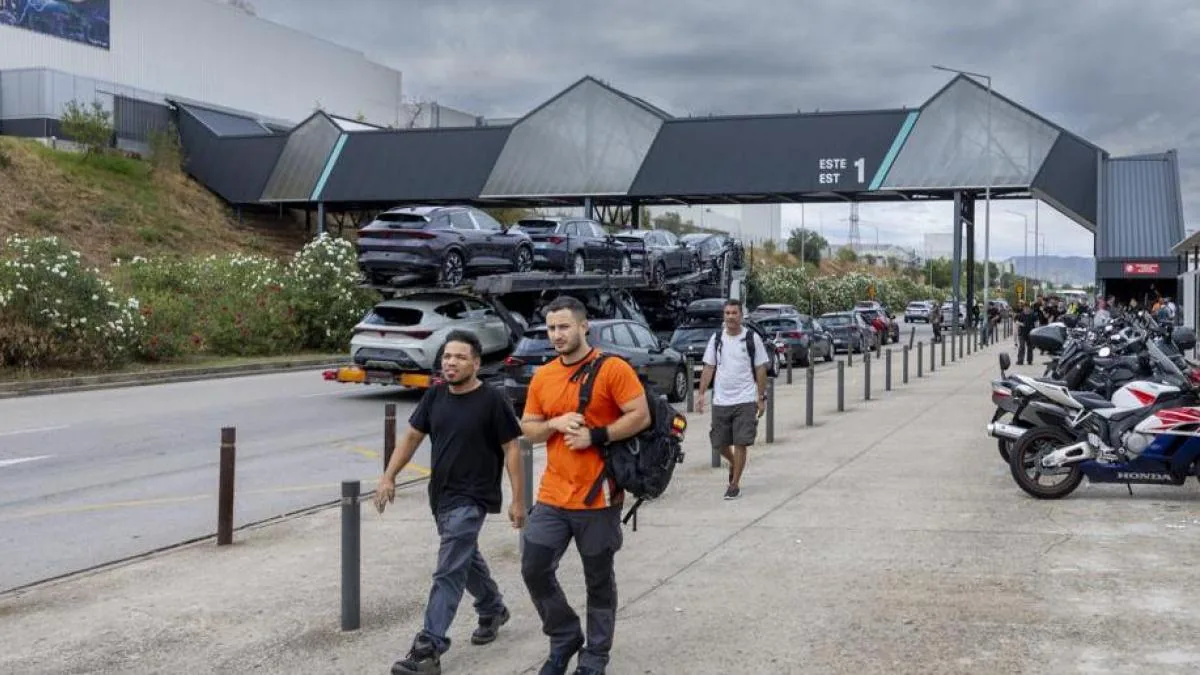
Just take a look at the road. In 2020, Chinese-owned car brands represented barely 0.3% of passenger car registrations in the European bloc. Currently, the share of purely Chinese brands is already close to 10%.
In this regard, European tariffs seem to have done little to protect their motor industry (tariffs of up to 35% to counteract Chinese public subsidies), since Chinese manufacturers have adapted their strategy by introducing hybrid and plug-in hybrid models that bypass these surcharges.
The Chinese development model, based on industrial overcapacity supported by state subsidies and massive investment, not only puts downward pressure on the prices of goods produced in Europe but also has direct consequences on employment.
Read more Barça takes a Gamper in which Flick gives few clues while waiting for the number nine
The ECB estimates that between 2015 and 2022 the eurozone lost 240,000 jobs due to Chinese competition
The areas most exposed to competition from Beijing, that is, those where imports from China have increased substantially, employ 29 million workers in the eurozone, which represents around 27% of total employment in Europe in 2024.
The manufacturing sector represents a significant part of this group, employing 24 million people in Europe. Well, as a result of the increase in Chinese commercial penetration, between 2019 and 2024 employment demand in the automotive sector in the eurozone fell by 55%, while the decrease in the chemical industry was 95%.
The impact of Chinese commercial expansion is leaving a mark on the European labor market: the ECB estimates that the increased pressure from Asian imports cost about 240,000 jobs between 2015 and 2022. Positions that have either disappeared or had to move to less exposed sectors.
The ECB usually pressures EU governments to accelerate the integration of the single market, the Capital Markets Union, and massive investment in innovation and digitalization to avoid falling behind the U.S. and China. But the current situation does not play in its favor. As Lagarde said, cheap energy has also disappeared as an advantage for the European economy, since high energy-consuming industries in the EU are paying, on average, more than double for electricity than in the U.S. and about 50% more than in China.
The European countries most exposed to Beijing’s commercial expansion are Italy and Germany
“Europe largely missed out on the first digital revolution (…) We cannot afford to repeat that experience with artificial intelligence (AI), the second digital revolution,” the Frenchwoman said yesterday, after acknowledging that the U.S. and Chinese economies are ahead of the eurozone both in capital attraction (the former) and commercial competitiveness (the latter).
Unfortunately, the bad news for the Old Continent does not end here either. Eurostat released the latest data on inflation in the eurozone this Wednesday, which rose to 2.9% due to the energy rebound. A level that, as the ECB’s chief economist Philip Lane recalled, is “well above” the desired targets. More than 80% of analysts surveyed by Reuters already point to a rate hike on September 10. When it rains, it pours…
Read more Gamper: From Flick and Raphinha’s speeches to the ovation for Rodri and the boos for De Jong