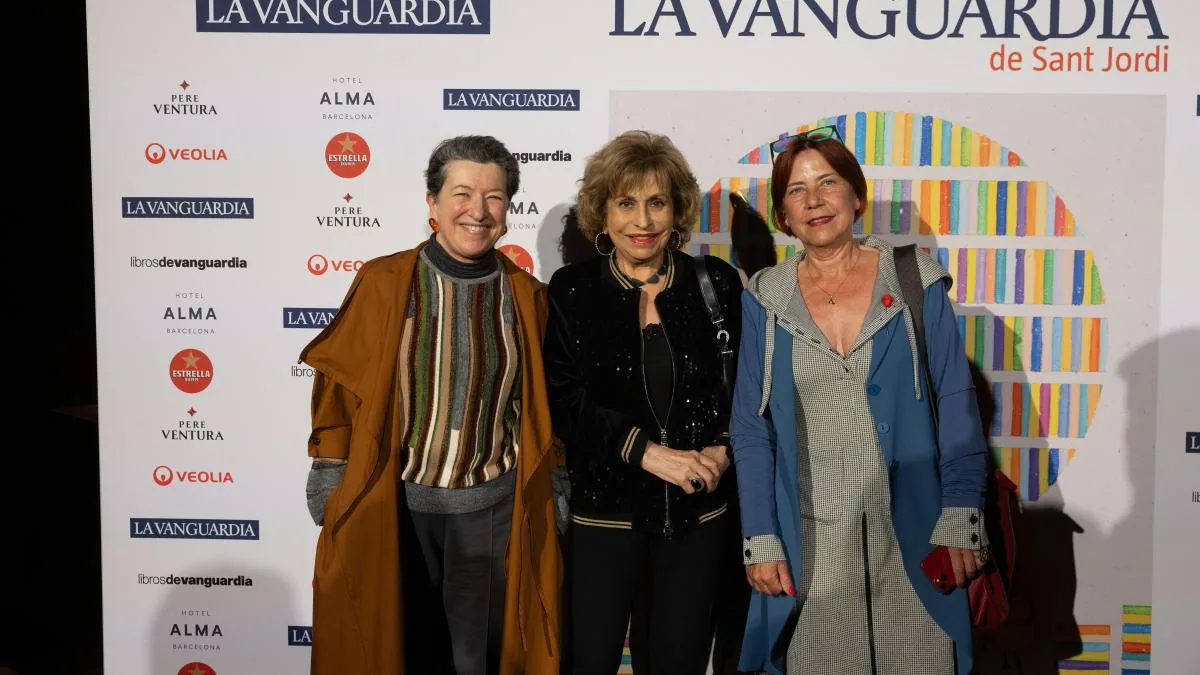
In the world of letters, on the fine line between literature and non-literature, and between reality and fiction, authors are added who, without having book writing as the center of their professional life, will also be at the stands signing books today. This is the case of Natza Farré, one of the attendees at the La Vanguardia party, who assures that she feels equally strange “in the world of literati, as in the journalistic, as in the media, because I am not part of any group”, but thanks to all those worlds, she assures that she makes a living writing, something that many authors cannot say.
Read more Good weather and a weekday: A record-breaking Sant Jordi
It’s a day when Catalans are happy, and I experience it with immense joy”
Natza Farré
‘L’última vegada que et dic adeu’
Farré declares herself a big fan of Sant Jordi: “I don’t understand the criticism; it’s a day when Catalans are happy, it happens one day a year, and I experience it with immense joy.” Her latest book, about her heroin-addicted brother, is L’última vegada que et dic adeu (Angle): “It talks about the eighties and nineties, a time that is not talked about much; it features drugs, family, and sisters and brothers.”
Grief touches us all, because life is one grief after another”
Paz Padilla
‘Alzar el duelo’
Also speaking about the recent loss of a brother and grief in general is Paz Padilla. The actress is also not new to Sant Jordi, and this time she brings under her arm Alzar el duelo ( HarperCollins). “Grief touches us all, because life is one grief after another: you get divorced, you lose your job, illness and death.” The actress assures that it is “a necessary book”, which no longer belongs to her: “It belongs to whoever reads it.”
Accumulated experience shapes our taste”
Xavier Grasset
‘El bon gust’
Journalist Xavier Grasset joins the celebration, “perhaps for the seventh or eighth time, seeing Sant Jordi from both sides.” This year he publishes El bon gust ( La Campana), which is a collection of articles. “This book is thematic about good taste. It talks about cooking, restaurants, wine, landscape, friendships, knowledge, books, theater, what we do when we don’t work, although in the case of journalists we keep working.” Grasset states that “the book raises more questions than answers,” and compares it to cod: “You soak the articles, they come back to life and acquire a different body when you put them in book form. Accumulated experience shapes our taste.”
Read more The Nobel laureate relaxes with Gaudí
We are not in a perfect democracy, but it is a democracy nonetheless”
Magda Oranich
‘Totes les batalles’
The title of Magda Oranich’s book, Totes les batalles (Columna), is misleading, because she assures that it is not a memoir, although this word appears in the subtitle. At 80 years old, the lawyer and activist declares that she wanted to tell what she has lived through, from the years of Francoism to the present: “When I see so many young people who say that things are better under a dictatorship, I wanted to explain what a dictatorship is, because it is worrying.” Oranich refers to all these battles, “which at the time were very complicated, with executions, death penalties…, but also the privilege of having lived through the transition from dictatorship to democracy.” And she concludes: “We already know that we are not in a perfect democracy, but it is a democracy nonetheless.”
Lawyer Xavier Melero uses all his accumulated legal knowledge to create fiction with a deep understanding of the subject. Crímenes decentes (Tusquets) “is not a true crime, it is judicial, which Americans handle very well and here it is not so frequent.” Melero takes on his fourth Sant Jordi “with great enthusiasm.”
From this selection of guests, we close with Oriol Mitjà, who arrives exhausted at Sant Jordi. The infectious disease doctor publishes On neix la llum (Columna): “I have had depression for 17 years. Going through painful moments and rewinding, I realize that now I am able to write sensations that when they were happening were chaotic. The effort I make is to put words to sensations and emotions that sometimes we find difficult to name. The book is a return for all the help that other people have given me.” Mitjà believes that “the entire population suffers, due to self-demand, the feeling of rejection, of inferiority…”, and writes this book as “an offering”. One more offering for this unique day.
Read more The day of all