





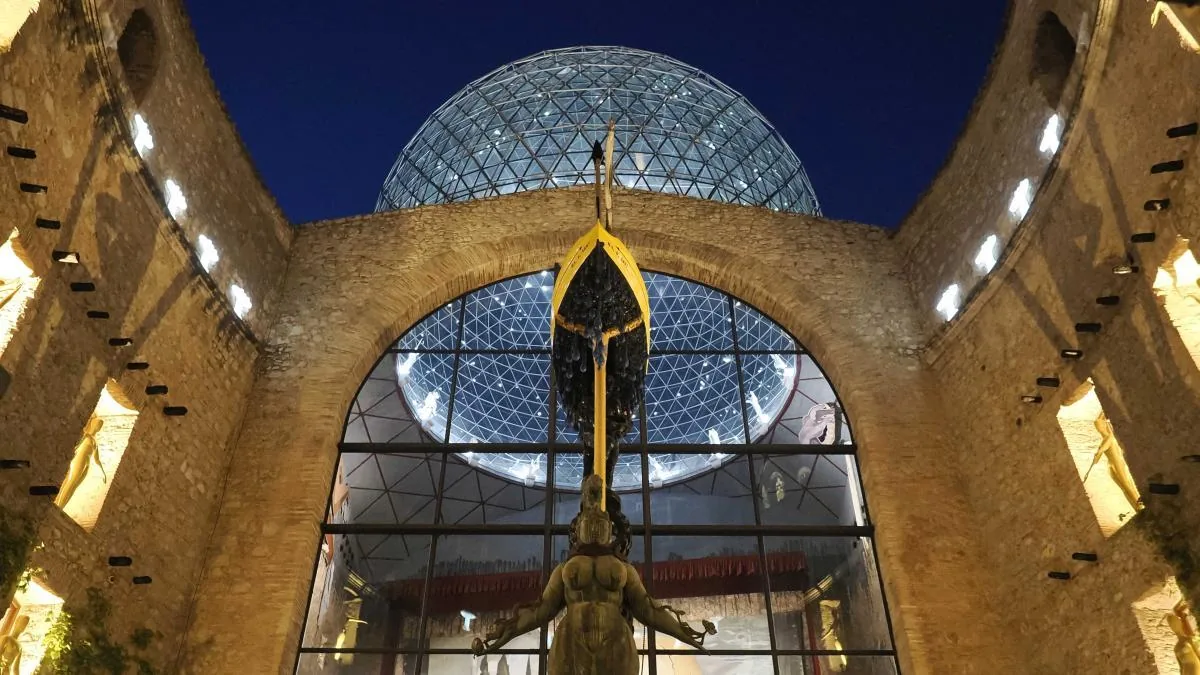
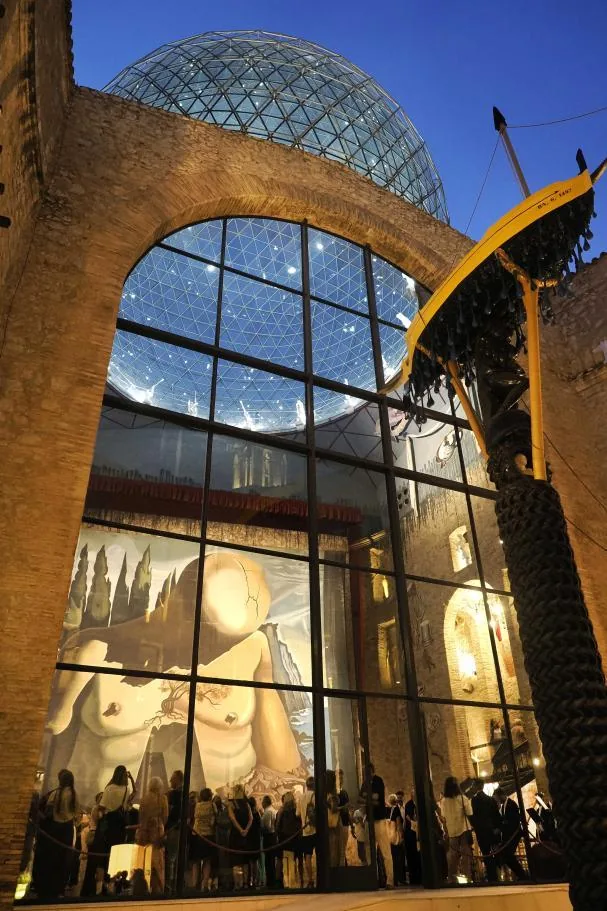
The Galatea Tower of the Dalí Theatre-Museum in Figueres became the painter’s last place of residence after the fire in Púbol. Salvador Dalí lived there from 1984 until his death in 1989, and experts on his work say that from his room he watched how the evening light transformed the textures of the stone into a play of shadows on the exterior walls of the museum. On these same walls, photographs and audiovisual fragments of Dalí and his complex universe are projected until August 23 in a play of lights, images, music, and sounds, including the voices of Dalí and a brief fragment of Gala, in the only sound document known to the foundation.
Read more Who are the ‘short kings’: the men who define the new masculinity
This new audiovisual proposal, visible from the Patio de las Logias at the end of the exhibition route, is one of the main novelties offered this year by the night visit to the Dalí Theatre-Museum, which has renewed the night experience it launched more than three decades ago, in 1992. A visit designed by Dalí himself, as recalled by the director of the Dalinian triangle, Montse Aguer, and which exudes “mystery, fantasy, and imagination,” like the genius himself. Since then, about 400,000 people have visited the Dalí museum at night. The number has stabilized in recent years between 5,000 and 6,000 (far from the 10,000 before the pandemic), a figure the Gala-Salvador Dalí Foundation would like to increase.
The museum’s night visit was designed by Dalí himself and exudes mystery, fantasy, and imagination
“We want to improve the visitor experience and have them leave the museum feeling Dalí and talking about him,” said a few days ago the general director of the Gala-Salvador Dalí Foundation, Fèlix Roca. The visual and sound production, titled Dalí, nit i subconscient , with which tourists will say goodbye to the museum, was created by Slidemedia, a studio specialized in visual arts and videomapping, and gathers over more than an hour some of the most significant audiovisual and photographic documents of Salvador Dalí’s legacy.
The proposal includes fragments from the surrealist film Impressions de la Haute Mongolie. Hommage à Raymond Roussel (1975), co-directed by Salvador Dalí and José Montes-Baquer; the interview Joaquín Soler Serrano dedicated to the artist on the program A fondo (TVE, 1977); and archive photographs from the Melitó Casals collection, Meli , showing Dalí directing the construction of his great work, the Theatre-Museum, or working in his studio.
Read more The best life insurance according to your needs: what to consider before signing up
The historic press conference the artist gave at the Gustave Moreau Museum in Paris in 1970, where he anticipated his future museum in Figueres, inaugurated in 1974, also appears in images, as well as scenes of Dalí in New York, where his appearance on the streets of Manhattan became a true happening. Small documentaries about iconic elements of the museum are also projected, such as the Cadillac, the hidden coins in the Wind Palace room, or the diving suit he used in 1936 at a conference for the international surrealist exhibition to “descend into the profanities of the subconscious,” which almost cost him his life.
The renovation of the lighting in the Patio de las Logias, where visitors will be offered a glass of rosé cava, Dalí’s favorite, has also highlighted some of the most characteristic elements of the Theatre-Museum, such as the geodesic dome under which the painter is buried.
Additionally, until August 23, coinciding with the museum’s night opening days, the Treasure Room exhibits a surrealist work that has been shown to the public on few occasions. It is Paranoiac Metamorphosis of Gala’s Face , a drawing dating from 1932, showing Dalí’s muse in profile and a book from which some characteristic elements of his iconography emerge, such as shoes, spoons, a cypress, and one of the first soft watches in his work. The director of the Dalí museums, Montse Aguer, highlights the “luxury” of seeing this drawing hanging for a few days on the museum walls, requested for several exhibitions. However, the Foundation does not lend it due to its delicate state of conservation.
Read more The mayor is right