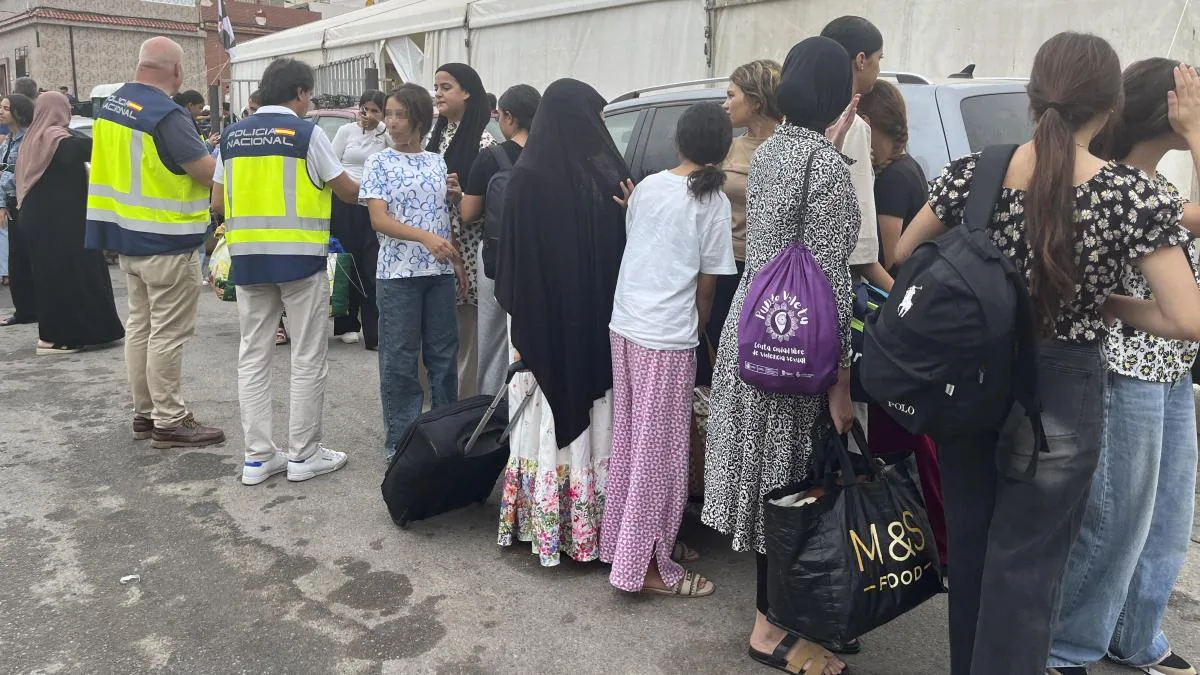
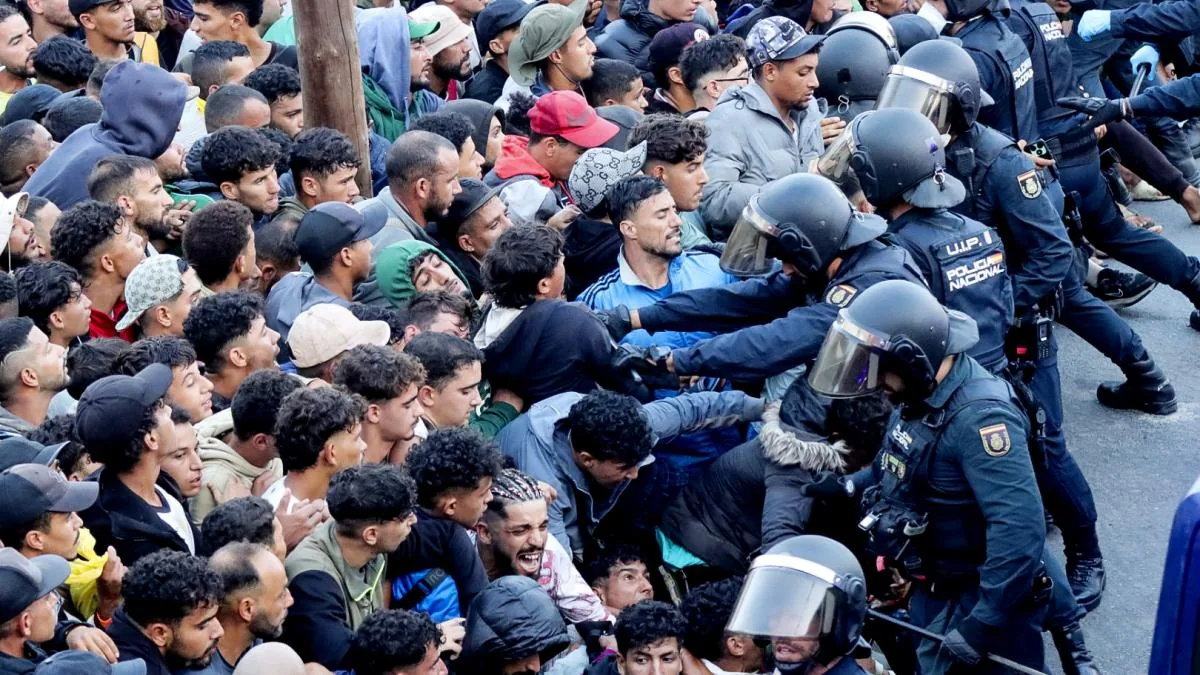
Day 40 after the massive entry into Ceuta: there are still more immigrants on the street than accommodated – and protected – in centers enabled by the Government. The humanitarian crisis is becoming entrenched with hundreds of people still sleeping outdoors in any corner, waiting for a place in a temporary resource. The people of Ceuta are not wrong when they take to the streets to denounce that their city has become a Temporary Stay Center for Immigrants (CETI). A tour of the little more than seven km2 where a population of 84,000 inhabitants is concentrated is enough to verify that Ceuta is the city of the 1,001 CETIs. There is only one official one, overwhelmed but with a roof, but any point serves to improvise a shelter to avoid the cold of the early mornings or the heat of the endless days. All share unhealthy conditions.
About twenty workers were advancing yesterday, at a forced pace, the new camp at the port of Ceuta where the Government plans to locate immigrants, despite the opposition of the president of the autonomous city, Juan Vivas. In white inflatable tents that last year served to assist the victims of Hurricane Melissa as it passed through Jamaica or in 2023 to assist those affected by the 6.8 magnitude earthquake that struck Morocco with its epicenter in the High Atlas. Each of the 40 tents of 35 square meters will have seven bunk beds. In total, 560 places that will not be ready, at least, until next weekend. And although new spaces continue to be enabled, as confirmed by the Ministry of Migrations, the number of available resources remains unchanged since August 31: 3,400. The head of Territorial Policy, Ángel Víctor Torres, insisted that “in the coming days” it is expected to reach 6,000 places. Meanwhile, the crisis outside the centers worsens.
The Trampolín beach remains overflowing. The smell emanating from the settlement where, according to the NGOs on the ground every day, about 2,000 people spend the hours, is increasingly noticeable from farther away. On the beach of the crisis, the Lampedusa of Spain, it is increasingly difficult to find a sand-free spot. Instead of the umbrellas that fill the coasts of the peninsula in summer, here shacks with Moroccan tenants continue to pile up. Like Hmad, who says he only receives one meal a day. The camp is growing near Loma Colmenar. The protests of the neighbors have not driven away the immigrants who gather at the entrance of the Embolsamiento parking lot, from where they see cots being set up but the doors do not open. This is the area where the greatest tension of the crisis is concentrated: clashes are being recorded between Maghrebis who, in turn, denounce being victims of attacks by neighbors who have seen a camp erected outdoors at the doors of their homes every night. Naufar Mansour keeps the report from the University hospital that records the “punctiform wound” on his buttock and left forearm as a result of a nighttime assault. Just like Bilal Kinany, who also shows medical papers that indicate he went to the Emergency Room with pain from a presumed assault.
According to the single command, 4,516 migrants have returned, 278 have been expelled, and 2,004 minors registered
The shacks are taking root in the Tarajal warehouses. The industrial estate near the border post continues to be a hotbed of immigrants who shelter every night among pallets, and even old appliances, which serve as walls for their improvised homes. On Sunday, the streets of the warehouses were evacuated – without offering any alternative – ahead of the imminent arrival of the Minister of the Interior, Fernando Grande-Marlaska, for the inauguration of the new detention center. Within hours, the pop-up camp was set up again, according to police sources. In fact, that was the image the Interior Minister saw from the official car that took him to the Temporary Immigrant Care Center (CATE). Rachid, who says he is 16 years old, has been near Tarajal for a month. In the mornings he wanders the streets, at night he returns to the warehouses. One day, and another, and another. He says he is learning Spanish “to work in Spain, for a better life.” Although for now, the only thing he pronounces, over and over, is “Goodbye Morocco, hello Málaga.”
Read more U.S. destroys five Iranian tankers in response to attack on warship
The Government, for operational – and security – reasons does not reveal the dates on which the new places will open. But yesterday, some figures were updated that help to dimension the crisis. And what lies ahead, although yesterday Grande-Marlaska assured that the situation evolves “day by day” in a “very favorable” way, so he showed himself “convinced” that “it will not be necessary” to renew the mandate of the single command of the crisis from December 31, when the situation of interest for national security declared at the end of August expires. Precisely Torres reported that a total of 4,516 migrants have voluntarily returned to Morocco since August 10, 278 people have been expelled, and 2,004 minors registered, 1,290 since July 30. For his part, the Interior official detailed that the police identification of 1,120 people has been completed. But above all, Torres pointed out that around 7,000 migrants remain in Ceuta, although last week that number was limited to 5,000.
Torres, from Moncloa, detailed that the Government, through the State Attorney General’s Office, has appeared in the criminal case being processed in the National Court for an “alleged criminal conduct committed abroad that has seriously attacked the territorial integrity of Spain.”
The King gathers Robles and the military leadership to “examine” the situation in Ceuta from the “defense” perspective
Late in the afternoon, the Royal House made public a meeting held by Felipe VI with the military leadership, to which the Minister of Defense, Margarita Robles, was also invited. The purpose of the meeting at the Zarzuela Palace, which did not appear on the public agenda, was to “examine the situation in Ceuta from the point of view of defense.”
Read more Back to school without safety for everyone in Ceuta