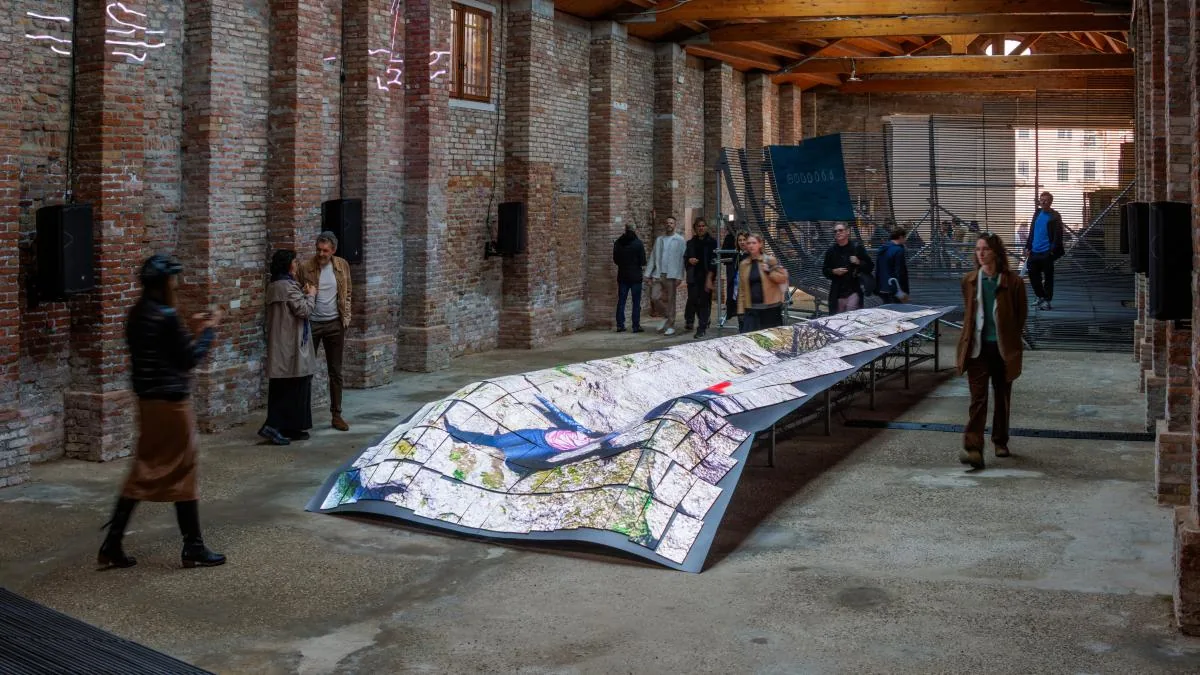
The poet Joseph Brodsky was born in Leningrad in 1940 and was expelled from his country in 1972, after which he settled in the United States. From there he traveled again and again to Venice. He visited it for the first time at the age of 32, and at the time he wrote the wonderful little book Watermark (Siruela/Vienna) he had already stayed in the city 17 times, always in December. For the Nobel laureate, seeing a wave breaking on the shore at midnight was like “seeing time emerging from the water.” Memory, death, love, beauty, dreams are also the materials that, subtly and poetically, the artist Claudia Pagès unfolds in the Cantieri Navali, the usual headquarters of Catalonia at the Venice Art Biennale, where this year she presents Paper tears ( Paper Tears), a waltz-paced installation created from 15th-century watermarks found in the Museu Molí Paperer de Capellades, the place where she was born.
Read more Bonnie Tyler, in induced coma after emergency surgery in Portugal
Claudia Pagès, who is also a writer (Més de dues aigües, Empúries) and grew up in the mill, has been fascinated since childhood by watermarks or filigrees, those naive-looking drawings used to identify the paper craftsman or the person who commissioned it, but which are only visible when viewed against the light. On the brick walls of the nave, four lasers project unicorns, ox heads, hands with tiny hearts, castles, or hearts pierced by an arrow, while five voices comment on them in what seems like a game of free associations: (“Heart pierced by an arrow”/“Tattoo, ink on paper”/“Mom”/“Looks like a sword. A bald man”/“A good boy suffering”/“Is ‘good boy’ already a euphemism for non-abuser?”. “1451”).
Also read
“When you speculate about an image, you speculate about yourself,” says Pagès, who has chosen all the marks from the 15th century, a time when the expulsion of Muslim communities, who had introduced and maintained paper production, caused scarcity and greater dependence on imports, especially from Italy. Words and stories also navigate a large central screen that sometimes looks like a river or a canal of black waters, and at times we see crystal-clear waters springing from different points in Catalonia (the Pont Nou aqueduct, the Diable pools, the Riera del Carme…) or Pagès herself singing and dancing alongside other dancers.
MNAC presented its expansion in Venice yesterday alongside projects in San Diego and Kristiansand
On both sides of the large central installation, like unstable skate ramps, the architecture studio Goig (Miauel Mariné & Pol Esteve) has installed stands from where visitors can attend an opera that, make no mistake, does not speak of the past but faces a present in which the ghost of Islamophobia reappears with enormous violence.
The inauguration of the Catalan pavilion in Venice, organized and promoted by the Institut Ramon Llull and curated by Elise Lammer, coincided yesterday with the unveiling of the future MNAC in the city and the moment where if someone were to plant a bomb the entire art system would disappear. Pepe Serra was in charge of the presentation at an event titled Making the future. Reimagining museums for the 21st century, where the projects of the Kunst-silo Gallery in Kristiansand (Norway) and the Strauss Museum in San Diego were introduced.
Read more Ronaldinho and Messi will ‘recreate’ in Castelldefels the Argentine’s first official goal for Barça
But the big sensation of the day at a Biennale where the sun has shone again and the festive pulse is beginning to recover despite the Pussy Riots’ reminders about the abnormality of the “Putin pavilion” continuing the party as if nothing, was the inauguration of the new center of collector and patron Patrizia Sandretto Re Rebaudengo on the island of San Giacomo, north of the Lagoon. She acquired it in 2018 along with her husband, and yesterday it was the place everyone wanted to attend. Invitations circulated clandestinely and until a few hours before the location of the boats’ departure was kept secret.
The sensation of the day was the inauguration of Patrizia Sandretto’s new center on the island of San Giacomo
The island, which housed a monastery, a convent of Cistercian nuns, a quarantine center, and later a convent of Franciscan friars, was transformed under the Napoleonic regime into a military enclave, with powder magazines and weapons depots. On these layers of seclusion, violence, and oblivion, new constructions have been built (thirty thousand bricks from the old powder magazines were hand-cleaned and reused in the exterior pavements) for exhibition spaces. One of them houses an exhibition with works from her collection, Don’t have hope, be hope! , and the other, a monographic of Matt Copson, curated by Hans Ulrich Obrist.
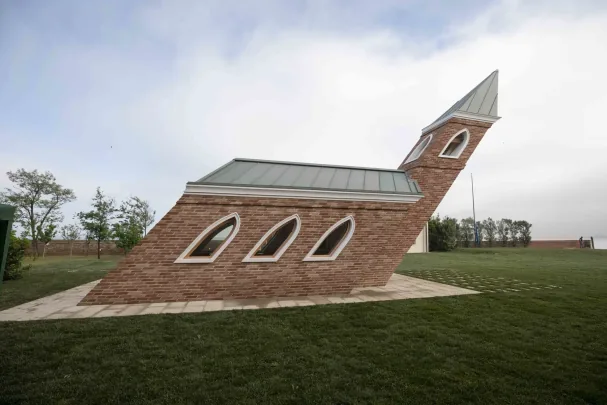
Although it is in the surrounding grounds where the most striking pieces are found, including Gonoco , by Goshka Macuga, a metal rocket on a fluorescent blue launch platform and, above all, a work by Hugh Hayden that takes the title from the story of The Three Little Pigs ( Huff and a Puff ) and represents a life-size chapel with capacity for about ten people, which leans forward at a 40-degree angle, as if the wolf were about to knock it down..
Read more Fine of 10,000 euros for starting a brawl on a Ryanair flight between London and Ibiza