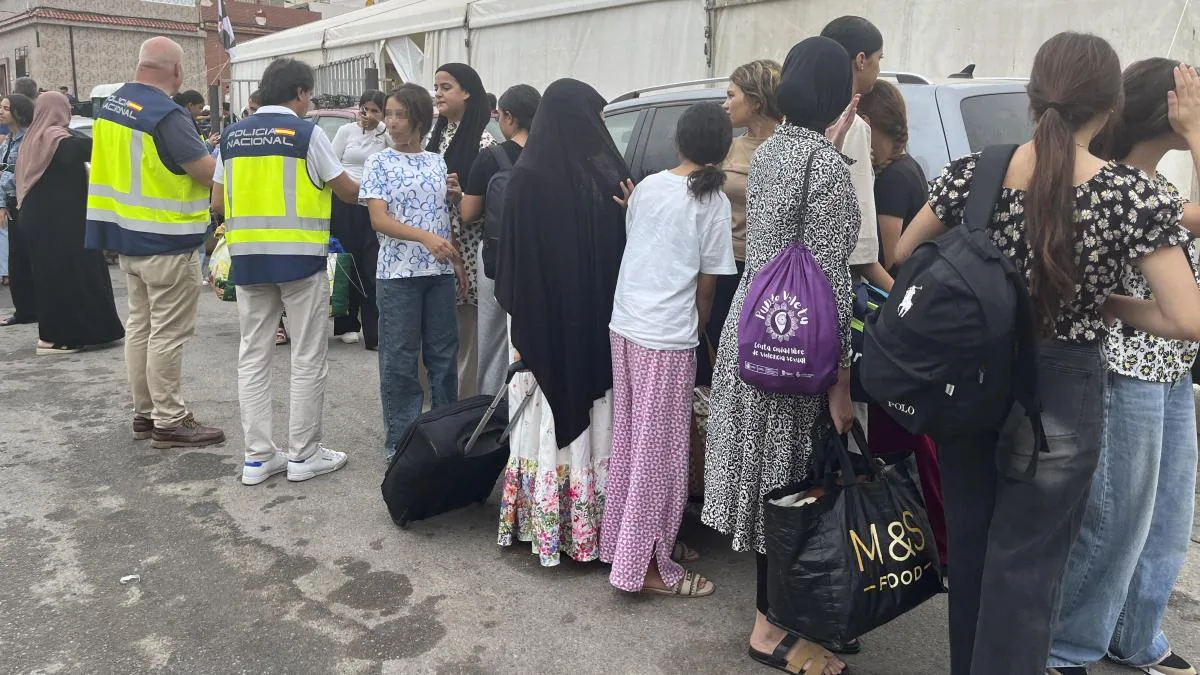
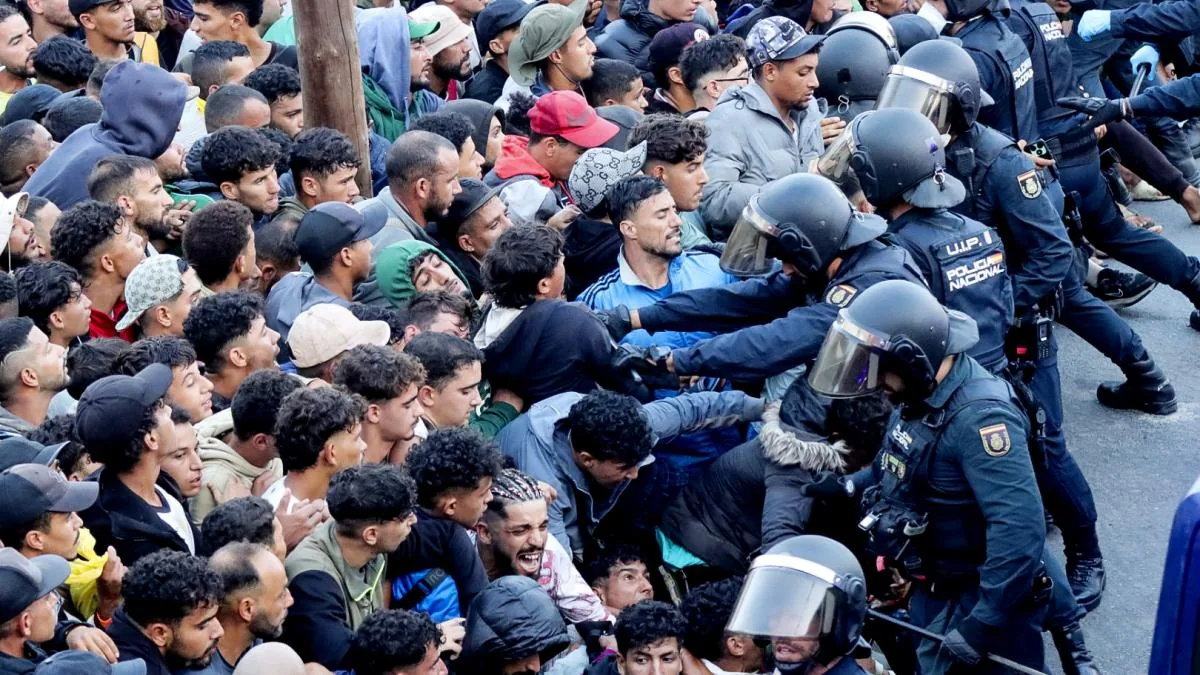
A human tsunami arrived on July 30 at El Tarajal beach in Ceuta, leaving thousands of clothing items, flip-flops, and personal belongings, but also a huge political crisis that is gnawing at Pedro Sánchez’s government, and a question that no one has answered so far: where and how does the wave start?
Read more Burn the ships in Morocco
Exactly one month earlier, a Supreme Court (TS) ruling establishes that an immigrant detained after irregularly crossing the border can only be returned immediately if they have proactively avoided physical barriers, but not if they arrive by swimming; in this case, a procedure with a lawyer, interpreter, and legal guarantees must be opened.
The ruling, dated June 29, is not made public until July 8 when the TS explains it in a press release, which is soon echoed by the newspaper El Faro de Ceuta : “The Supreme Court confirms it: the law does not allow hot returns of immigrants at sea.”
It is 13:01 hours. The Facebook version of El Faro has 149 reactions, 106 comments, and is shared 21 times. At 19:15, the Moroccan newspaper TelQuel replicates the information. It receives 11,297 “likes.” Readers’ comments encourage going to Spain. Some suggest doing it during Spain’s next World Cup match, on July 10, against Belgium, to take advantage of a possible relaxation of border forces.

The message is simplified: if you enter by sea, you are inside. The earth has started to shake. And the sea. Three weeks later, about 72,000 people will enter Ceuta by swimming. At least 141 drown in the attempt.
Although most who cross the border will voluntarily return to Morocco in the following hours, several thousand remain there, becoming a huge problem and Twitter fodder for the international far-right and an enigma: was it Morocco itself that stimulated the avalanche to highlight the Moroccan identity of the plaza? Was it stirred up by Russia or Israel, as Pedro Sánchez or his Foreign Minister, José Manuel Albares, or even his Ukrainian counterpart, Andri Sibiga, have suggested? Or was it only exploited afterward, in favor of the far-right anti-immigration discourse?
On July 31, the owner of X, Elon Musk (with 218 million followers), posts a tweet under images from the dystopian movie World War Z , exclaiming: “Wow, the situation in Spain looks crazy!”. Donald Trump will also take the opportunity to attack Spain.
Five analyses – police and social media experts – agree in highlighting how the illegal immigration business, always active in this part of the Maghreb, receives extra fuel from July 8. Facebook, Instagram, TikTok, Telegram, and WhatsApp nodes carry the message of “open doors,” or “open beach,” to hundreds of thousands of people.
The conversation starts in open groups but becomes secret to spread practical instructions
The report prepared for the investigation opened in the National Court by the National Immigration and Borders Center (Cenif) of the Police is categorical: social networks have been “an element of extraordinary relevance” and clearly show “the importance of the actions of certain profiles and phone numbers that play a decisive role in the massive dissemination of key messages.”
The Spanish police, infiltrated in some groups, detect between July 24 and 28 a “sudden increase” in messages urging people to approach Castillejos (Fnideq in Arabic) to jump to Ceuta. The agency alerts Madrid of movements in the area on the 27th.
Between July 29 and August 1, messages grow by 3,363%. The massive entry is on the 30th, but the same networks are inviting another jump on August 15.
The conversation starts in open Facebook, Instagram, and TikTok groups with encouraging messages, data exchange, and calls to go to Ceuta. As interest grows, activity migrates to closed WhatsApp groups where more precise operational instructions appear. Among other things, they know they are being watched.

Police investigators identify administrators and users present in several groups, acting as diffusion nodes. More than 90% of the phone numbers analyzed are Moroccan. The rest are a rosary of 28 different countries.
For Cenif, the mobilization of between 75,000 and 85,000 people cannot be explained solely by chance or the spontaneous spread of rumors.
The report speaks of a “viralization design process” aimed at reducing dependence on random factors and emphasizes that moving such a number of people without blockages on access routes or public order incidents is “incompatible” with a spontaneous movement.
“Disinformation kills. There have been 140 people who reached Castillejos beach and drowned, and that was due to disinformation”
Marcelino Madrigal
Network and security expert
The consulting firm Golden Owl, specializing in digital traffic analysis, agrees with this diagnosis: the massive entry to Ceuta “was not a spontaneous event” but “a coordinated, pre-constructed, and publicized operation” that pursued a purpose.
Read more Eurofighters take off
For this, there was “a closed coordination core” that connected with diffusion groups on Facebook with more than 1.5 million members. The campaign was organized “horizontally, not hierarchically” and used a brand and a market, with coded vocabulary, visual identity, and shared slogans. Thanks to these factors, it “reached the scale it reached” and was also resilient to arrests and possible content removals.
This Alicante-based consultancy identified “a small set of administrators and recruiters.” Among them, they point to a native of Casablanca, residing in Istanbul, who offered a Turkish WhatsApp number (revealed by the +90 prefix). Also, an operator of two accounts built entirely around the hashtag “haragaceuta” – referring to the “burning” of documentation so you cannot be returned – which was used those days as a key for the jump. And another from the Tetouan area pushing identical content to three groups of 50,000 members.
Algerian markers are also detected. Golden Owl and Moroccan engineer and data analyst Marouane Lamharzi locate (by the use of a phone with the +213 prefix) that a month before the assault, an Algerian network, under the hashtags korob_haraga and Haraqa Spain, offers a trip to Spain in a boat with an engine of 600 to 900 horsepower, with payment to be made at the destination. According to this analysis, it is a sign of how the migration market is always active but also how the July outbreak takes advantage of its terminology and networks.
Cibergy places the first Ceuta appointments on July 13: generic messages mutate into practical data
Golden Owl discovers nodes in northern Moroccan cities such as Casablanca, Khouribga, Tangier, Tetouan/Azla, Beni Chiker, Nador, and Agadir, but also sees signs of operators in Madrid or Rome.
The massive entry relied on a pre-existing digital infrastructure and not on a network created specifically, concludes a report prepared for La Vanguardia by the consultancy Cibergy, led by Àlex Lozano, digital research professor at the Escola de Prevenció i Seguretat Integral de la UAB. The analysis identifies 23 Facebook groups, which gather 1.7 million members, and which have been used since at least August 2024 to exchange data on migration routes and access to Ceuta.
According to the study, the first unequivocal references to the autonomous city appeared on July 13, 18 days before the events. An evolution is observed from generic messages about migration to content with practical indications for those intending to cross.

Investigators point to two profiles as especially relevant in the previous phase: Al Hajj Mohamed and Simo França, the only ones who acted as a bridge between several groups before July 30.
Both connected exactly the same communities, which points to possible routes of information transmission, although the report emphasizes that there is no evidence of centralized coordination. Simo França is the user who mentions Ceuta the most times in July, with six references before the day of the avalanche, and changes groups just after an intense batch of posts.
Cibergy detected 54 cases of the same text published in different groups, in some cases with just seconds of difference. However, these systematic republications occurred after July 31, so they did not serve to organize the action.
Were bots used to amplify the message? The study identifies 52 accounts linked to the Tetouan Tube channel created in a short period, with similar names or identifiers, little own activity, and an almost exclusive dedication to sharing or amplifying third-party posts related to migration, indicators that they are not real users.
The consultancy Golden Owl discovers diffusion nodes in northern Morocco, Rome, and Madrid
However, the consultancy maintains a cautious position. It talks about possible dynamics of “inauthentic diffusion,” but does not claim these accounts are bots nor attribute their management to a specific organization. It also emphasizes that most of these signs appear after July 31, so they cannot be used alone to prove the existence of an organized campaign before the massive entry.
Network and security expert Marcelino Madrigal has not found signs of prior preparation comparable to what he does detect for the later call on August 15. “On the 15th, they had very clearly indicated that something was going to be prepared. But on the 30th, no,” he summarizes. His reading is that the July 31 crisis was the result of the confluence of several factors: the ruling, the contagion effect, the very volume of people already gathered in the area; more than the outcome of a plan. He compares it to the phenomenon of a false supermarket offer that goes viral and causes a crowd.
Madrigal is documenting hostile narratives to Spanish foreign policy in Russian and Israeli media and considers it plausible that these actors “take advantage of the situation” to destabilize the Spanish Government, given what represents “a very large window of opportunity.” But he is careful to distinguish this from the organization of the assault: for Madrigal, this dimension of state disinformation operates as amplification after the fact, not as its origin.
The main problem, he adds, is that the difficulty in detecting signals on networks prevents anticipating measures that, in this case, would have saved lives: “Disinformation kills. There have been 140 people who reached Castillejos beach and drowned, and that was due to disinformation.”
THE OUTBREAK
A month of messages and rumors
June 29. The Contentious-Administrative Chamber of the Supreme Court issues ruling number 814/2026, which prohibits Spain from hot returns of migrants unless they have expressly overcome fences or barriers, but not those who arrive by swimming. In these cases, an ordinary return procedure with legal guarantees must be opened. The ruling will take ten days to be made public.
End of June. The activity of migration mafias operates normally on networks. On the 29th, for example, a video on Facebook offers a trip to Spain, with payment upon arrival.
July 8. The Supreme Court issues the press release informing about the ruling. El Faro de Ceuta echoes it (13:01h), emphasizing the prohibition of hot returns. Immediately, posts begin to circulate on networks that distort the ruling and imply that those who enter by swimming can stay in Spain. At 19:15h, the Moroccan newspaper TelQuel replicates the information, which receives 11,297 “likes.” Readers’ comments encourage going to Spain. Some suggest doing it during Spain’s next World Cup match, on the 10th against Belgium.
July 9, 11:04 hours. Content creator Moatassim Mansouri, on the account @its.mansouriii, encourages in a video to cross to Ceuta using diving fins and a wetsuit. It has 424,806 views.
July 12. A video on the Moroccan news website @inidnews states that “Spain prohibits the immediate deportation of migrants.” It has 1,342,804 views, is shared 5,429 times, and will be forwarded another 1,269 times on WhatsApp.
From July 17. Digital creator Aadile Tami, originally from Casablanca and residing in Istanbul, is for the consultancy Golden Owl – which has prepared a detailed report on the use of networks in the days before the jump to Ceuta – “the most competent cell builder” in the case. Between July 17 and 29, he publishes almost identical recruitment calls in at least five Moroccan irregular migration groups, urging to assault the Ceuta fence (“the kriaj”) from the Castillejos forest.
July 17 to 21. In public Facebook groups and also in comments on Instagram and TikTok posts, calls multiply to join private WhatsApp groups where specific instructions for the operation are given.
July 24-28. The Spanish National Police, infiltrated in some groups, detects between July 24 and 28 a “sudden increase” in messages urging to approach Castillejos. The National Immigration and Borders Center (Cenif) alerts the Interior Ministry of movements in the area on the 27th.
July 28. A video on El Faro de Ceuta shows two girls celebrating their arrival swimming to the city. It has 667,485 views on TikTok and 2,036,476 on Instagram. In the following hours, the video begins to circulate on Arabic accounts; it reaches 32 million views in a few days.
July 28, 21:44 hours. The Moroccan website Akhbarona, independent but officialist, reports the existence of six WhatsApp groups called “Assault on the Ceuta fence.” It states that a certain Taha, identified as Algerian (by a mobile with the +213 prefix), proposes people join secret groups and offers experienced managers to go “to the forest” near the Spanish city, in groups of 10, before starting “the plan.”
July 29. Cenif detects an “exponential” increase (3,363%) in messages urging to cross the border in Ceuta.
July 30 and 31. Massive entry into the city. The Interior Ministry will estimate that 72,000 people enter the autonomous city irregularly, by sea and land. The number of drowned is between 82 and 140. On the last day of July, the owner of X, Elon Musk, posts a tweet with images from the dystopian movie World War Z and the phrase: “Wow, the situation in Spain looks crazy.”