Minister Ángel Víctor Torres (Arucas, 1966) has been responsible since last August 25 for the unified command to manage the Ceuta crisis. With experience in migration emergencies during his time leading the Canary Islands Government, he advocates collaboration with Morocco, trusts in restoring normality as soon as possible, and accuses the PP of “turning their back” on Ceuta.
Read more The patience of Ceuta governs Spain
You assumed the unified command ten days ago. When do you think Ceuta will recover normality?
I wish I could say tomorrow, but I would be deceiving. Some intend to do so, saying that all migrants currently in Ceuta can already be returned. Alberto Núñez Feijóo did so again on Thursday, contradicting Juan Jesús Vivas, who on Ceuta Day said they must be returned according to the law. And for that, they must first be registered. Temporary locations are also needed. But in these ten days, we have announced the opening of spaces with more than 3,500 places, reinforced teams to process files, and prepared an economic plan of 308 million euros. So the answer is that we will do it in the shortest possible time.
How many people remain unidentified today and how many remain on the street?
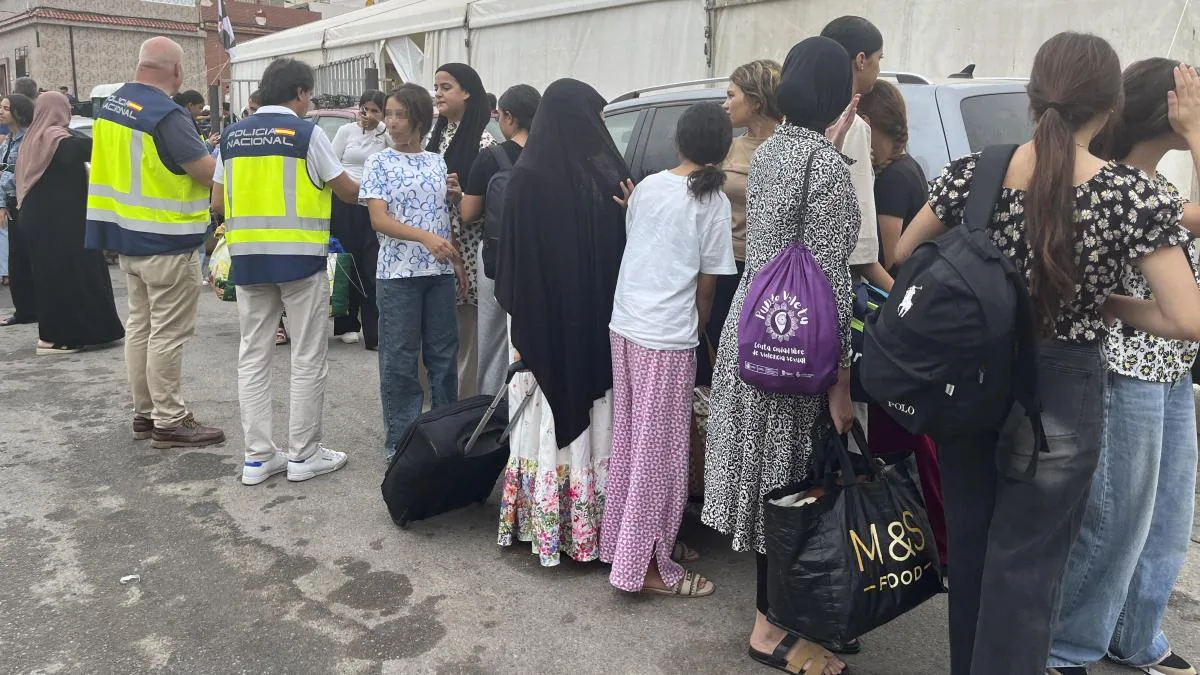
The figures change daily. From August 10 to Thursday, about 3,800 people had already returned voluntarily and 3,500 are in spaces enabled by the Government. 1,000 of them are minors.
Settlements
“We need spaces to register people and accelerate returns”
And the expulsion figures?
More than 200 have been executed and new files are being completed. The pressure will decrease, but the sooner we have spaces to register these people, the sooner we can accelerate returns. I know there is neighborhood opposition, but enabling those spaces will reduce that pressure.
Ceuta will reach 6,000 reception places in the coming days. Is this device only for this emergency?
They are temporary and provisional infrastructures. It is different that in the future all border territories have permanent spaces, because they allow responding to humanitarian emergencies. Ceuta requires specific infrastructures and, for that, we have a CATE (Temporary Foreigners Care Centers) that will open next week and we have expanded the places at the CETI (Temporary Stay Center for Immigrants).
Are you considering making the provisional spaces permanent?
No. They will recover their use. The land of La Reina will return to housing use and the port land will remain as it was. The intention is to have a minimum number of fixed places in specific spaces, but not those we have enabled now.
The longed-for normality
“I wish I could say tomorrow; but we will resolve the crisis in the shortest possible time”
Why is there not already an extraordinary transfer of minors to the Peninsula?
We have registered about 1,400, nearly 1,500 with their name, origin, and situation, but the file is not finished. The priority is reorganization and family reunification.
Does Morocco collaborate?
We are completing those processes so that, according to what Morocco says, which is willing to accept them, it is done through individual files.
And if that reunification is not achieved?
In parallel, there are other mechanisms provided in the Immigration Law. One allows minors to go to the Peninsula, although guardianship remains with Ceuta. The other is article 35, in which, through a faster process that can take about a month and a half, guardianship passes to the autonomous communities. The PP voted against the redistribution and relocation of minors. Therefore, it is false that they helped Ceuta. Because Vivas himself requested that relocation, and his party turned its back on him.

Did Rabat have any responsibility in view of the report pointing to Moroccan gendarmes?
All this comes from journalistic information. The Government was the first interested in knowing the literal content of the report and the Interior Minister asked the Police Director General that same night, who told him that in that report, nor in any other, was there evidence of an action that we could attribute to Moroccan authorities. Things must be analyzed with proof and evidence, not conjectures or suspicions.
Others seem to have a clear reading of what happened.
I find it irresponsible that opposition leaders point to a Government, in this case Morocco’s, without proof or evidence. A leader aspiring to preside over the Government must also be responsible when in opposition. If there were proof, Spain would act decisively.
The role of Morocco
“If there were proof, Spain would act decisively”
Is there any scenario in which the Government reviews or suspends agreements with Morocco?
That concerns the president and the Foreign Minister. I must say that there cannot be an attack on national sovereignty or our territorial reality. All this is being analyzed and investigated. We are talking about two countries that share a border and must maintain a good relationship, but that obliges both. There are agreements and obligations on both sides. And it is evident that, if there had been no collaboration from the Moroccan Government, 90% of those people would not have returned in the following days.
Are the statements of Moroccan ministers about “freeing” Ceuta and Melilla compatible with a cooperative relationship?
Read more From the fear of going out at night
They are statements made at party events. We are on the eve of elections in Morocco. But the Foreign Minister responded decisively. Ceuta is untouchable, it is Spanish. All our territory will always be defended, especially border territories like Ceuta, Melilla, and the Canary Islands.
The Government summoned the Moroccan ambassador on August 22. What was Morocco’s response?
I did not participate in that meeting.
Criticism of Feijóo
“A leader aspiring to preside over the Government must also be responsible in opposition”
If the crisis worsens, will the Government call the Spanish ambassador for consultations?
The Government will decide based on how the situation evolves. My task now is very specific: to achieve normality in Ceuta as soon as possible.
The image of Minister Robles sitting in her seat while the rest of the ministers applauded the president has been much commented on. Is there division in the Government?
No, I deny that. I was in the Plenary and saw Margarita Robles stand up and applaud. Saying she did not stand when the president spoke is not true. Robles is part of the Government of Spain. I talk with her and Fernando Grande-Marlaska every day and they are part of the situation committee. We have worked together to enable military spaces to house National Police officers who had to stay in Algeciras.
After the disturbances, with injured and arrested police officers, is the security situation under control in Ceuta?
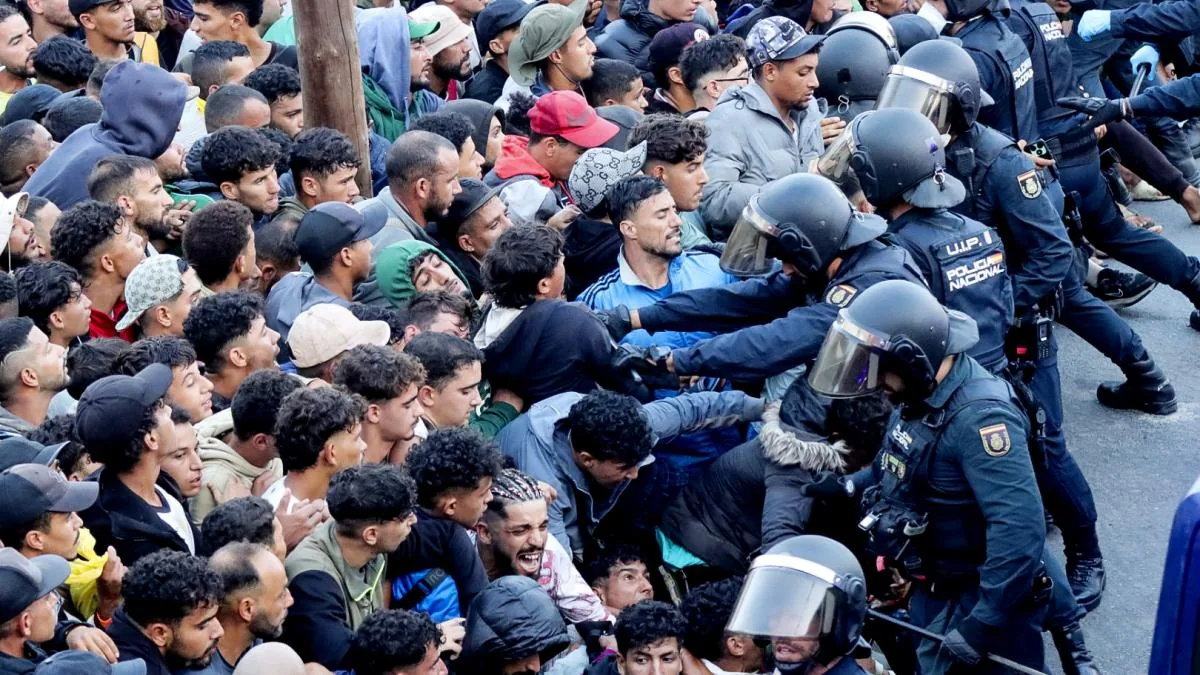
There were moments of tension that were quelled in time. There were gatherings and threats that prevented food distribution for two days. Some immigrant huts were also burned. There have been groups that moved to the call of violence. After talking with Vivas, we agreed to send a joint message against violence. Since then, food distribution has been restored. This is the way.
Division in the Executive
“Robles is part of the Government; I talk with her and Marlaska every day”
Is it necessary, as Feijóo says, for the army to have the status of law enforcement agents?
The situation remains complex. Thousands of people are sleeping on beaches and streets, and that generates tension. But there are many agents from the Security Forces and the Army deployed, and they are doing important public order work.
Has the Ceuta Government been loyal to the Executive?
That is a question I have to answer passively today. I will continue to be loyal. There are issues that, when all this ends, we will logically discuss. I have asked Vivas to work together and I believe that, fundamentally, we have done so.
Do you think the National Security Council was convened too late, 26 days after the massive entry?
No. There was a first moment when the priority was to prevent the more than 70,000 people who entered from staying in Ceuta. 90% returned and that was a correct action, which required reinforcing resources and also had Morocco’s collaboration. Then the humanitarian emergency had to be addressed. On August 3, thousands of meals were distributed, police devices were reinforced, and spaces were enabled. When the crisis entered a new phase, the National Security Council was convened and a collective command was created representing ministries, the National Security Directorate, the State Attorney General’s Office, and Ceuta. It was convened when it should have been.
Why did you not assume the unified command at the beginning of the crisis?
Because priorities changed. At first, the Security Forces focused on guaranteeing security and preventing a repeat of the massive entry while responding to the humanitarian emergency. Now we are in the phase of co-governance, enabling spaces, and processing files. I understand the anxiety to resolve the crisis and the need to act as quickly as possible, but that does not mean we can break the law.
The response
“Anxiety to resolve the crisis does not mean we can break the law”
Can it be guaranteed that an entry of this magnitude will not happen again?
Such an entry had never happened before and neither did it occur on later dates, like August 15. I hope and trust it will not happen again. It will be necessary to rigorously analyze what happened and how so many people arrived. Citizens have the right to complete, rigorous, and verifiable information, not decontextualized images or interpretations.
Why is there still no date for the King’s visit to Ceuta?
The President of the Government has already said that Felipe VI will visit Ceuta in the coming weeks. It will be a historic milestone.
Does the Government fear Morocco’s reaction to that visit?
The King of Spain visits all Spanish territories. Ceuta, Melilla, and the Canary Islands are Spain and, therefore, there should be no doubt that the King can visit Ceuta. Others governed Spain before and that visit did not happen.
Did the president make a mistake by not returning to Ceuta in August as the opposition reproaches him?
The opposition is wrong. The president has not stopped working for Ceuta. And they know it. He has been giving instructions from the beginning, with meetings and constant calls 24/7. Not being in Madrid does not mean he was not working. Those criticisms are a smokescreen without a constructive proposal. They are not here to give lessons.
Read more Manresa, about twenty young people and the fear of a city