The main rivers of Europe have seen their flows drastically reduced. The Rhine in western Germany and the Danube in Romania register approximately one third of the water volume they usually carry, while the Loire and the Po also suffer the effects of the drought affecting much of the continent.
Read more Fine of 320,000 euros imposed on Reggaeton Beach Festival for various abusive practices
Several nuclear power plants have been forced to reduce or cease their electricity production due to the inability to cool their reactors, while the low flow level has hindered the navigation of vessels and thus harmed trade and tourism.
Impact on electricity production
Nuclear power plants at risk due to water scarcity
The low water levels of the Danube have forced several nuclear power plants that use river water to cool their reactors to reduce or even cease their activity. The most worrying situation is in Hungary, where the Paks nuclear power plant, which generates nearly 40% of the country’s electricity, will disconnect its last operating reactor in the coming hours, marking the first time the plant ceases activity in its 44 years of operation. Prime Minister Peter Magyar has warned that, consequently, Hungary’s electricity market will face “critical” conditions, as the likelihood of the plant reactivating soon is small due to the prolonged drought.
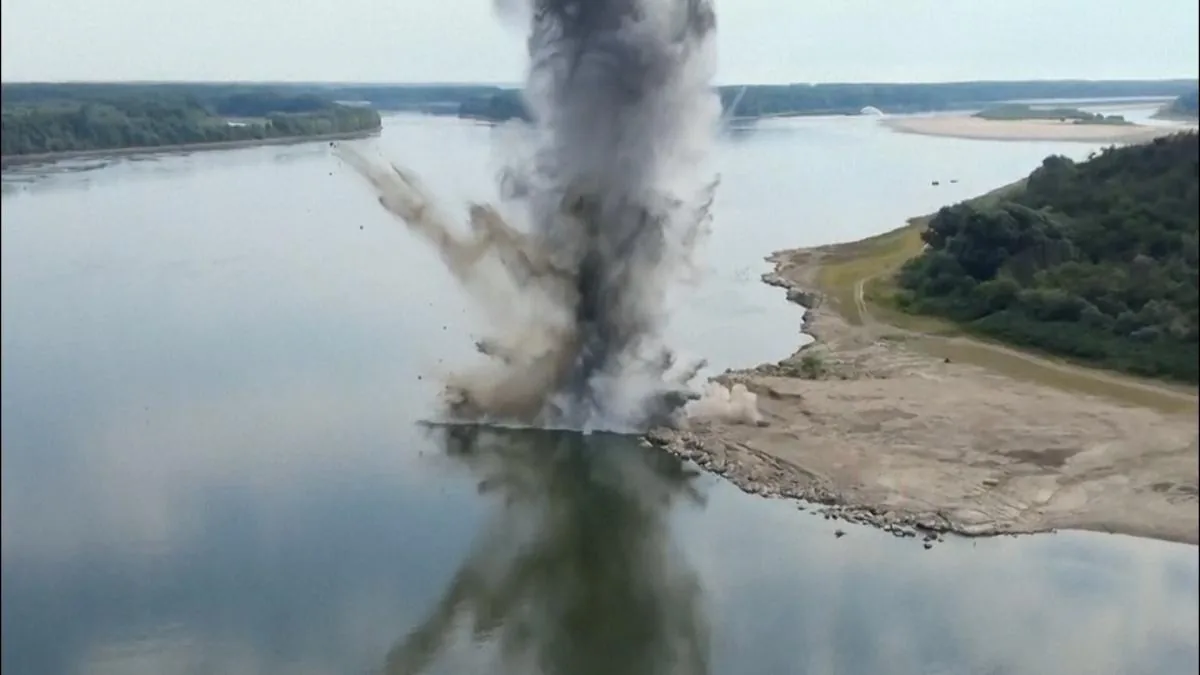
Meanwhile, in southeastern Romania, authorities closed a reactor at the Cernavoda plant last Tuesday for safety reasons, and the decision to close the second reactor could be made if the water level continues to drop, according to Nuclearelectrica, the plant’s operating company. Additionally, the Romanian army used explosives this Monday to blast rocks near the Bala canal, in the lower course of the Danube, aiming to redirect water towards the main river channel and the nuclear plant.
In France, where nuclear energy generates approximately two-thirds of the country’s electricity, production has also had to be cut back as rivers cannot supply enough water for cooling.
The combination of high temperatures and lack of precipitation has increased evaporation, reduced soil moisture, and limited the water feeding the rivers, according to an analysis by World Weather Attribution, which highlights that climate change has intensified this process.
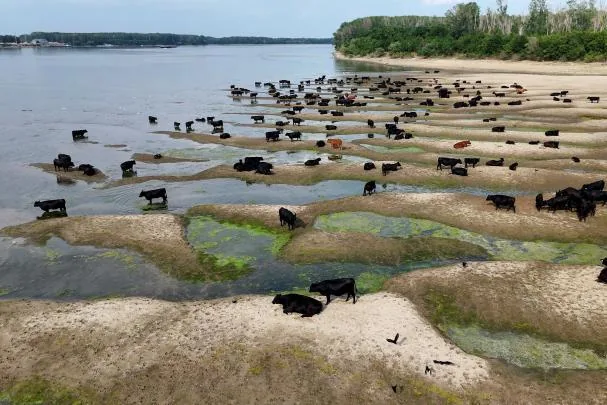
River flows were below average last June across Europe, specifically in much of France and Central and Eastern Europe, as well as in territories in the northeast of the continent, according to the Copernicus Climate Change Service. This is also influenced by the lack of snow in high mountain regions, such as the Alps, which reduces water contributions from glacier melt.
The Rhine
The drop could cause raw material shortages in German trade
The vital ‘artery’ for inland navigation in Germany, the Rhine River, is in a critical situation. At the Kaub gauging station (west of Frankfurt), the main bottleneck for commercial navigation towards southern Germany and Switzerland, the water level recorded last Friday was 25 centimeters, matching the previous historic low recorded in 2018 (this figure does not reflect the actual river depth but the water level relative to the gauging station reference point; it shows the navigable depth and risk of grounding).
The shallow water column has forced a reduction in the load of ships traveling it and the distribution of goods among several vessels. This leads to increased transportation costs and poses an additional challenge for Germany’s economy.
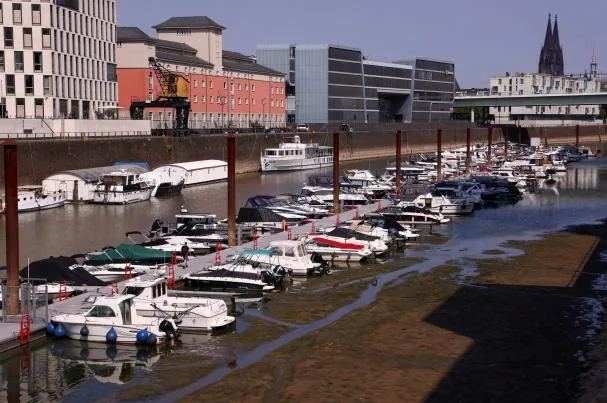
Additionally, the flow, that is, the volume of water the river carries, dropped to 550 cubic meters per second (m³/s), compared to an average of 1,490 m³/s in July, nearly a third reduction, making it the lowest flow for July since measurements began in 1901, according to the Low Water Level Information System in Germany and the German Waterways and Shipping Administration.
Meanwhile, the Rhine’s water level at its entry into the Netherlands (in the town of Lobith) registered 6.47 meters above sea level last Thursday. This figure marks a new historic low, compared to the previous record of 6.48 meters set in August 2022, and is expected to continue dropping in the coming days, according to French media.
The Rhine is an important transport route for goods such as cereals, minerals, coal, and petroleum products, including gasoline. In fact, according to the German Chamber of Industry and Commerce, this water shortage could cause a shortage of raw materials, which are normally transported by ships.
Read more Trump and the Pickaxe dilemma, the mountain where Iran hides a mysterious nuclear facility
France and Italy
The Loire and the Po on drought alert
For the same reasons, the Loire, France’s longest river, is on alert. It presents the sad images of sandbanks stretching to the horizon and water temperatures close to 30 °C. The river faces an exceptionally early drought affecting its flow, which is usually low in summer, impacting ecosystems and tourism activities.
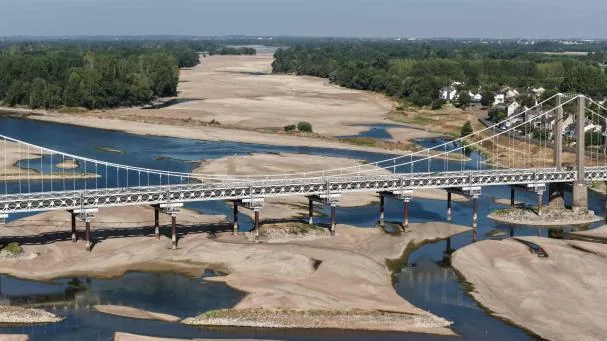
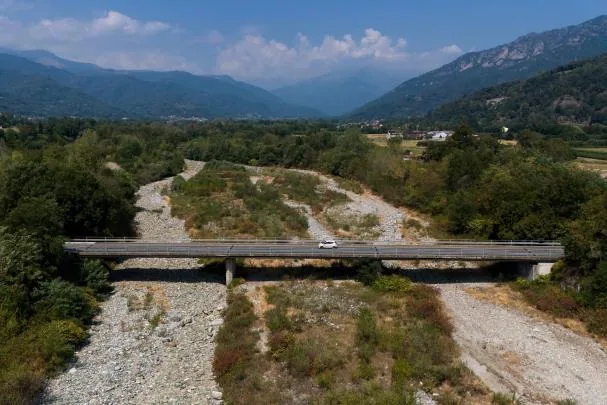
On the other hand, Italian authorities raised the drought alert level to “high” last Thursday in the Po River basin, the country’s main river. Additionally, more than 100 municipalities in Piedmont and Lombardy, regions in northern Italy, are already experiencing supply difficulties, and the reservoirs of Lakes Maggiore and Como recorded a drop in their filling levels of 7% and 6%, respectively, within a week, according to the Po River Authority.
Historic lows in the Danube
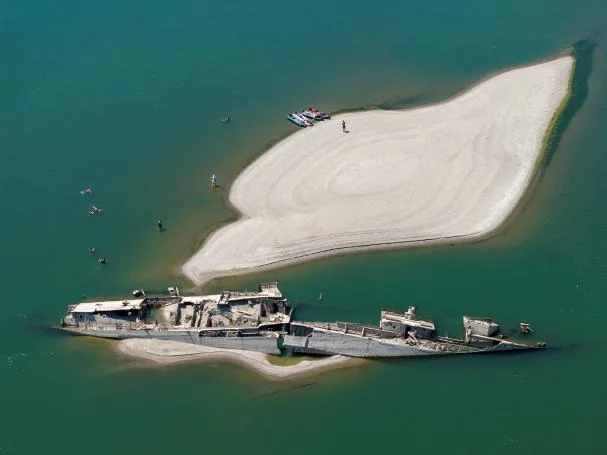
Drought exposes WWII bombs and ships and remains of a possible mammoth
The Danube River, which crosses ten countries from southwestern Germany to the Black Sea, suffers the effects of drought at various points along its course. Passing through Budapest, it has reached its lowest recorded level to date, according to the Central Danube Valley Water Management Directorate, the Hungarian body responsible for its supervision. This Monday it reached 10 centimeters, well below the historic minimum of 33 centimeters that had been in place since October 2018.
Tourism and trade have also been heavily impacted by this situation. In Hungary, tourist cruises have had to change their docking locations, and river freight transport has drastically reduced, according to the Ministry of Transport. Near the city of Vidin, Bulgaria, a cruise ship ran aground.
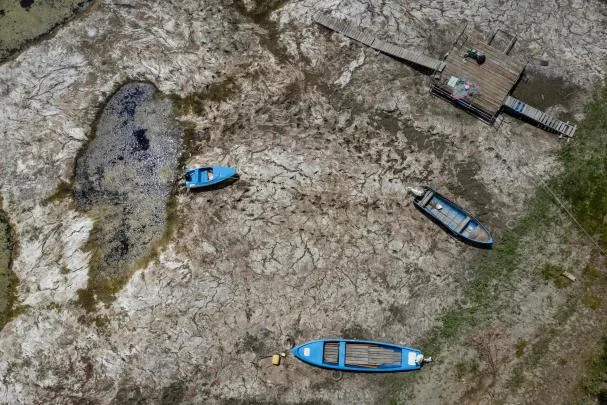
Additionally, extensive sand areas have been exposed on the banks, revealing unusual scenes such as a World War II bomb in Budapest and the remains believed to be of an ancient mammoth in northern Bulgaria.
The drop is repeated in other points such as Romania, where the flow fell on July 19 to 1,700 cubic meters per second, compared to a usual average of 4,700, which equals more than a third (36%) of the average level recorded in July, its lowest point in 3 decades.
In Serbia, the flow is also approaching historic lows, and in Bratislava (Slovakia), the Danube recorded the lowest average flow for a July in 125 years of measurements.
Also read
Europe dries up
Climate change worsens the drought
Europe is the fastest warming continent in the world, and many scientists say that climate change caused by human activity increases the intensity of heat waves, droughts, and fires.
Last June, much of Western and continental Europe, including Italy, large areas of Central and Eastern Europe, and southern United Kingdom, experienced drier than normal conditions associated with these extreme heat episodes, which increased drought risk in some parts of Eastern Europe, as reported by the Copernicus Climate Change Service.
The three heat waves recorded since mid-May have worsened the situation, and by mid-July, the water situation had deteriorated across practically all of Europe, from France and southern Germany to Hungary and Romania, southern United Kingdom, and northern Italy, with effects also in Switzerland, Austria, Czechia, Slovakia, and Serbia, according to the European Drought Observatory (EDO) of the European Commission.
United Kingdom affected
About 78% of England’s rivers show below-normal levels
Half of England is in drought. Seven areas are affected: London, East Anglia, the Thames Valley, Hampshire and the Isle of Wight, Devon and Cornwall, West Midlands, and Wessex, according to the Environment Agency’s report on Wednesday.
About 78% of England’s rivers show below-normal levels, and reservoir water volume has fallen to 75.3% of capacity. So far in July, only 7% of the long-term average precipitation has been recorded, dropping to 1% in some parts of southern England. In response, several water supply companies have already imposed temporary restrictions such as garden watering and car washing to preserve reserves and reduce pressure on rivers and reservoirs.
The announcement follows a similar measure adopted in Wales, where drought was declared last week for the north and upper Severn River basin due to historically low river flows, successive heat waves, and exceptionally dry conditions.
Read more The European Union changes flight rules: this is how they will affect carry-on luggage and delays