Iran’s war today revolves around the Strait of Hormuz, but Israel has been trying for days to shift attention elsewhere: the Kuh-e Kolang Gaz La mountain, better known by its English name, Pickaxe.
Read more The European Union changes flight rules: this is how they will affect carry-on luggage and delays
Located in Isfahan province, about 220 kilometers south of Tehran, this massif supposedly houses one of the most modern and best-protected nuclear facilities of the Iranian regime inside it. For Israel, the complex should be a priority military target, but the U.S. is currently reluctant to bomb it.
The site began construction in 2020 as an alternative to the Natanz plant, which is right next door and suffered a strange explosion that year that Iran attributed to Israeli intelligence services.
Although Tehran publicly announced its plan to build this new infrastructure at the time, the place is shrouded in mystery. It is not exactly known what is inside the mountain, nor the status of the construction. There is not even confirmation that the plant is operational.
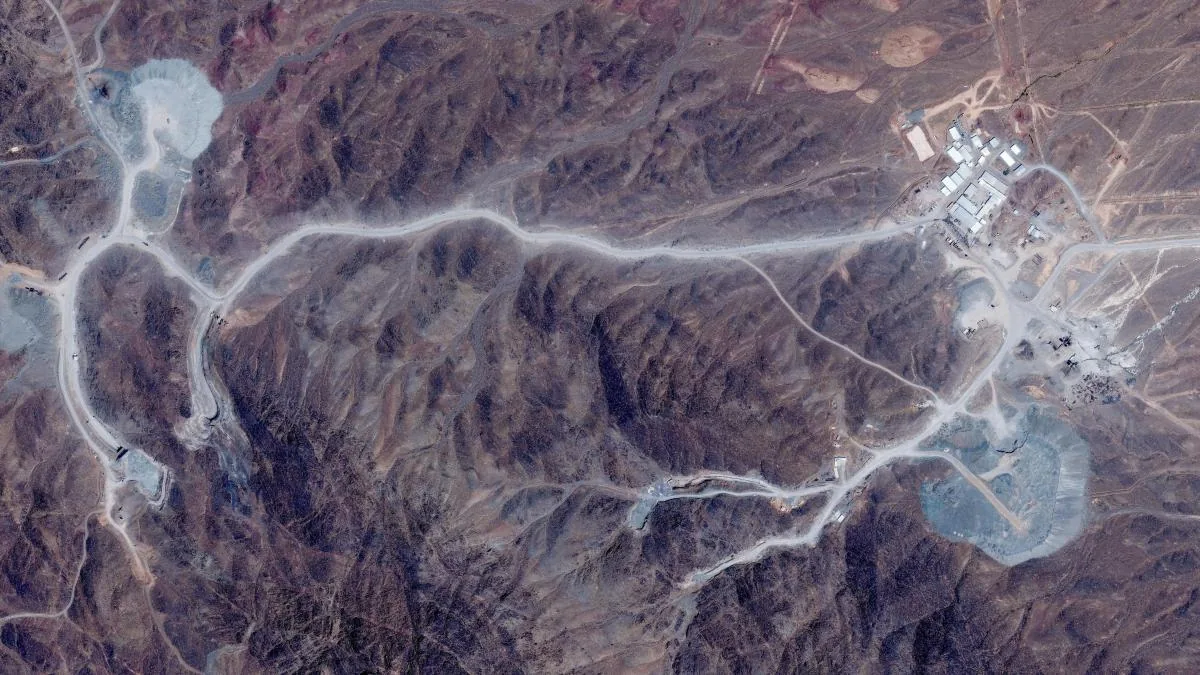
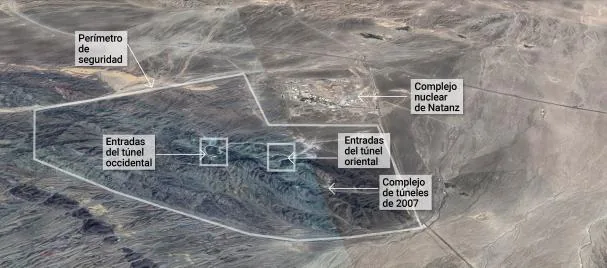
In the absence of detailed plans, the only available information comes from satellite images. The most recent photos reveal that the mountain—whose summit rises about 1,600 meters above sea level—is protected by a wide security perimeter, and large amounts of rock have been excavated. The images also show two reinforced concrete entrances, which supposedly lead to a tunnel network.
According to the Institute for Science and International Security (ISIS), based in Washington, the nuclear facility is at least 100 meters underground, protected by layers of rock, granite, and concrete, and would be large enough to house a uranium enrichment plant with advanced centrifuges. In other words, the essential machinery to manufacture atomic weapons.
ISIS experts also believe that construction of the plant has accelerated in the past year, after the June 2025 war, when Israel and the U.S. launched a wave of attacks against various Iranian nuclear plants. One of them was Natanz, which was partially destroyed. Pickaxe, on the other hand, escaped the bombs.
After that offensive, Donald Trump claimed that Tehran’s atomic capabilities had been “annihilated.” However, both U.S. intelligence services and the UN later concluded that part of Iran’s nuclear program remained intact.
Read more Spain exceeds 22.5 million affiliates for the first time in July despite the rise in unemployment
According to the latest UN assessment, Tehran retains at least 440 kilograms of uranium enriched to 60%, very close to the 90% needed to produce a bomb. Some of that material could now be at Pickaxe, although there is no evidence to that effect. Everything remains in the realm of speculation.
That vagueness does not prevent Benjamin Netanyahu from being determined to blow the mountain up. According to Israeli media, the Hebrew prime minister tried to convince Trump of the need to launch an attack during their last meeting at the White House last Tuesday. It is unknown if he succeeded, although before the meeting, Trump downplayed the matter. In fact, he even showed some irritation at Netanyahu’s insistence. “I don’t need Bibi to tell me that. Bibi tells me because he wants me to stay involved,” the president said.
In fact, a week earlier, Trump had already referred explicitly to Pickaxe, stating that the U.S. was watching the mountain “very closely” and had detected “no activity.” Still, the Republican hinted that he could attack the plant “very soon” and “with great force.”

The truth is that an offensive against Pickaxe has a high chance of failure. Destroying a complex of this nature is not easy. Last year, the U.S. attacked the Fordow plant, which is also underground, and had to resort to its most powerful bunker-buster bomb, the GBU-57. The extent of the damage caused by that attack is unclear, and it seems unlikely that the projectile used then could make a dent in the Pickaxe plant, which is located at a greater depth.
A more realistic objective would be to hinder the use of the facilities. For example, by collapsing its entrances. But since the plant’s design is not well known either, there are no guarantees that such an operation would be entirely effective.
Given these difficulties, Trump may continue to keep Netanyahu waiting. After all, if there is one lesson this war teaches, it is that one can come out badly if dragged along by the Israeli leader.
Read more 17 migrants die after fifteen days adrift while trying to reach the Balearic Islands by boat