What would good stories be without secondary characters? Without being the pillars of the narrative, they also support it and give it depth and texture; they are often the ones who lift the veil of appearances, at least a little. For this reason, they put so much effort into the castings that brought Vida privada (1932), Josep Maria de Sagarra’s great novel, to the screen.
Read more The White House reacts to Ferran Torres’s cap: “Everyone wants to get on the wave”
In the two miniseries filmed to date, Francesc Betriu’s (1987) and Sílvia Munt’s (2017), both directors entrusted the role of the Baron of Falset to Héctor Alterio, in the first case, and to Pedro Casablanc, two superb actors, capable of getting into the skin of that cotton industrialist with a purchased title and an erotic secret that will drag him to perdition.
Betriu, however, takes some liberties with respect to the original: the Baron of Falset does not attend the party we are concerned with today. Moreover, his absence sparks rumors among the attendees; some claim he has gone mad, and it’s no wonder: he is being subjected to horrifying blackmail.
The soirée in question is held in a large house with a garden on Paseo de la Reina Elisenda, owned by Hortènsia Portell, a stand-in for the patron Isabel Llorach, heiress to a real-life fortune thanks to bottled purgative water. A very recognizable disguise. If the publication of Vida privada was a scandal, it was not so much because of the ménage à trois and the high-voltage sexual passages, but because contemporaries could read it as a roman à clef and distinguish among its pages prominent figures of Barcelona’s high society, a series of imitations that the passage of time has already erased.
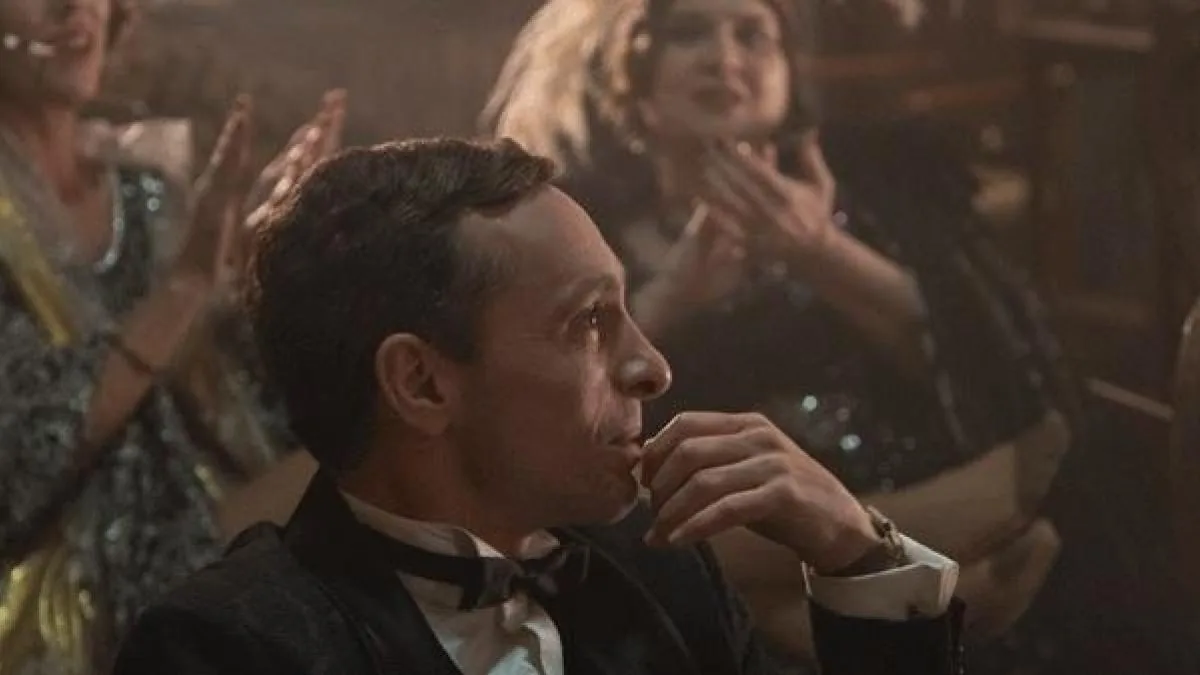
In any case, we are at a party, on a mid-June night in 1927, and it is “a colonial and greasy heat” (how well Sagarra adjectives, and he wrote the novel in two months!). 150 people attend the event, dancing jazz and drinking champagne in abundance; the reader knows this because the hostess frets, a few pages later, about having spent a fortune “to give drink to all that lymphatic and grotesque personnel.” In both film versions, the guests drink from Pompadour glasses, the shallow, wide-mouthed ones.
The character of Hortènsia Portell, the hostess, is inspired by the patron Isabel Llorach
At Hortènsia Portell’s party, one of the novel’s most colorful episodes, the two tectonic plates that articulate the plot converge: on one side, the old Catalan aristocracy, ruined by the decline of agricultural rents and forced to divest itself of its stately estates, represented by the Lloberola lineage; on the other, the booming industrial bourgeoisie, enriched, ambitious, and determined to transform its economic power into social prestige, under the opportunities opened by Miguel Primo de Rivera’s dictatorship and the International Exhibition, which would open in Barcelona on May 19, 1929.
The tension between both worlds crystallizes in an object of great symbolic charge: the 17th-century tapestry that the Lloberolas had been forced to sell to the hostess, a piece that recreates the biblical scene of Jacob and Esau, who gives up his birthright for a plate of lentils. Everything has a price, indeed. Two guests at the soirée, two nameless gentlemen, criticize both sides, especially the arriviste businessmen: “Since they are people without convictions, they go straight to the point; today they are supporters of this stupid general and tomorrow they will be supporters of a republic or a communist regime if they see a way to earn two reales.”
Read also
The attending ladies wear rows of well-set pearls and diamonds; no costume necklaces. The course of the party, scattered among various groups and salons, pivots on two figures: Conxa Pujol, the wife of the Baron of Falset (absent), a beauty of Antillean descent whose grandfather had become rich in Cuba through the slave trade and coffee commerce; and, on the other hand, General Primo de Rivera, whose arrival is so long-awaited that the assembled guests begin to doubt it.
But, when the character finally enters the scene, Sagarra’s gaze descends upon his prey with the ferocity of an eagle (the predatory metaphor is by Marcos Ordóñez). The prodigious writer describes a tired and vulgar man, “a mix between a police inspector and a blackjack player, with something of a clergyman and a tiger tamer.” Incidentally, Betriu’s miniseries for TVE takes another creative liberty: the dictator, dressed in civilian clothes, dances the pasodoble La banderita, with one of the guests, a song very popular among Africanist military personnel.
The prodigious writer describes Primo de Rivera as a tired and vulgar man, “a mix between a police inspector and a blackjack player, with something of a clergyman and a tiger tamer”
The joke and the charade continue until a quarter to four in the morning. The day after the revelry, a small group of guests and Mrs. Portell improvise an excursion through the underworld of the Chinese quarter, where they try to have fun at the cabaret La Criolla, the flamenco tablao Villa Rosa, and a dive bar called La Sevillana.
At the beginning of the second part, Sagarra’s talent needs only five splendid pages to synthesize both the splendor of the Exhibition—an enthusiasm quite similar to the Olympic euphoria of 1992 –“Barcelona was boiling in a stew of grandeur and every man for himself”—and the subsequent economic crisis and the advent of the republic. Vida privada is one of the novels to take to a desert island.
Read more Firefighters rescue dog missing for two weeks that was swimming in San Francisco Bay