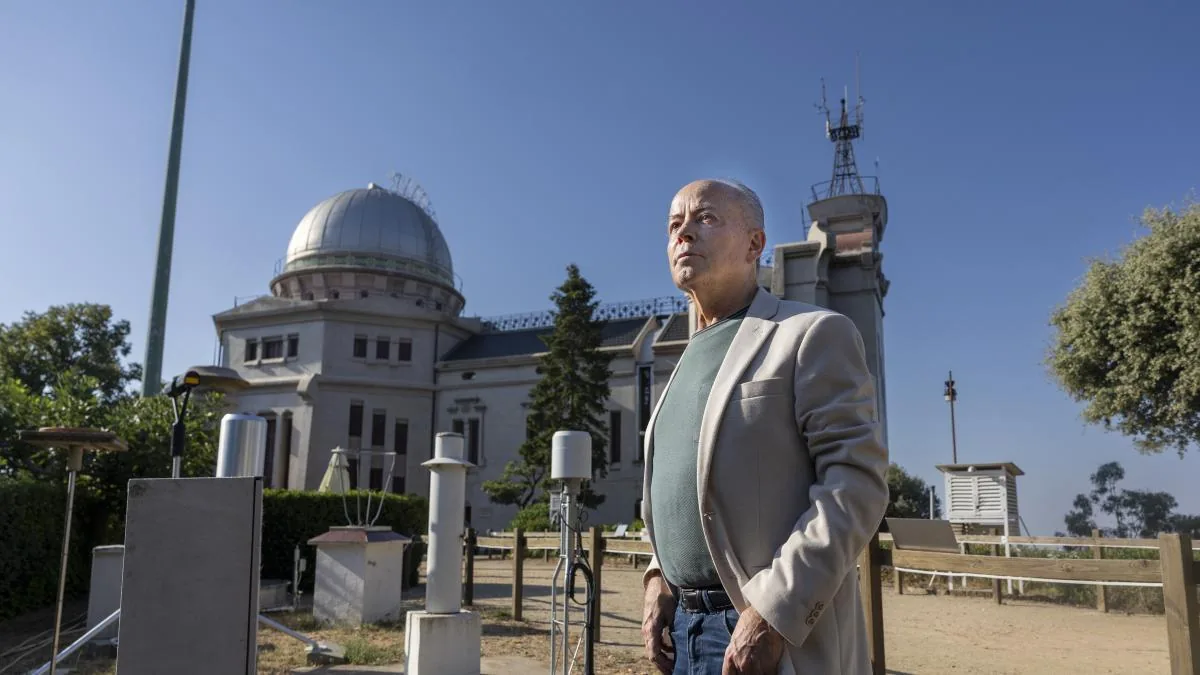
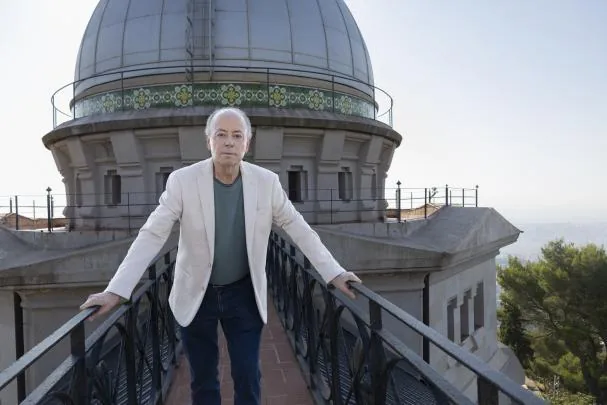
Javier Martín Vide, director of the Fabra Observatory in Barcelona (located very close to Tibidabo), emphasizes the importance of this meteorological station, which recorded on July 8 the absolute record for the highest temperature in the city of Barcelona: 40.9ºC. Its value lies – he tells us – in the uninterrupted 112-year series of weather measurements, which makes this station a true thermometer of climate change.
Read more Artificial intelligence accelerates the search for alternatives to the smartphone
As we toured this place, Martín Vide explained the history of this scientific center, inaugurated in 1904 by King Alfonso XIII and owned by the Reial Acadèmia de Ciències i Arts de Barcelona (created in 1764), the oldest scientific institution in Catalonia after the University of Barcelona.
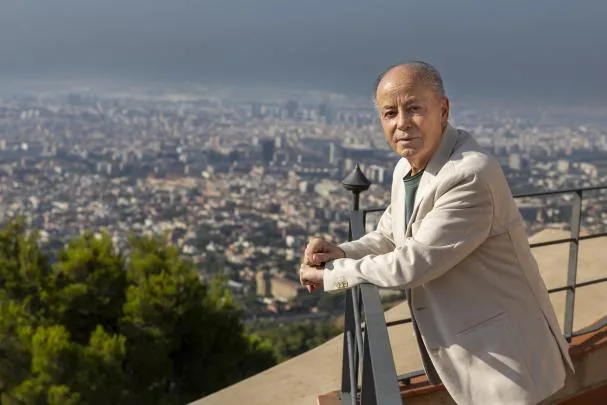
Located in the Collserola mountain range (at 413 meters altitude), the observatory is also famous for its astronomy and seismology sections, as well as for its popular “Dinners with Stars” from this fabulous viewpoint of Barcelona.
When did records start being taken here?
Astronomical observations have been made since its inauguration and continue today. The first director was Josep Comas i Solà. And Comas i Solà was a great astronomer; he discovered 11 asteroids, naming the first one Hispania. He also discovered two comets. He intuited that Titan, Saturn’s most important satellite, had an atmosphere; this was later confirmed around 1944. But Eduard Fontserè was also here, who was director of the meteorological and seismic section, and the first director of the Meteorological Service of Catalonia.
Martín Vide recognizes Camilo Fabra as a key figure in this history. A wealthy industrialist, he invested part of his fortune here; he was mayor of Barcelona, a deputy in the Restoration Cortes, and acted as a true patron. He facilitated the construction of the observatory by providing the necessary funds, with a clear scientific motivation.
The meteorological measurement series show clear signals: both the annual average temperature and any month of the year are clearly rising
What should be valued about this observatory?
This place is a marvel from a meteorological point of view, because the other observatories in the city of Barcelona have been itinerant. However, here, in this very same place, temperature, precipitation, relative humidity, and other variables have been recorded on site for more than a century, without gaps or missing data.
There has been a clear commitment to continuity in these data…
Absolutely. This volume of data results in long, continuous, systematic, accurate, and homogeneous climate series. It is a true treasure when studying climate change, as it allows us to see the signals this phenomenon gives us. And the series show clear signals: both the annual average temperature and any month of the year are clearly rising.
Not even during the war were observations stopped
Not even during the war were observations stopped here.
“This is a listed building and its maintenance and conservation are really costly,” explains Javier Martín Vide before praising the work of the salaried professionals in this institution (Alfons Puertas, in meteorology), Maite Merino (seismology), and Daniel del Ser (astronomy). “More than 15,000 people pass through here each year in scientific outreach activities,” he highlights as we contemplate the city from one of its viewpoints. A tour that allows us to confirm his knowledge of the observatory’s history.
– Which days have been the most critical here at the Fabra Observatory?
– Without a doubt, December 25, 1962, when the great snowfall fell in Barcelona and other parts of Catalonia. The resident observer at Fabra, who lived with his family, was covered by snow; there were 4 palms of snow, almost 1 meter, and he could not access the meteorological shelter; but later in the day, he was able to reach it and recorded the corresponding values.
On July 8, the manual station of the Observatory marked 40.9ºC, it was quite an event. What importance does this record have?
Only two years ago, on July 30, 2024, the observatory reached 40.0ºC and two years later we have broken it by almost a degree, with 40.9ºC. It is normal that this record has significant impact, especially in the current context of climate change and public awareness regarding the negative effects heat waves have on citizens.
Were there temperatures higher than 40.9ºC anywhere in Barcelona that day?
Almost certainly not. In the Raval, there were 38.6ºC, it approached 39 degrees, that is, almost 2.5 degrees less than here [we are at Fabra Observatory, very close to Tibidabo].
What is the hottest area of the city of Barcelona?
It depends on the time of day and the time of year.
For example, in summer.
In summer, during the day, the cooler areas are the coastal facade, the coastal neighborhoods, Vila Olímpica. Barceloneta, for example, has a slightly lower temperature than the Eixample, and sometimes also than the Fabra Observatory, although not always. And it has a lower maximum temperature than the interior.
This is one of the oldest observatories in Europe.
In 2018, the World Meteorological Organization declared the Fabra Observatory a centennial long-term observation station. In Spain, there are very few: Izaña, Madrid-Retiro, the Ebro Observatory (Roquetes), and Daroca, in the province of Zaragoza.
With this perspective, do you foresee that temperature could increase with new records in Barcelona?
Yes, yes, without a doubt, without a doubt. We had 45.4ºC in Figueres, Catalonia, on July 18, 2023. We did not imagine that in northeastern Catalonia, in Figueres, temperatures would reach the highest levels suffered by the Guadalquivir Valley, although there it reached 47.6ºC once in La Rambla, Córdoba. In a decade or so, 45ºC could be reached at the Fabra Observatory. Records will continue to be broken, even though very high values have already been reached.
If we take data from a century, the warming measured by the Fabra Observatory is 2.2 degrees Celsius
Why were temperatures so high on July 8?
There was, first of all, some thermal inversion. The hotter air was compressed over an altitudinal level that includes the Observatory. This happens sometimes. And also, down there [points to the city], at least near the sea, the marine influence tempered the extreme values.
Does the urban heat island effect influence the Fabra Observatory?
It influences by some tenths. If we take data from a century, the warming measured by the Fabra Observatory is 2.2 degrees Celsius. Over a long century since 1914, Fabra has 2.2 degrees Celsius of warming.
What factors have contributed now to that 2.2-degree increase?
Basically, global warming is the most important part, a phenomenon noticeable worldwide, but regional warming has also had an impact, that of the Mediterranean basin, which is a more sensitive area than the planet as a whole. Because the observatory is located here, the warm and very sunny Mediterranean basin in summer adds some more tenths.
Read more Josep Santacreu: “The Chamber is not just the Chamber of SMEs, it is for all companies”
And the third?
The fact that at the foot of Fabra we have a large city and a large metropolitan area influences a little bit. That is, the heat island has its maximum between the Eixample and the upper part of the Raval, but here it is also slightly noticeable.
And how much warming does that represent?
On average, not much, two or three more tenths. The urban effect is mild, but it increases the average values by some tenths. The air heat island effect is nocturnal, but the surface heat island effect, caused by artificial surfaces like asphalt, is diurnal. It occurs where there is asphalt, concrete, and the like.
A report from the Institut Metròpoli has estimated the number of deaths due to excess heat in the Barcelona area and concludes that up to about 1,000 deaths occur annually. There is growing social awareness of this health risk while we are doomed to suffer continuous heat waves.
Yes, because excess heat has a negative impact on health. The number of deaths attributed to heat is deduced from the calculation of excess mortality, comparing the number of deaths with the average number of deaths for each date of the year. If this year, during the last heat wave, X more people died than the average and there is no other factor to explain it, such as a catastrophe, a pandemic, or another special cause of mortality, there is no other option but to attribute it to excess heat, to those very high temperatures.
Extreme heat kills, it must be taken very seriously, it also lowers productivity and work performance
One of the effects of high radiation has been high ozone pollution that has exceeded alert levels, although it has been practically silenced by the Catalan administrations. What are we seeing here? – I point to the thick cloud over Barcelona.
Now we have a marine haze, there is also suspended dust and pollution, and surely also ozone.
What impacts worry you most about this warming in cities?
Above all, those related to human and animal health. Extreme heat kills, it must be taken very seriously, it also lowers productivity and work performance, even due to tiredness from poor sleep at night. Schools must be air-conditioned. There can no longer be any school without air conditioning. But also, school calendars will have to be adjusted; I don’t know how, but maybe with more intensive days during winter. And this year many people have already drowned, in some cases on beaches where there was no lifeguard yet, because the control campaign had not yet started. It had not started yet, but people needed to go to the beach due to the May heat peak and the June heat wave.
How do we adapt cities to climate change?
The first thing is to create climate shelters. And in this regard, it must be said that Barcelona is an international model. This year there are 500 just in the city, not counting the metropolitan municipalities, which also have them. Secondly, greening the city is key. That is, introducing urban greenery everywhere.
And green axes? They are also key
Yes, of course, although they have their problems, because we have seen that housing prices soar. More parks, more gardens, more flowerbeds, more green roofs, green terraces are required. Hard, cemented, asphalted ground must also be replaced by more permeable ground. There are more permeable materials where irrigation water or rainwater does not escape and can evaporate, with the consequent cooling. In the 1980s, Barcelona was a world icon of ‘hard squares,’ which are now useless. They have ceased to have any utility.
Also read
The Països Catalans square in Barcelona is undergoing a full renovation.
No elderly person sat there between May and October, nor the skaters, because they know that at 3 p.m. on a summer day they can collapse. And it is also key to create water sheets sometimes, and shading of those busiest streets or squares. Many towns in southern Spain have set an example of this, such as Sierpes Street in Seville. We need structures that provide shade and thermal insulation in buildings, of course.
Climate attribution studies are increasingly abundant. However, climatologists previously did not dare to directly link a specific extreme weather event to climate change…
These attribution studies have a very media-driven aspect of opportunity and immediacy, but one must be cautious, because attributing an extreme weather episode or a percentage of its intensity to climate change requires having a very complete database of the place where it occurred, performing a fine statistical analysis to see where the extreme record lies in the frequency distribution; if it is, for example, very far from the median, and to see what probability value that has. I would be cautious about giving a quick answer.
Where do you think climatology study will evolve?
Without a doubt, what has to do with advances in climate projection, that is very interesting. It has been shown, based on the study path we already have on global warming, that climate models made reasonably good projections. That is, we have no doubt that these physical-mathematical models – essentially, a climate model is a physical-mathematical model – reasonably reproduce the evolution of climate variables, reconstruct them into the past, and project them into the future. There is still work to be done here and models are being improved year after year. That is a very important line; it allows knowing, for example, how many torrid nights we will suffer in 30 years with some precision and so on.
It has been shown, based on the study path we already have on global warming, that climate models made reasonably good projections
Any other line?
Another is the climatology of extremes, the climatology of meteorological risks. This is very important because human victims, potential human victims, are involved. That is also fundamental. And many others, such as climate and tourism, climate and productivity, adaptation of cities to climate change, and so on.
Last question. I get the impression that the fourth climate change report of Catalonia is delayed.
I have distanced myself from this project. This work should have been done already. A decade has passed. The world and the country have changed a lot. It depends on the Climate Change Office and the Advisory Council for Sustainable Development, among other bodies. I don’t know what willingness there is to do it. They say they want it to be participatory, open, which seems very good to me. In the first three, the Catalonia Climate Change Expert Group (GECCC) was involved, authors of most chapters. I don’t know its current status. We sent them a letter.
Why?
If they had consulted us, even as a courtesy, I think we would have improved the structure of chapters, as well as the planned contents. Probably, from the Fabra Observatory (RACAB) we will prepare a report on the state of the climate in the metropolitan area of Barcelona.
Read more The barn of the world, in danger