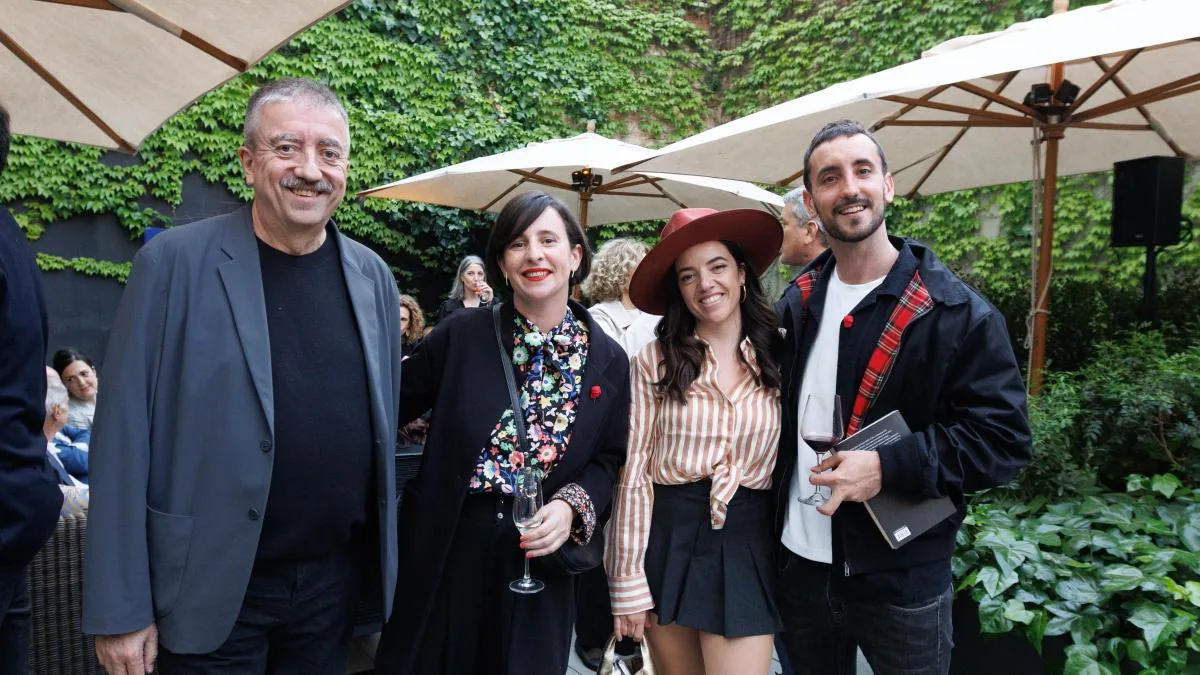
What is literature made of? Of emotions, structures, actions, ideas…, yes, of course, but above all, as you know, of words. One after another, they line up and mix first in the author’s mind and then in the reader’s. And if there’s a literary party, its soul is those who have chosen certain words and not others, and yesterday at the Alma hotel there were plenty.
Read more Illa: “Catalunya is living today the time of solutions”
If there is a writer who masters and showcases the value of lexicon both internally, in books, and externally, in articles, radio, and television, it is Màrius Serra. At the beginning of the party, Serra looks for Cristina Fernández Cubas to thank her for a word he has learned: contumelia , an “opprobrium, insult or offense said to someone’s face,” that is, “telling someone something you know will offend them.” If there was any during the evening, we don’t know, but there is, however, contumacy, not in the sense of rebellion but of tenacity: one word after another, until many books are made.
Fernández Cubas and Fernando Aramburu explain that the grace of a celebration like this is precisely meeting peacefully before the whirlwind of this Diada. They agree that sometimes on Sant Jordi you meet someone who tells you their life, but for the better: because the book has helped them. Aramburu also specifies that “luckily, the music here is not very booming and allows for conversation.”
Emma Lira, the brand new winner of the Edhasa Historical Narratives prize, is excited waiting for her readers; a couple of years ago she came to Barcelona for Sant Jordi as a visitor and was impressed, but this is the first time she will be there as an author. The same goes for Natalia Moreno, but the Aragonese writer, a debutant, has never been before and the anticipation has her marveling. Beside her, Ricard Ruiz Garzón does not stop expressing joy: he has left his other jobs and has been dedicated solely to writing literature for a few months.
I want to talk about the catering, very good; lately there has been a generalized decline”
“I’m walking David Uclés’s octopus,” says, a little further on, Regina Rodríguez Sirvent, holding the plate of octopus from the writer from Úbeda, with whom she has been chatting for a while. Melcior Comes jokes and assures that he thought about swapping their hats. Spoiler: he doesn’t.
David Trueba says he doesn’t have much to explain… “well, yes, I want to talk about the catering, which is very good, and it must be said, because lately I’ve found a generalized decline in other places, while tonight’s must be said to have been very good.”
“I’m an easy woman: my hairdresser suggested I cut my tail and I let him”
Gemma Ruiz Palà has just arrived from Bilbao and has had a meeting with reading clubs, but before that she had been on tour in Italy – she announces that her first novel, Argelagues , will be translated there – and suddenly this Wednesday morning she realized that it’s already Sant Jordi! Luckily she realized in time.
Agnès Marquès notices the difference from when she debuted four years ago, especially having won the Ramon Llull prize: “I’ve traveled a lot through Catalonia, and it’s impressive how many people move in towns and cities to organize events.”
“I’m an easy woman,” says a smiling Antònia Carré-Pons: “the hairdresser suggested I cut my violet tail and I let him.”
Read more Welcome to the Sant Jordi of pollen, with a new literary axis and not without controversy