Felix Gonzalez-Torres -without accents and with a hyphen to join his two surnames into one- was a child when, in 1971, he was in Madrid for the first time, arriving from Cuba, sent by his family to keep him away from the Castro regime. Twenty years later, in 1991, he returned and consummated a “sweet revenge,” it is not known against what or whom, which now, more than three decades later, is echoed by the Museo Nacional Centro de Arte Reina Sofía.
Read more The BBVA board meets in Barcelona with Catalonia and AI among its focuses
The enigmatic phrase with which the artist evoked his first stay in the Spanish capital upon his return, just five years before his premature death due to AIDS, serves as a conceptual framework for the first large-scale exhibition of his work in Madrid – there was a retrospective at the Macba four years ago – curated by the Uruguayan Alejandro Cesarco and the American Nancy Spector and which can be seen from this Wednesday, May 27 until next October 12.
In this way, Madrid settles its “debt” with the artist, born in Cuba in 1957 and died in the United States in 1996, announced Manuel Segade, director of the Reina Sofía, at the presentation of Felix Gonzalez-Torres: Sweet Revenge, an exhibition in which the “apparent lightness” of the Cuban-American’s works contrasts with the “enormous influence” of his work on generations after his own.
Felix Gonzalez-Torres became a U.S. citizen at a time when multiculturalism was the dominant currency in the art world, the curators responded to the surprise that today, when identity markers have come to the forefront, his renunciation of the linguistic signs denoting his Hispanicity to universalize them in English from his move to New York might cause.
And in some way this paradoxical character of his biography also runs through his artistic production, in which the intimate and the public, the elegy and the celebration coexist, Alejandro Cesarco reflected before the press when talking about the “productive tension” that characterizes Felix Gonzalez-Torres’s artistic production.
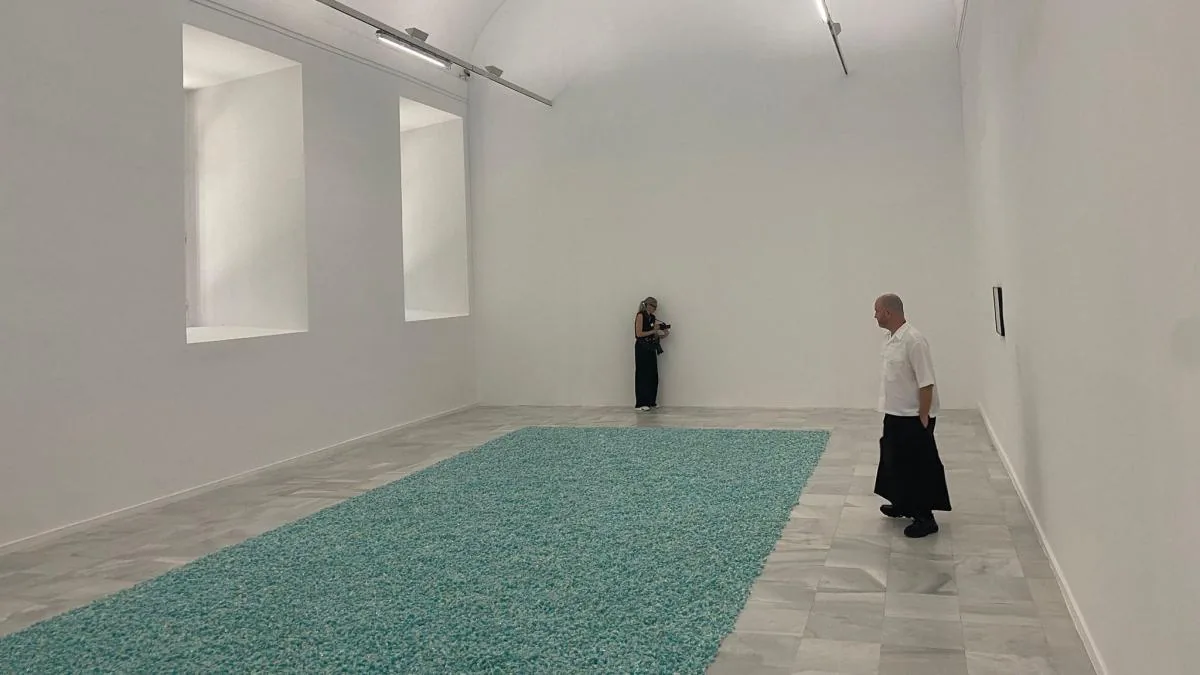
His work, limited to the last two decades of the 20th century, is a child of its time, that of the AIDS crisis and the rise of Ronald Reagan’s neoliberal conservatism, and has a marked conceptual character. The artist intends to disappear behind his work and leaves the spotlight to the visitor, who transforms it to the point of being able to take the candies that form some of the installations (it is an exhibition, therefore, perfect to visit with children) or the large sheets of paper stacked in the form of a column.
Read more Loewe signs the travel suits for the Spanish football teams
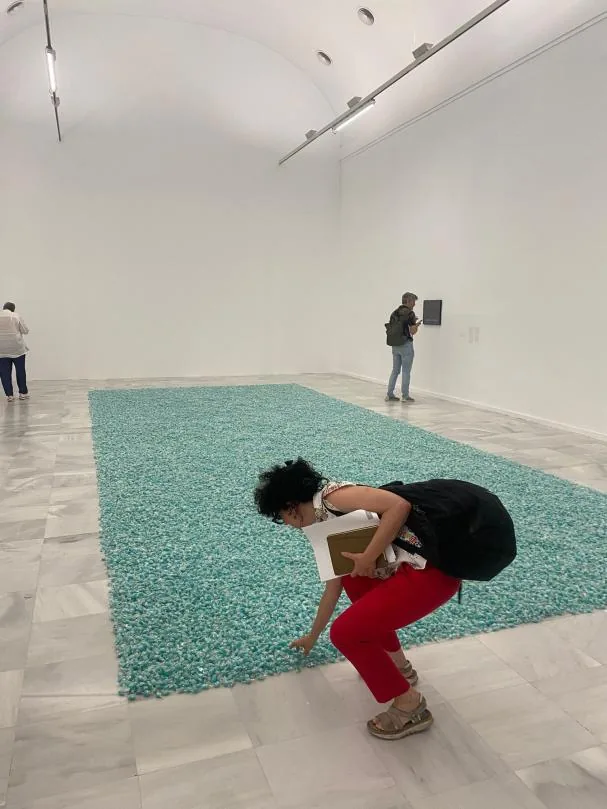
But that subtlety of sweets wrapped in transparent paper whose intense blue seems to resemble a pool is nothing more than a way to encourage critical reflection. Their supply is inexhaustible and in each exhibition a supplier is sought to provide them throughout the time and to manufacture them in series. “People are given something in exchange for assuming a responsibility, that of taking a part of the museum outside,” the curator analyzes about the breaking of the artist’s “fixed conditions.”
A gay and HIV-positive man who died before turning forty in the nineties, Felix Gonzalez-Torres did not avoid reflection on mourning and loss in his work – his partner, Ross Laylock, died in 1991 – but he did so without despair and by blurring himself in a strategy of “infiltration” that allowed him to operate within institutions, through abstraction, to represent queer love. Something that would be especially revolutionary today, Cesarco argued, in a world “saturated with visibility.”
Ultimately, the exhibition Sweet Revenge, which requires the active participation of the receiver and questions notions of authorship and permanence, represents for the Reina, a museum crossed since its very creation, forty years ago now, by “democracy, collective memory, political trauma, and resistance,” the possibility of “inhabiting contradiction instead of resolving it,” the curator asserted.
The other curator of the exhibition, Nancy Spector, insisted on the intersection between the concepts of exile and displacement as axes of the exhibition and contrasted them with their “reverses” of dream and travel through the “idea of return” proposed by Sweet Revenge, an “eternal return,” in this case round trip to Madrid, which does not exhaust the “multiple interpretations” of an artistic project like that of Felix Gonzalez-Torres.
“His work is a Trojan horse in which beauty has a subversive content and the political and the personal intermingle. You cannot separate the biography of Felix Gonzalez-Torres, whose work is deliberately unstable, from the social critique it poses. He defended that there is no private space against the public, that aesthetics itself is political and is reflected in the values embedded in the ideology of power,” Spector concluded.
Read more Haakon of Norway, concerned about Mette-Marit: “She is sick and her condition has worsened”