







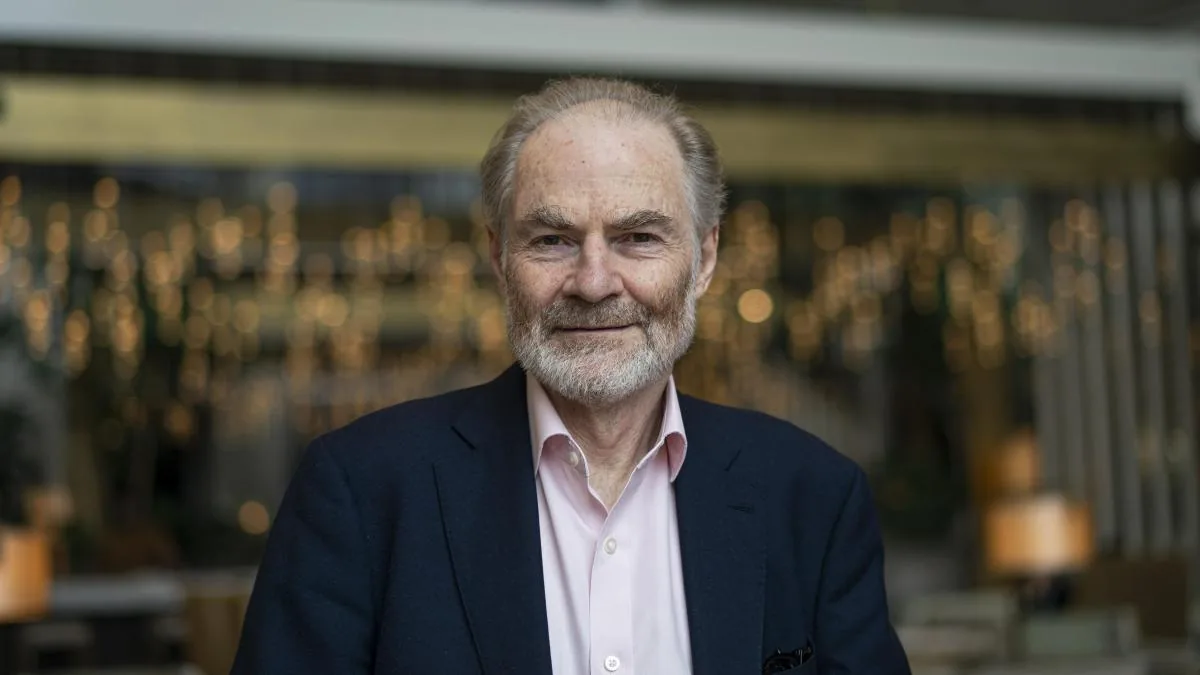
Timothy Garton Ash (London, 1955) has documented live the European history of the last four decades from his dual role as historian and journalist. Professor of European Studies at the University of Oxford, he has outlined in his books a history of the European present that he has compiled in books such as Freedom of Speech, Facts are Subversive or his own History of the Present, all published by Tusquets. A representative of the old enlightened liberalism, he studied Modern History at Oxford, where he became interested in the German resistance to Hitler, which led him to live in Berlin and to gain an in-depth knowledge of the countries of the former Eastern Europe. Precisely in his book The Magic Lantern (Taurus) he narrates the moment when Eastern Europe on the other side of the Berlin Wall began to falter, a moment he experienced firsthand, including the first free elections in Poland.
Read more The collision of a train with a school bus in Belgium causes four fatalities
Although perhaps his most personal book is Europe (Taurus/Arcàdia), published in 2023, in which he mixes the history of the old continent over the last four decades with his personal experiences, from his encounters with people from towns that have changed their names and countries repeatedly in Eastern Europe, to a conversation with Putin in 1994 that shows his post-imperial ambitions were already early.
Also read
On the occasion of an interview given for this book to La Vanguardia – the newspaper that awarded him its Journalism prize in 2025 – Garton Ash reviewed the shift that the continent’s history has undergone in recent years. “The nineties and the beginning of the millennium were one of the most hopeful periods in all of European history and one of the things that has led us to the cascade of crises we have experienced since 2008 is that we deceived ourselves into believing that things would continue to go our way, that history would continue to follow our path. Part of what has happened in these years is reversible. The world around us has changed. And instead of a world following Europe to become an example of multilateralism and postnational multilevel governance, we are competing with great powers, China, Russia, the U.S., Turkey, Brazil, India, South Africa. And they behave more like the great powers or European empires of the 19th century than those of the late 20th century.”
“Europe convinced itself that history was on our side, we became complacent, lazy, we neglected the other half of our own societies”
And he reflected that “it is a more dangerous world and Europeans do no favors to themselves by closing their eyes to it and maintaining illusory thoughts, Europe has already had too much wishful thinking. We must recognize that this is the world we are in and adapt.”
Also read
Garton Ash believes that the great problem of the West in recent decades has been arrogance. “Specifically, pride. We convinced ourselves that history was on our side, we became complacent, lazy, we neglected the other half of our own societies. Throughout Europe. Economic freedom is an indispensable component of freedom. We need it. But a liberalism reduced to only one dimension, economic liberalism, without political, cultural, and social liberalism, is not liberalism at all. And that is what happened in the nineties and early millennium, free markets were going to do everything, and for that mistake we are now paying a very high price.”
Read more Llorca and Vox reach an agreement to present the budgets and include the ‘national priority’
And he emphasized that “my version of liberalism, like that of Dworkin, Rawls or Ralf Dahrendorf, was always an egalitarian liberalism. We believed you need a significant level of equality to enable individual freedom, what Dahrendorf called the common ground: everyone must have education, healthcare, housing, opportunities in the labor market. That is what we lost in the nineties and two thousands and populism came and said: we see you, we hear you, we are going to do the things you need. So part of making populism recede is addressing the social needs of the other half of our societies.
“Trump connects with the frustration of being ignored and not respected, with that accumulated anger”
Already at that time, 2023, his analytical instinct led him to predict the electoral outcome in the U.S.. “I am worried about U.S. democracy. If you put a gun to my head and ask me who will be the next president of the U.S., I will tell you Trump. And it will be a disaster for the U.S., a catastrophe for Ukraine, a great challenge for Europe…”. Prophetic words when it still seemed that Trump could not be re-elected after the Capitol was taken by his supporters. “I can understand that some people like his policies, but how can they vote for such an absolutely and incomprehensibly unpleasant human being? He connects with the frustration of being ignored and not respected, with that accumulated anger that makes them, despite everything, ready to vote for him rather than allow the liberal elites to take over,” he reflected.
And he concluded his book Europe with optimism, addressing the feeling of decline in the old continent and the echoes of The World of Yesterday by Stefan Zweig. “Many people today talk about The World of Yesterday by Zweig. I strongly feel that we need to avoid its fatalism. It was written when Europe was in flames and its despair led him to suicide. Much of what we have achieved in Europe since 1945 is still in place, battered, threatened, but there. There is a lot to defend. The combination we need is pessimism of the intellect and optimism of the will. Intellectual pessimism to recognize the depth of the problems we have, we must analyze how to help Ukraine win the war, address the issue of mass immigration, help resolve the war between Israel and Hamas, regain the other half of our own societies, but we must also have the optimism of the will to believe that it is possible.”
The jury of the 2026 Princess of Asturias Award for Social Sciences was chaired by Emilio Lamo de Espinosa, with Jaime Pérez Renovales as secretary and composed of Marta Elvira Rojo, Jorge Freire, Teresa Freixes, Javier Garciadiego, Pablo Hernández de Cos, Silvia Iranzo, Ricardo Martí Fluxá, Manuel Menéndez, Sir Robin Niblett, Leandro Prados de la Escosura, María Dolores Puga, Valerio Rocco Lozano, Fernando Vallespín and Astrid Wagner.
Read more The Congress expels Vito Quiles for three months due to irregular recordings and altercations