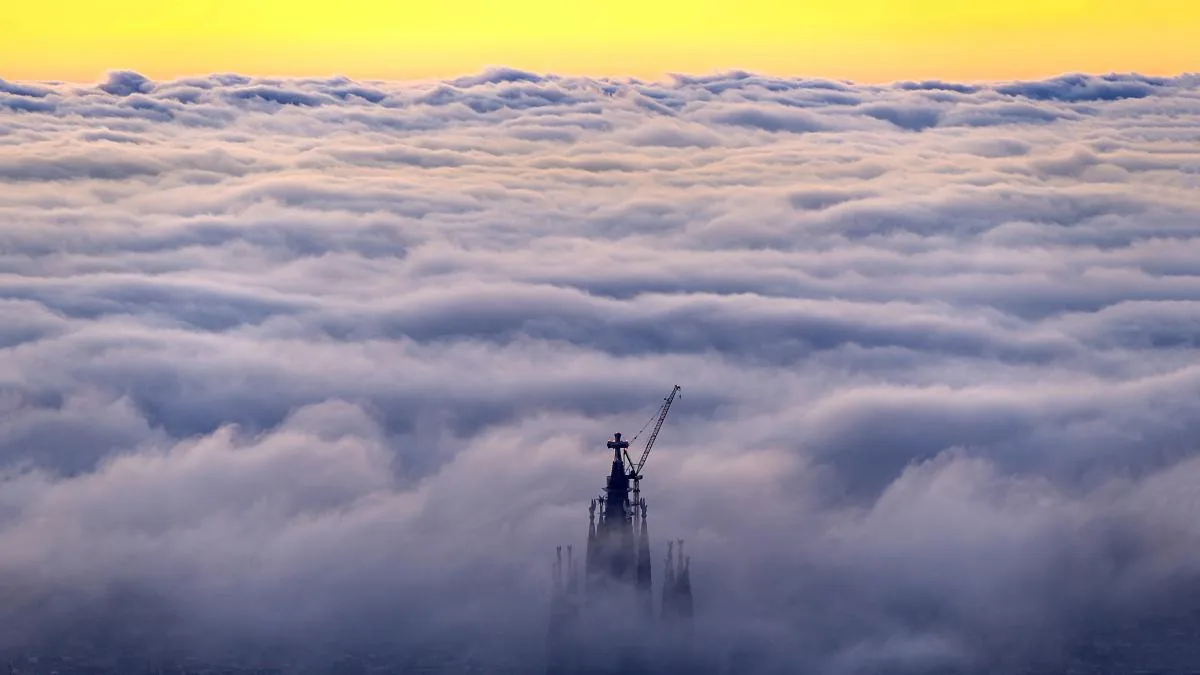
Days ago, in a talk about city and tourism at the CCCB, the issue of the Sagrada Família arose, and the long shadow it is beginning to cast over Barcelona. The room where the event was held is known as the Mirador, located at the highest part of the complex, but with very flattened windows overlooking the city.
Read more A fire broke out on Montjuïc mountain, forcing the evacuation of the castle
One of those present wanted to test it and asked if the temple could also be seen from there. And it seemed not. “Surely some of those ski lifts, or an elevator cabin, are covering it,” someone said. Until someone pointed: “There!” Indeed, in the middle of a forest of buildings, the cross that has crowned the basilica for a few weeks now proudly hinted itself.
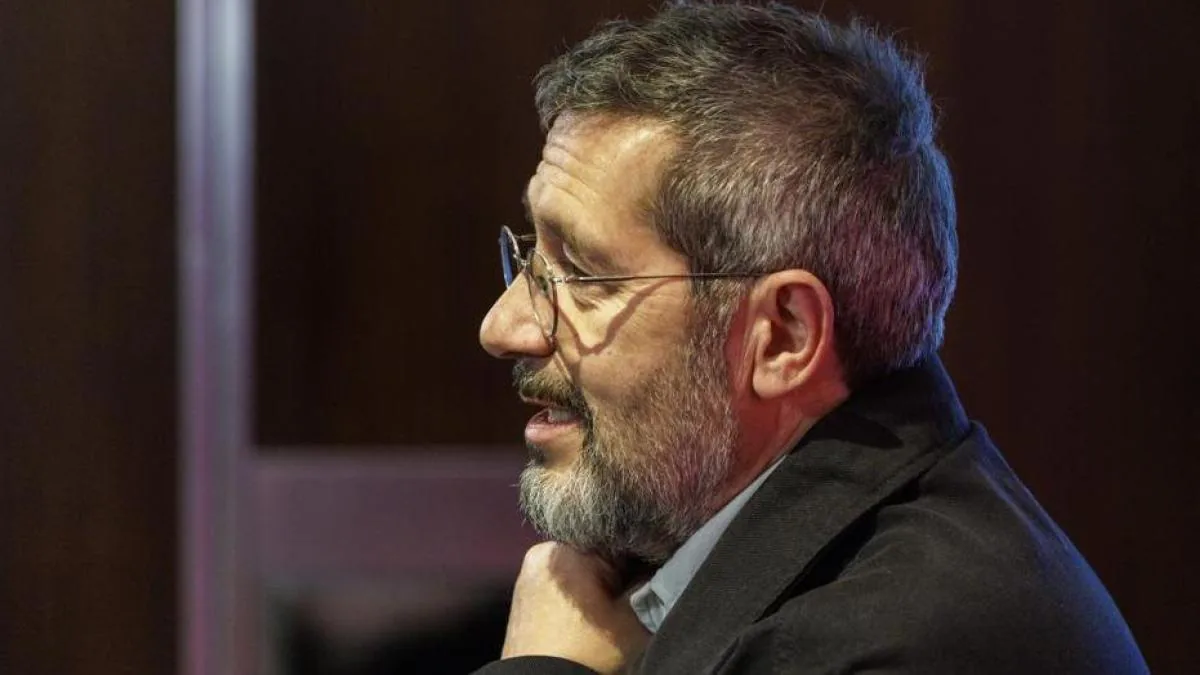
The talk was led by the geographer and art historian José Antonio Donaire, who since last summer has been Barcelona’s Commissioner for Sustainable Tourism. Donaire faces a complex challenge: to put limits on a certain type of tourism, the most destabilizing, without this economic activity reducing its significant contribution to the city’s GDP. He is certainly qualified to take on the challenge.
Donaire, among other contributions, is the author of a book that offers very suggestive reflections for designing policies in pursuit of respectful tourism. It is titled Cultural Tourism. Between Experience and Ritual , was published in 2012 by Edicions Vitel·la and deserves a re-edition.
What can we learn from Venice regarding the basilica’s effect on Barcelona’s tourism?
Because focusing on cultural tourism, as Barcelona Turisme has been doing for a few months now, is a way to redirect the enormous flow of visitors received by the Catalan capital towards a more satisfactory experience, both for locals and foreigners.
In this context, one of the initiatives Donaire is working on is inviting private operators to apply restrictive measures similar to those imposed in public spaces, such as the visitor limit at Park Güell. One of these monuments would, obviously, be the Sagrada Família, whose managers are to be convinced to reduce its capacity. The result would be a decrease in the impact on the neighborhood and, incidentally, an improvement in the quality of the visit.
Read more The left in search of a new manual
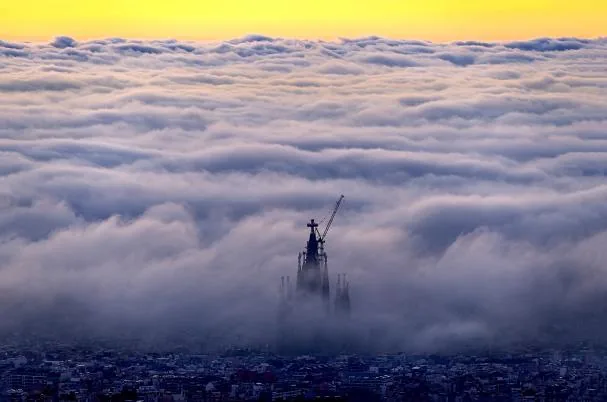
The talk also raised questions that are already circulating around the city and that can be summarized in a single question with an improbable answer: Is Barcelona prepared for the emergence at its epicenter of such a powerful icon, with such a capacity for attraction and susceptible to eclipsing the rest of the city’s cultural symbols?
Read also
It is paradoxical that visiting the Sagrada Família can be considered a practice of cultural tourism, but, at the same time, a fast look variant, (quick glance), a simile of fast food that Donaire uses to refer to the ultra-fast visit that, many times, has the mission of posting on social networks the post that “all your friends expect you to post when you travel to Barcelona.”
In 10, 20 or 30 years, studies with titles similar to The Impact of the Sagrada Família’s Completion on Barcelona’s Symbolic Narrative will be published. Now we can only speculate. If we make the exercise of discarding the obvious negative effects, perhaps exciting ideas can emerge. Who knows. Perhaps the relaunch of the temple as a global icon, which will be officiated this June with the visit of Pope Leo XIV, will serve to activate other symbolic potentialities by reaction and thus elevate the city’s cultural tone.
Or perhaps the beneficial St. Mark’s-Rialto effect of Venice can be achieved, a city much less affected by tourism than is often said. An effect that could be summarized as concentrating tourism in a specific area to decongest the rest. You can try it. Travel to Venice in high season, avoid the iconic square at all costs (until eight at night, when the cruise passengers leave), the famous bridge and the area around the Accademia, and enjoy the north of Cannaregio, Castello, Dorsoduro, a large part of the Salute neighborhood or Giudecca without stress.
Read more Illa takes President Sheinbaum to visit the Barcelona Supercomputing Center