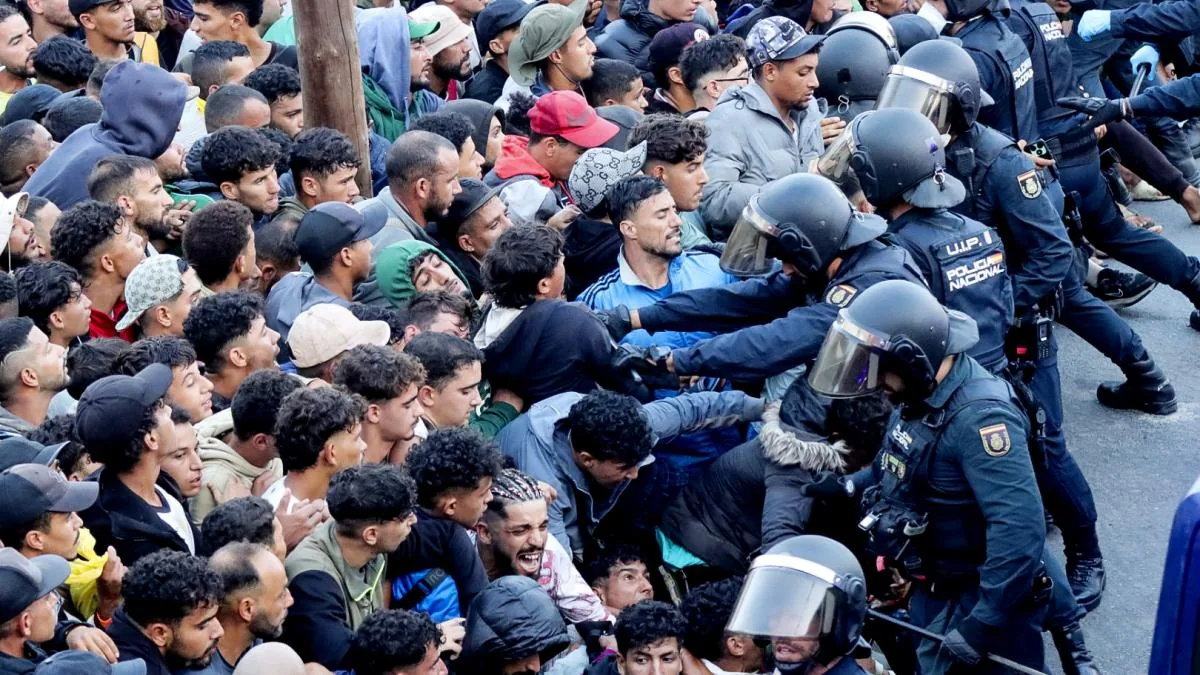
Fifteen years ago, the American essayist Robert D. Kaplan warned about the revenge of geography. The physical framework of the world was gaining more importance with digital globalization. We just saw it in Ceuta.
Read more Start of the political course: from the fatigue of Ceuta to the return of Puigdemont
Ceuta will one day appear in a book by Robert D. Kaplan, the man who fifteen years ago warned us about an imminent revenge of geography. In fact, without being explicitly mentioned, the Spanish city that watches over the Strait of Gibraltar from the south already peeks its head in his latest book, Wasteland (2025), a title inspired by a poem by T.S. Elliot about the desolation of the world after the First World War. In his allegory about the “global Weimar” we are living through, Kaplan, an intelligent conservative, classic republican, a realist school carved in marble, warns that any local conflict can become a conflict of general scope in a matter of minutes, depending on its reverberation in the digital mesh that surrounds us. This is what happened this summer with Ceuta.
“Look at Ceuta, this is what will happen to us if the Democrats win again in the United States,” said, with lightning speed, Elon Musk, the richest man in the world, once again putting himself at the service of Donald Trump, who faces the midterm elections burdened by the fiasco in Iran, and that is why he announced yesterday that the United States is going to make a fortune with Venezuelan oil.
Local crisis, global scope conflict. Sometimes one word is enough. “Invasion.” The Russian regime also very quickly activated its army of bots, as documented by the Ukrainian Ministry of Foreign Affairs, which constantly monitors Russian digital networks.
The president of the European People’s Party, Manfred Weber, also did not waste time. On the night of July 30, Weber was already blaming the Spanish government for what was happening in Ceuta. The Italian Prime Minister Giorgia Meloni, also on early alert, was already proposing to exclude Spain from the Schengen Agreement, while in Madrid the exact magnitude of what had happened was still unknown. Ursula von der Leyen remained silent. The President of the European Commission let some things happen and did not react in favor of Spain until a few days later. The president of the EPP, a Bavarian conservative, whom we could not call a friend of Von der Leyen, nor of Pedro Sánchez, nor of Emmanuel Macron, made no reference to Schengen, but paved the way for the letter signed on August 1 by 22 European Union countries, accusing Spain of encouraging a “call effect” with its recent regularization of immigrants. That letter, which only France, Portugal, Ireland, and Luxembourg refused to sign, is the hardest blow Sánchez has received in European politics, his main strong point for years. Victory for the Spanish PP on the European board.

France and Portugal are countries bordering Spain and would be the main victims of a migratory overflow. The attitude adopted by Macron and by the Portuguese Prime Minister Luís Montenegro, a member of the European People’s Party, has significant political value. On August 1, the French and Portuguese leaders did not want to stab their neighbor in difficulties. The Danish social democrat Mette Frederiksen, on the contrary, did not hesitate. She detests Sánchez and wants European social-democratic leadership to return to Scandinavia. Attention to the legislative elections in Sweden on September 13, while we await the result of the referendum in Iceland on opening negotiations to join the EU, whose count is very close.
Ceuta changes the framework, the crisis will last long and ties Spain to the international sway
We return to the south. We return to the border between Europe and Africa. The escalation was lightning fast. In less than 48 hours, Gibraltar entered the list of critical points on the planet, a catalog today headed by the Straits of Hormuz and Bab el-Mandeb. Kaplan’s warning was fulfilled: in the global Weimar, any local crisis can become general if it connects with the neuralgic points of the mesh. With extraordinary speed, Ceuta became part of the propaganda arsenal of the struggling MAGA movement and a propaganda resource of the Russian FSB. Ceuta pushed the nervous Italian government to show what Europe will be like the day the far right wins in Germany and governs France: a hysterical and ill-matched condominium with constant reprisals between neighbors, a vulgar version of Europe before the Great War, while new and not so new areas of influence are rebuilt. Gripped by fear of a war with Morocco, Spain could end up tutored by the viceroyalty of Miami.
Read more The CIA director’s visit to Moscow sparks speculation about a Russian attack on NATO
In the Ceuta episode of 2021, things went differently. It was clear who pulled the strings of the invasion of the 10,000 between May 17 and 18 of that year. It was moved by the Moroccan government, with the undeniable purpose of changing Spain’s position on Western Sahara. The United States then took a back seat. Secretary of State Antony Blinken, a refined Democrat educated in Paris, limited himself to saying that what happened in Ceuta should be solved by Spaniards and Moroccans. The combative Manfred Weber then sided with the Spanish government, and the European Parliament approved a resolution very critical of Morocco.
Also read
Sánchez, however, got the message. He handed over the head of the Minister of Foreign Affairs, Arancha González Laya, changed the policy on the Sahara – without Podemos leaving the government – and accepted the expansion of the Rota military base, which the United States government had been requesting. The NATO summit held in Madrid in June 2022 was a great scenic success, to the point that Alberto Núñez Feijóo, newly arrived in Madrid, congratulated the government. Oops! The hangover from the Ukraine war had not yet arrived, nor had Trump returned to power.
Now we are in the global Weimar. Ceuta 2026 changes axes. It changes the framework and ignites passions. These days there are cacophonies of the Barranco del Lobo, the 1909 drama that ended the Restoration parties, inflamed the reservists of Barcelona, and changed the course of Spanish history. The tranquility for Ceuta and Melilla is over. The stress of both cities will last long and will be Spain’s stress.
Macron may soon visit Spain, if the blockage of the friendship treaty with France is resolved
The course begins that could be the tomb of President Sánchez. The domestic political struggle will be tough, thick, and deafening, but the game will be decided more abroad than inside. The US midterm elections, the elections in Israel, the elections in Morocco, and the long and intense European electoral cycle 2026-2027, which begins next Sunday in the German federal state of Saxony-Anhalt, in the former GDR, will mark the course.
The course begins and a prompt visit to Spain by French President Macron could take place. French diplomatic sources admit such a possibility. Everything depends on what the Constitutional Court decides soon about the Spain-France friendship treaty, which the Spanish right refuses to ratify. A thrilling course begins.
Read more Ceuta, facing the fear of breaking apart