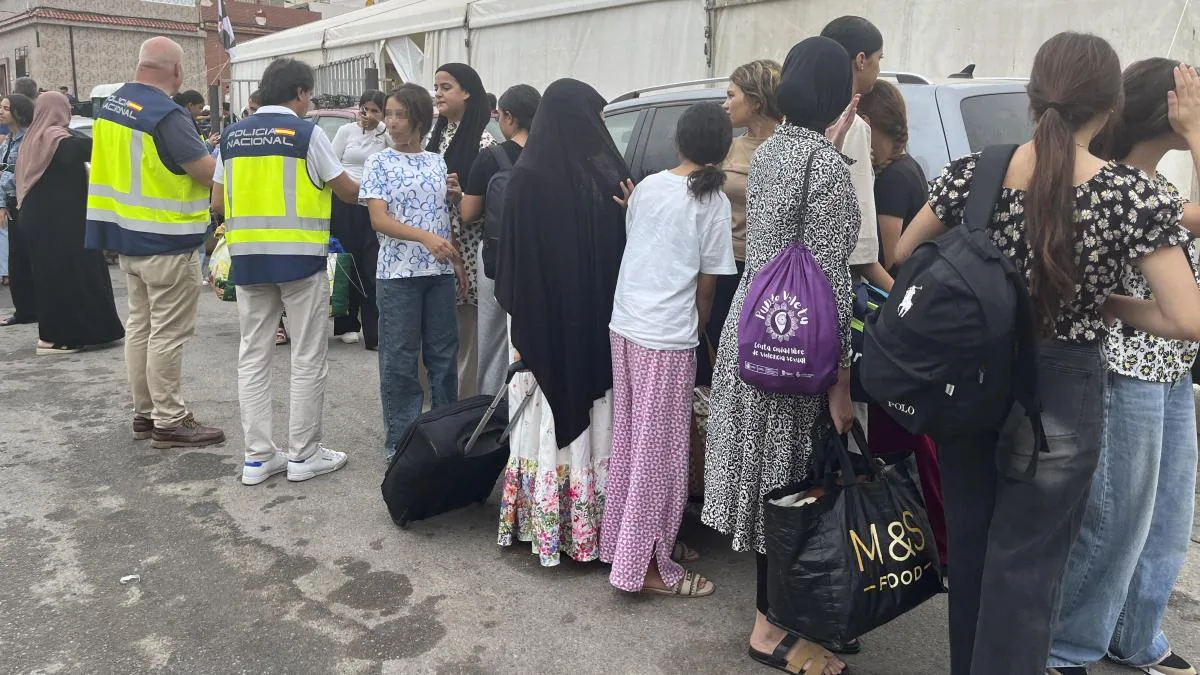
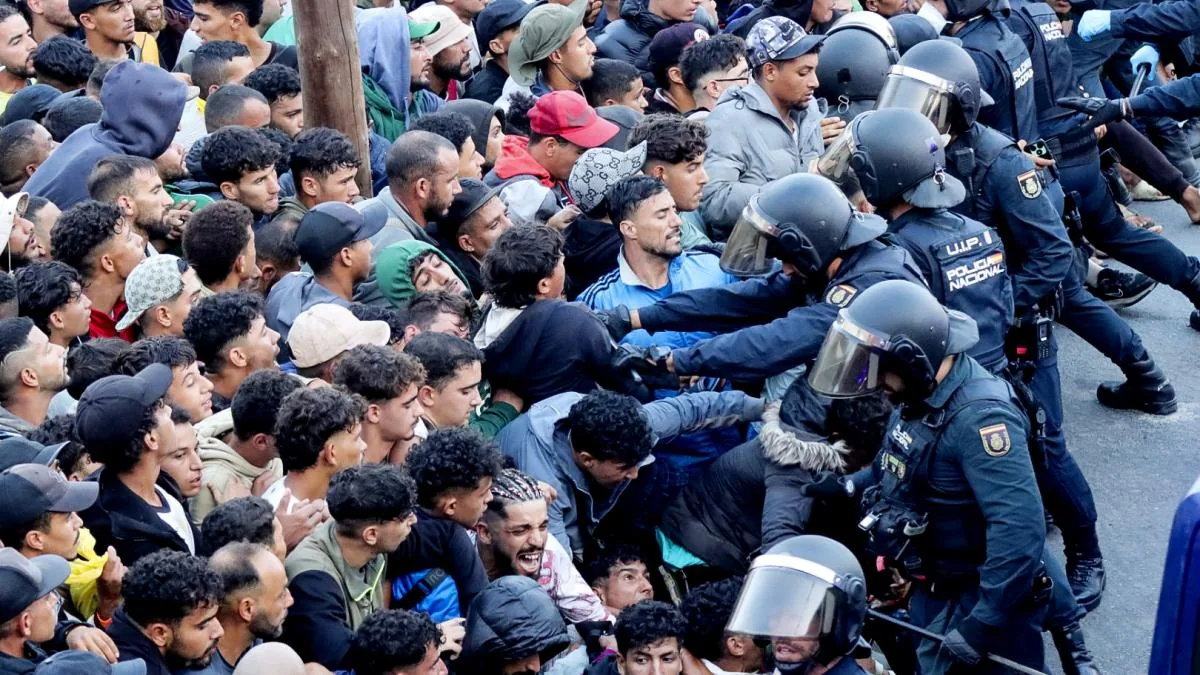
“That summer of ’26.” It is very likely that in a few years the summer of 2026 will be remembered for two extreme events: the human avalanche in Ceuta, with 150 people dead, most of them drowned while trying to reach the coast, on July 30 and 31, and the gigantic flood in Nepal on August 26, as a consequence of the massive collapse of a glacier, which has caused more than a thousand missing persons. In both cases, the images are impressive, terrible. We live in times of extreme events whose fury is measured by the impact of video clips spread through social networks.
Read more Spain asks Frontex for help to speed up the return of migrants
The avalanche in Ceuta has left the Spanish government on the ropes, has definitively added the Strait of Gibraltar to the list of straits and channels in critical condition worldwide — almost all of them at this moment —; has issued a serious warning that there will be no peace for the cities of Ceuta and Melilla in the next twenty-five years, has very likely changed the axes of Spanish politics, has revealed the obscene weakness of European solidarity, and has once again made clear that one of the strategic objectives of the current United States government is the structural weakening of the European Union, as explained, without euphemisms, in the new National Security doctrine publicly released at the end of last year.
Also read
The brutal flood in Nepal speaks to us about global warming and may represent a tremendous blow to the influx of tourists to a high mountain country where a year ago the government was overthrown by a youth rebellion against corruption. The trigger for that revolt was the government’s attempt to restrict access to social networks amid growing protests.
At that time, much was said about the outbreak of Generation Z (young people born between the late 1990s and 2010) in various countries around the world, convened through social networks. These outbreaks have had varying intensity in several parts of Africa, Asia, and Latin America. In the past year, there have been vibrant protests by Generation Z in Nepal, Morocco, Madagascar, Peru, Indonesia, and India. On the African island of Madagascar, for example, young people took to the streets against extreme poverty and corruption and forced a government restructuring after a military pronouncement. In India, three months ago, they forced the resignation of the Minister of Education amid evidence of cheating and favoritism in entrance exams for the highly sought-after Medicine degree.
The Strait of Gibraltar joins the list of channels and straits worldwide in critical condition
Protests by Generation Z in Morocco? Yes. It happened a year ago, in September 2025, under the slogan “We want hospitals, not just stadiums!” Thousands of young people criticized the government for allocating more than 5 billion dollars to build and remodel stadiums for the African Cup of Nations and the 2030 World Cup (co-hosted with Spain and Portugal), while there are serious deficits in basic services and youth unemployment is 37%. The protest was coordinated through a Discord server called GenZ 212 (after the country’s phone prefix), which quickly grew from a few members to gathering more than 200,000 young people. Although the protests began peacefully, attempts by the Moroccan police to disperse the marches caused severe riots. There were vehicle burnings, stone throwing, and clashes in more than 15 cities, including Rabat, Casablanca, Tangier, and Agadir. Three dead and hundreds injured, among protesters and police. One thousand four hundred young people prosecuted.
They were stopped. A year later, thousands of young people from that same generation tried to swim to Ceuta, mobilized by accounts on Facebook and TikTok, activated after the Administrative Litigation Chamber of the Spanish Supreme Court annulled the ‘hot returns’ in Ceuta (‘border rejection’ in legal terms), as there are no physical containment structures in the sea. The rapporteur of that ruling, which initially went almost unnoticed in Spain, was magistrate Carlos Lesmes, former president of the General Council of the Judiciary and a prominent figure of the most conservative sector of the Spanish judiciary.
“You can swim to Ceuta without risk of expulsion!” That was the call that began circulating on social networks and reached a true paroxysm between July 30 and 31, with the consequences known to all. What link exists between the youth protests of September 2025 and the massive escape attempt of July 2026, in which a large number of girls participated? Has the frustration over the repression of those protests fueled the events of July? That trail should be followed.
Also read
Who pulled the strings? That question still has no answer, a certain, irrefutable answer shared by all. The Spanish government talks about mafias dedicated to human trafficking. A good number of Spanish press columnists generically accuse Morocco. Ignacio Cembrero, the Spanish journalist probably best informed about the inner workings of Moroccan politics, points to the possible intervention of the secret services, directed directly from the court (the famous Majzen), outside the Moroccan government, headed by businessman Aziz Ajanuch, who may have been surprised and overwhelmed by the magnitude of the mobilization while the country celebrated the Throne Festival. While King Mohamed VI exalted Morocco’s modernization in his speech, thousands of disillusioned young people traveled north to try to swim to Ceuta, under the promise that it was possible by virtue of a recent Spanish court ruling. It is worth remembering that legislative elections will be held in Morocco on September 23 and that Ajanuch’s continuity at the head of the Executive is becoming unlikely. The events in Ceuta, therefore, took place in a context of power struggle in a country where it is not easy to know what happens inside the Majzen. On the horizon, the succession of Mohamed VI and the arrival on the throne of his son Mulay Hasán. Another source of tensions. Another conspiratorial framework.
Who pulled the strings? The answer to this question is key for a correct political diagnosis of the Ceuta crisis. If the Moroccan government pulled them, we would be facing a serious betrayal of Spain, whose government believed it had reached a new balance point with Rabat after recognizing in 2021 Moroccan sovereignty over Western Sahara if it is articulated through a formula of autonomy supervised by the United Nations.
If the Moroccan government pulled the strings, it would be a very serious failure of the government of Pedro Sánchez and his Foreign Minister, José Manuel Albares. The Spanish Executive exonerates the Moroccan government again and again. “They knew nothing,” official sources reiterate. “They did not act more forcefully at the border because they could have caused a massacre,” they add.
Read more Spain asks the EU for Frontex support for the triage of migrants remaining in Ceuta
Who pulled the strings? Who activated social networks after reading the ‘Lesmes ruling,’ or being warned of it? Who decided it was time to reactivate Moroccan Generation Z to provoke a major international crisis in the city that presides over the southern shore of the Strait of Gibraltar? That is the question that still today, a month after the human avalanche, has no answer. Neither do those who call for a tougher stance by Spain against Morocco. This demand is now supported by very diverse people, less so by the two right-wing leaders, Alberto Núñez Feijóo and Santiago Abascal. The prudence of Feijóo and Abascal towards Rabat is significant. A strong anti-Moroccan atmosphere is being generated throughout Spain, but the leaders of the parties that could govern the country in coalition within a year are very careful not to explicitly adopt hostile attitudes towards the Moroccan regime, whose great protector remains the United States, now flanked by Israel.
Not everything is broad strokes these days in Spain: the leaders of PP and Vox also carefully avoid clashing with Morocco
Who pulled the strings? We know who had very good reflexes. Hours after the Ceuta crisis began, tech entrepreneur Elon Musk, owner of the X network, among many other companies, the richest man in the world, political agitator at very specific moments, posted a series of tweets on X, his own network, characterizing the events in Ceuta as a ‘savage invasion’ caused by the ‘weakness’ of the Spanish government.
His first message was supported by a video clip from the movie World War Z, in which part of the world’s population, infected by an unknown virus, turns into aggressive zombies who form human pyramids to assault fortified cities. Then came images of Ceuta from that same day and then images of Latin American immigrants trying to cross the border between Mexico and the United States. “This is what happened in Joe Biden’s times, this is what is now happening in Spain, and this is what could happen again in the United States if the Democrats return to power.”
Very quickly, with good reflexes, Musk’s team produced in record time a good spot for the campaign of the decisive midterm elections to be held on November 3 in the United States. “Invasion.” Invasion at the border between Africa and Europe. That was the message. This was also the massive message rebroadcast by Russian bots, quickly activated, according to a report prepared by the Ukrainian Ministry of Foreign Affairs, which constantly monitors Russian digital platforms.
That speed does not prove that US and Russian agents were the covert conveners of the Moroccan stampede. It only certifies that they had good reflexes and that the situation created suited them perfectly to fuel the Republican electoral campaign in the United States, to denounce the Spanish government, which was at odds with the Trump Administration, and to inflame European public opinion with the drama of immigration ahead of a decisive electoral cycle for the future of the EU, an electoral cycle that starts right now: regional elections in Germany, legislative elections in Sweden (September), legislative elections in Italy, Spain, and Poland throughout next year, and presidential elections in France between April and May 2027. Let us not lose sight of that framework. Midterm elections in the United States and electoral carousel in Europe.
The propaganda machinery of Trumpism and Putinism quickly realized that the events in Ceuta were prime ammunition. It does not prove that they were the promoters of the assault. It only proves that they knew how to see it.
The Spanish government was shocked and remains in shock a month later. Pedro Sánchez mistakenly believed the situation would deflate once Morocco agreed to immediately reabsorb those who had crossed the border by swimming. Almost all have returned to Morocco, except about five thousand immigrants who remain in Ceuta, the official government figure, which the opposition believes is much higher. Nine thousand people are talked about, with a large number of minors. There is no room for everyone. Outbreaks of violence are beginning to emerge. The city feels besieged. Surely that was also one of the objectives of the operation. Ceuta’s stress is today Spain’s stress. The Spanish political framework has changed, old passions have been unleashed, and Sánchez’s weakened government arrives in September on the ropes. The president will appear next week in Congress.
PP and Vox are flirting with a future electoral victory (the gain may be greater for Vox than for PP) and their leaders are very careful not to alienate the Moroccan government. Núñez Feijóo has already announced that if he reaches the presidency of the Government in 2027, his first foreign trip will be to Morocco. In this bitter hour, both leaders also do not want to upset the United States government, which has found in Ceuta a magnificent electoral spot.
Read more The Government increases the allocation for humanitarian aid in Ceuta to 44.5 million
We will remember the summer of ’26.