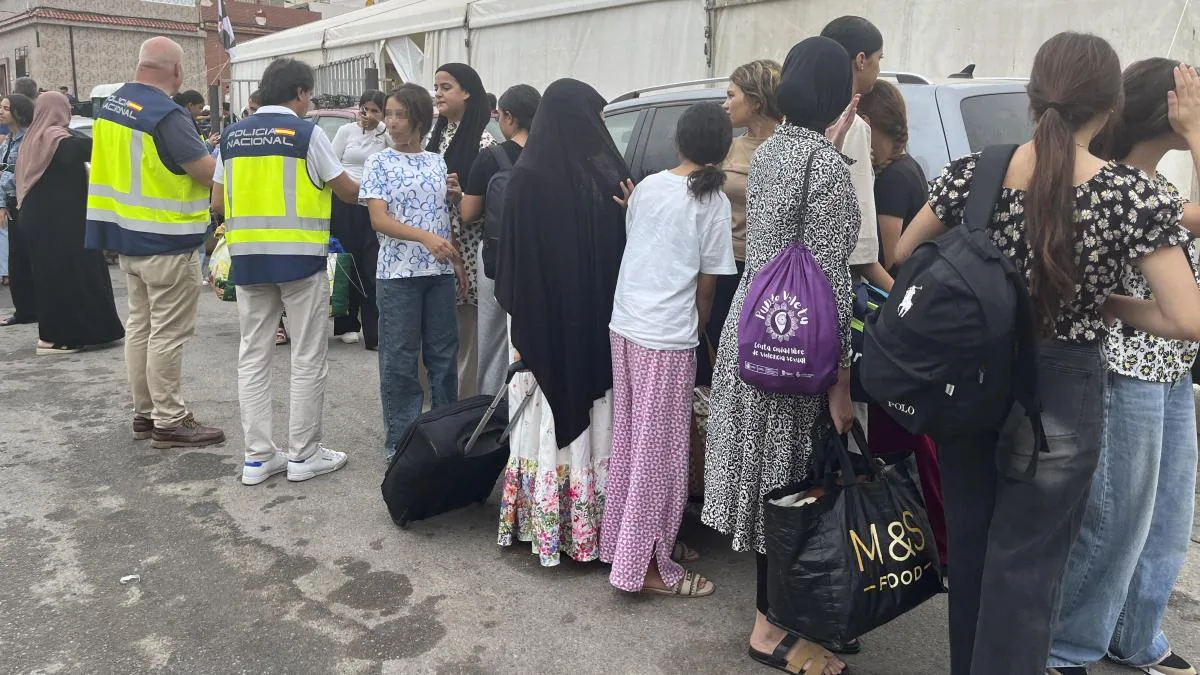
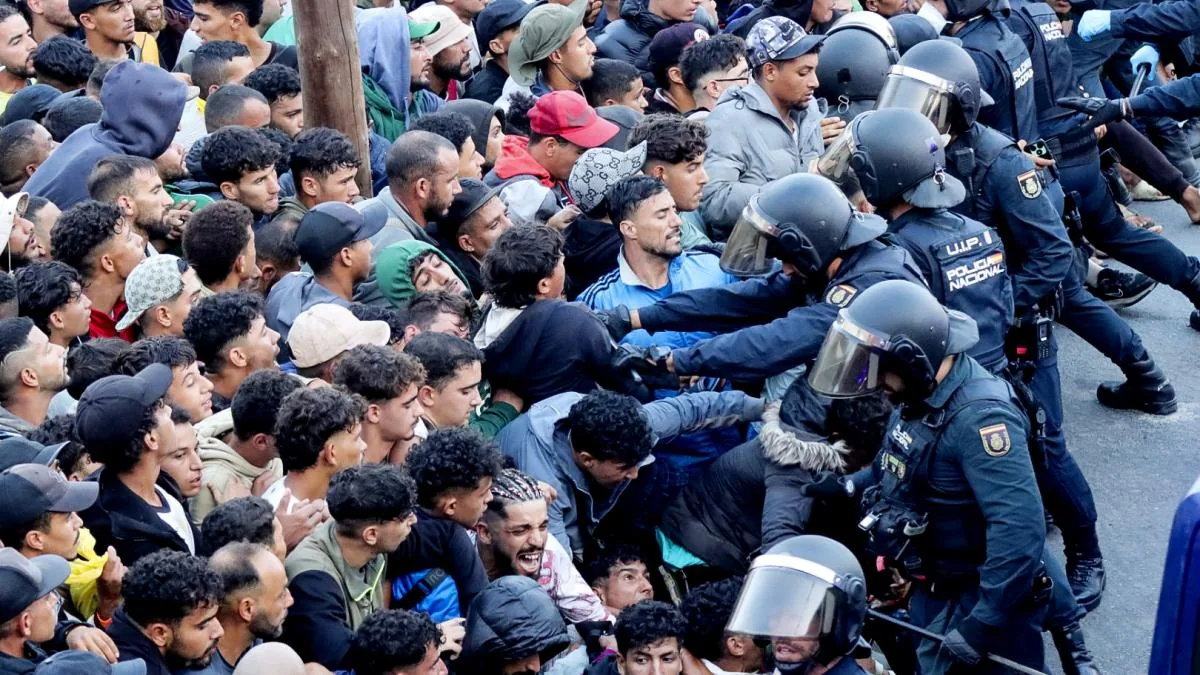
Two weeks after the massive entry that overflowed Ceuta, the border faces a new day under surveillance this Saturday. Morocco deployed an extraordinary device yesterday in response to calls on social networks to cross again from Fnideq (Castillejos). Thousands of agents and military personnel, road controls, patrols in the forests, and new barriers at sea are part of an operation aimed at preventing a repeat today of the entry of tens of thousands of people recorded on July 30.
Read more The Urban Guard arrests a suspect for the Collserola fire
Spain, for its part, has also reinforced its border device throughout the week. “A massive entry cannot happen again,” summarized the Minister of Equality, Ana Redondo, in an attempt to counter and discourage the calls to go to the border that have circulated in recent days on social networks. “The Ceuta border will be open on the 15th,” some of these messages indicate, coinciding with the holiday this Saturday in Spain.
Morocco multiplies controls from Tetouan to Fnideq and Spain reinforces its device
The Civil Guard monitors these calls in real time, although it is not yet confirmed who is behind them or how many people might respond to the call.
The Moroccan shielding begins far from the border. Since Thursday afternoon, the National Security, the Royal Gendarmerie, and the Auxiliary Forces have been setting up controls in Tetouan, Rincón, and Fnideq to prevent the movement of migrants towards Ceuta. On the road that connects Tangier with Fnideq, about 80 kilometers, controls have multiplied. About eight kilometers from Ceuta, riot police were checking vehicles late in the day looking for people trying to reach the border.
In Fnideq, meanwhile, dozens of empty buses usually used to transport migrants to cities in central and southern Morocco are piled up in a gas station converted into an open-air parking lot.
Pressure is also concentrated on the coast. The urban beach closest to Ceuta remains partially closed, protected by metal fences and Auxiliary Forces vehicles, while two large vessels of the Moroccan Royal Navy sail offshore. On the maritime front, the land fence has also been reinforced and a steel pillar structure has been installed that extends between five and ten meters into the sea, completed with barbed wire and metal nets to prevent migrants from swimming around the border breakwater. The wooded areas near the border have also been patrolled in search of migrants. Those found were transferred inland.
Read more Young talent Finlay Tarling from Iniesta’s development team dies in accident at the Volta a Portugal

On the Spanish side, the image offered by the Moroccan side of the border contrasted with the absolute normality on the beach of El Tarajal. In these waters where 82 bodies have been recovered, when the sun began to set, dozens of children were still playing, while on the other side of the road, groups of young migrants aware of today’s call approached to take a look.
At sea, the Navy has reinforced its presence with the frigates Santa María and Navarra. However, the scene they saw was very different from what they experienced firsthand two weeks ago, when civil guards and military lined up guarding the shore.
Although it is still common to come across some armed forces vehicles on the streets of the autonomous city, yesterday the area they usually occupied was full of a line of taxis in a coming and going of journalists and cameras.
Sources from the Ministry of the Interior insisted that the concern was focused on Ceuta, but without losing sight of Melilla, where it was known that groups of sub-Saharans had approached the border.
In Melilla, where Rabat has also reinforced its device around the borders, the department led by Fernando Grande-Marlaska has sent a group of GRS, with 55 Civil Guard agents, and a Police Intervention Unit (UIP), with about fifty of the so-called riot police.