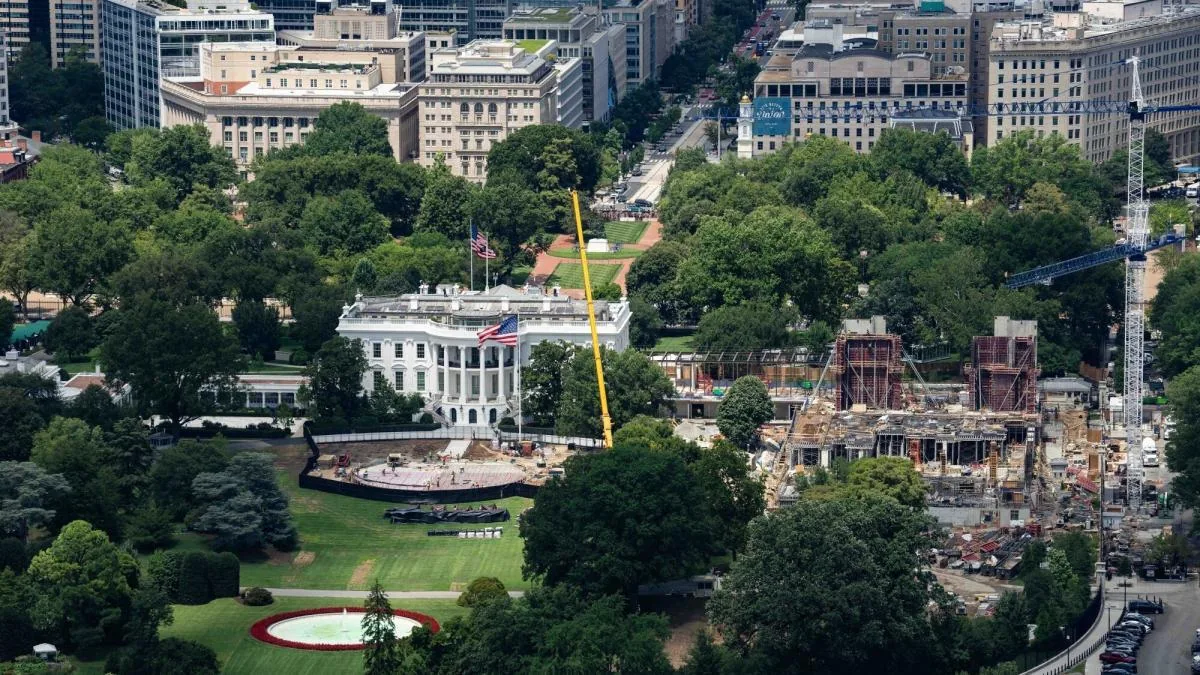
A United States federal appeals court ruled this Friday that Donald Trump does not have the authority to destroy the East Wing of the White House and build a ballroom there without Congressional approval.
Read more Meloni rejects removing border controls as Sánchez demands
The ruling, which the Trump Administration will almost certainly appeal to the Supreme Court, orders the Republican to stop work on the 8,000-square-meter facility, modeled after the ballroom in his Mar-a-Lago residence in Palm Beach, and budgeted at over 400 million dollars of public and private investment.
Also read
“It is up to Congress to decide whether or not a ballroom of that size should be built, and it is not a matter that the Executive Branch can resolve on its own,” the court ruled in its statement, siding with the group of historic preservation advocates who filed the lawsuit. “This decision has absolutely nothing to do with whether the proposed ballroom is desirable or not from a public policy standpoint. Nor does it necessarily mean that the defendants cannot ultimately build the ballroom,” it continues.
“What it does mean is that the defendants cannot do so while the expedited procedure before the district court is ongoing without obtaining Congressional authorization, as required by the Constitution and laws,” the appeals court concludes. However, the judicial body has immediately suspended the enforcement of its ruling for two weeks to give the Administration time to seek assistance from the Supreme Court. If the highest judicial authority does not intervene within that period, construction above ground level must stop.
This is the latest legal setback to Trump’s controversial project, perhaps the most important and contentious of all the profound transformations initiated by the president at the White House and in Washington since he returned to power last January. Despite lacking authorization, last year the president ordered the demolition of the historic East Wing of the presidential residence, a major transformation that, unlike other smaller changes—such as paving the Rose Garden floor or the huge flagpole with the American flag—does require Congressional approval.
Read more U.S. loses 23,000 jobs in July, complicating the Fed’s strategy against inflation
Appeals Court Ruling
“It is up to Congress to decide whether or not a ballroom of that size should be built; it is not an executive matter”
“Executive actions that wrest control of that property from the people’s representatives, while irreparably damaging the historic and visual architecture of perhaps the most prominent public building in the U.S., severely interfere with the public interest,” wrote the judges in the majority opinion of the appeals court, Patricia Millett, appointed by Barack Obama, and Bradley Garcia, appointed by Joe Biden, after a vote with one dissenting vote from Judge Neomi Rao, appointed by Trump.
The judges rejected Trump’s argument that he could unilaterally start the works on national security grounds. Although construction began last year, the president has frequently used that argument after, at the White House Correspondents’ Dinner at the Hilton Hotel in Washington, a man entered armed intending to assassinate him.
“The bold claim that the Executive Branch can act with absolute illegality, destroying cherished national monuments and harming citizens’ interests, and that no court can stop it, challenges our constitutional order,” Millett and Garcia wrote firmly. “Although this court gives great weight and deference to national security invocations and presidential protection, those arguments are not a blank check to operate outside the law.”
Friday’s ruling confirms the decision made by lower courts. Judge Richard Leon, appointed by George Bush, determined in April that Trump’s project far exceeded the scale of minor changes traditionally made by presidents at the White House and therefore required Congressional approval. In the same vein, he also stated in his opinion that “national security is not a blank check to proceed with activities that would otherwise be illegal.”
Read more «The armorer is a locker»: Civil Guard associations call for strengthening the custody of weapons