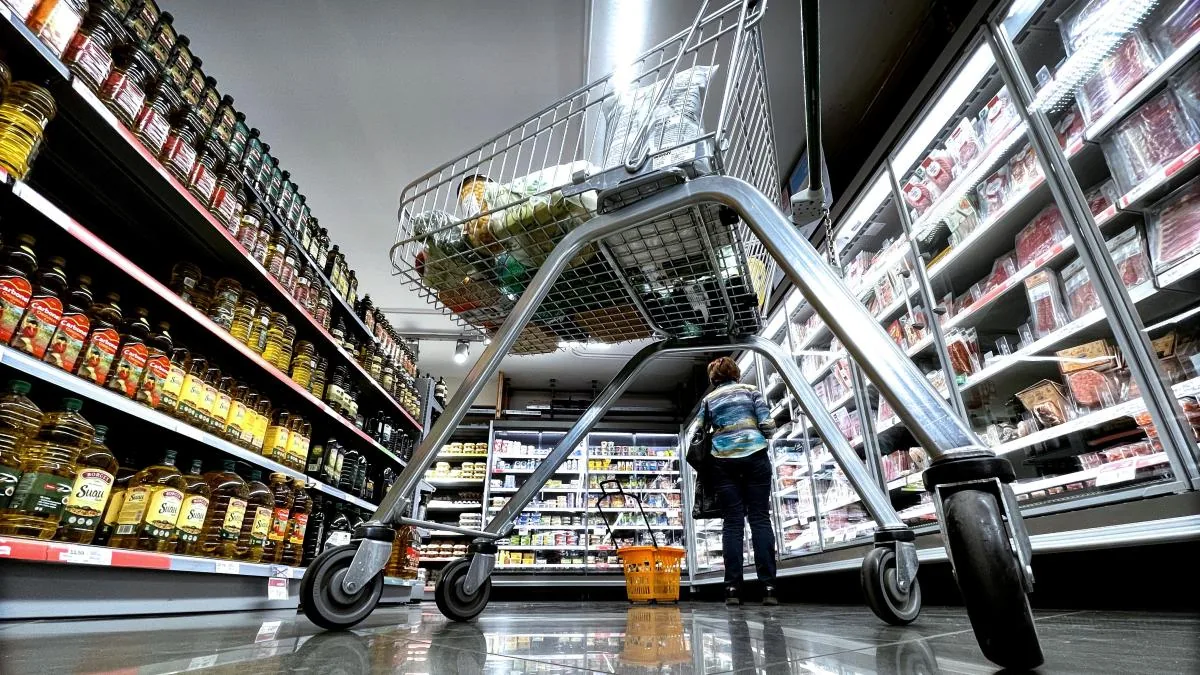
The concentration of supermarkets in specific areas of large cities changes the eating habits of families and promotes an increase in the consumption of ultra-processed foods. A report from the Barcelona Urban Research Institute (IDRA) and coordinated by AMcoop – Escola de Mobilitat Sostenible, points out that the food purchasing decisions of families in the Barcelona Metropolitan Area rarely depend solely on personal preferences. Economic capacity, time, and above all, the food supply they have access to are the main determining factors.
Read more Burnham announces “immediate” measures to reduce the cost of living while reforming the Government
The consolidation of the supermarket as the main food purchasing channel in large cities has contributed to this change in consumption. In the last thirty years, the consumption of ultra-processed foods has tripled across the country. In Catalonia, the presence of this commercial model is clear and widespread: 97% of the population lives near a supermarket and these establishments represent 75% of total food sales. Furthermore, the province of Barcelona accounts for 69% of Catalan supermarkets, which are mainly concentrated in the AMB and the coast.
Income and lack of supply, main factors of inequality in access to healthy and fresh products
Although at first glance it may seem that access to healthy and fresh products is guaranteed, Adrià Rodríguez, director of the report Entre el Camp i la Taula and IDRA researcher, warns that income remains a barrier to accessing this type of product in the AMB. This is what the report calls a “food mirage.” “There are areas of the city that have guaranteed access to this type of product, but cannot afford them,” explains Rodríguez.
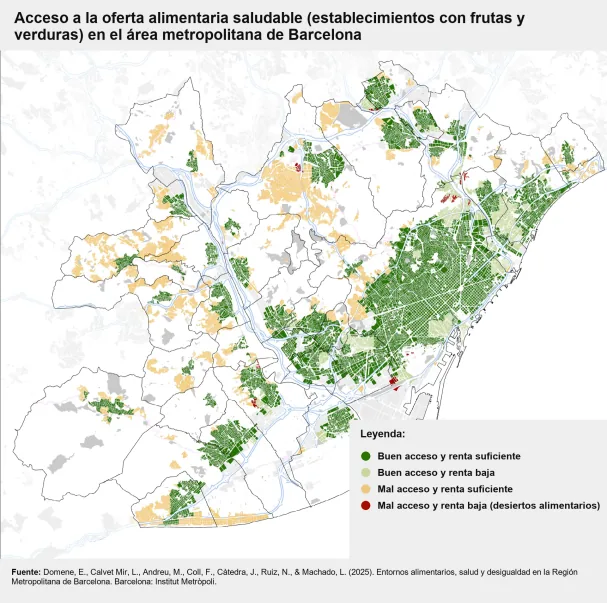
Moreover, this phenomenon worsens due to the high presence of stores selling ultra-processed products or fast food chains. According to this researcher, this type of business is present throughout much of the territory and, specifically, in city areas with high tourist pressure.
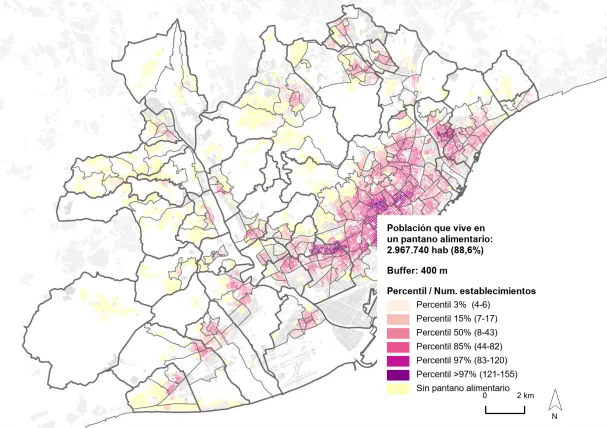
Inequality also manifests in the opposite way. There are neighborhoods that, despite having sufficient income to purchase healthy products, part of the population is forced to travel to acquire healthy and fresh products due to the lack of nearby establishments offering them.
“When we go to buy at a supermarket we are surrounded by ultra-processed products”
Adrià Rodríguez
Director of the report “Entre el Camp i la Taula” and IDRA researcher
Despite this, Rodríguez points out that there is another variable that also influences the decision-making process. “Large stores turn the scarcity of time into a market niche.” “When we go to buy at a supermarket, we are surrounded by ultra-processed products.” If one goes shopping with limited time, because they have to pick up children from school or quickly go to work, it is very likely they will end up choosing less healthy options.
The report also exposes what it identifies as “food deserts.” That is, areas with minimal or nonexistent presence of establishments offering fresh and healthy foods, where at least 30% of the population lives below the poverty line. This is the case in Vallbona, Torre Baró, Baró de Viver, or la Mina.
Read more The director of the US agency for AI security resigns
Spaniards consume twice as much meat as fifty years ago
On the other hand, in the last fifty years meat consumption has doubled. Rodríguez also highlights the key role supermarkets have played in this trend, concentrating more than half of the meat market (54.1%) nationwide. According to the latest annual food consumption report in Spain from the Ministry of Agriculture, Fisheries and Food, Spaniards consume 41.64 kilos per person per year.
“We are twice above the limits set by the World Health Organization,” says Rodríguez. Retirees are the social group that buys the most meat, with 24.37% of the total, followed by households made up of couples with children (18.92%) and adult couples without children (13.61%).
Likewise, income again appears as a factor in meat consumption. A low-income family eats 23 kilos per person per year more than a high-income family. Families with low incomes consume 57.17 kilos per person — 15.53 kg more than the average — while high-income households stand at 34.45 kilos — 7.19 kilos less than the average. Catalonia ranks second in meat consumption — with 16.91% of total consumption — just four hundredths below Andalusia.
Food prices have increased by 34% since 2020
The report points out that the general increase in the cost of living directly affects the weekly supermarket basket of many families. Since 2020, food prices have increased by 34% nationwide, especially in some basic products such as oil, milk, and eggs. Additionally, the family budget for food represents 23% of the total family expenditure of AMB families — to which the high cost of housing is added — 7% more than the average for all of Catalonia.
Furthermore, the report includes about ten proposals to reverse the consumption trend and promote the purchase of healthy foods. “Structural policies are needed,” assures Rodríguez. Among others, the report proposes implementing labeling policies to make organic products visible — and at the same time highlight the most polluting or unhealthy ones — developing a universal card to guarantee healthy purchases, and universalizing school menus.
Read more U.S. and Iran head towards total war after the ninth consecutive night of bombings