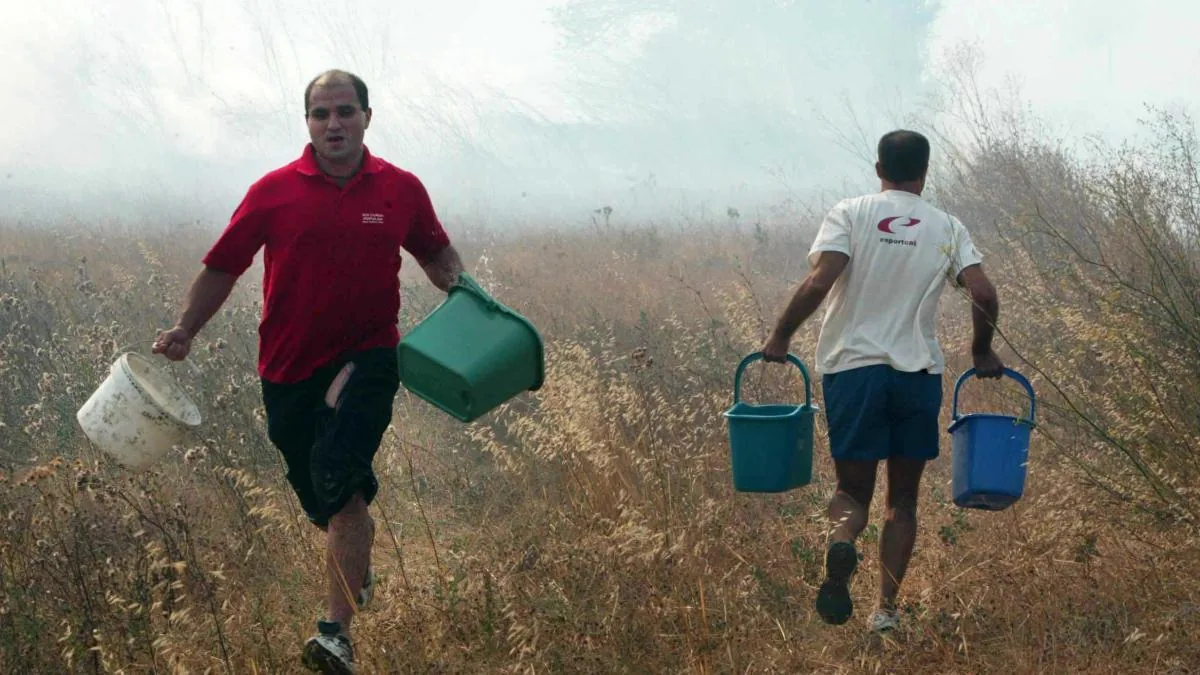
Now 20 years ago, during a heatwave, dry vegetation due to lack of rain, and a tramontana wind that lasted for two weeks, nearly 2,000 hectares burned in the Empordà in a succession of nine fires between August 3 and 7. Most were caused by human hands, as are 90% of the fires recorded in Catalonia. The largest of that 2006 episode, which started in Ventalló and burned about a thousand hectares across several municipalities between Alt and Baix Empordà, according to data from the Agents Rurals, was intentional. There were no personal injuries, but there was material damage, and it sparked a debate about improving forest management, restoring the mosaic landscape, and protecting residential areas. These proposals are repeated every time there is a major fire, like the one in early July that burned about 2,200 hectares in the Gavarres massif and has so far become the most significant this summer in Catalonia.
Read more Real estate agencies earn more than 500 million euros relying on AI
Also read
Quim Guàrdia was working as a firefighter in Llançà in 2006 when he was assigned to the Cistella fire, which on August 4 burned between this municipality and Terrades. Asked if the situation could happen again in that territory, he is clear. “It’s a matter of time before a large fire happens again,” he admits. Guàrdia focuses on the large amount of fuel that has returned two decades after that fire. “We all share some blame, administrations and individuals; we have to row in the same direction,” says Guàrdia, now a member of the Agrupació de Defensa Forestal Puig Segalar, which was established in 2016. “We have an immense and very dense forest that has grown in hectares and regenerated on its own; every inch has a pine tree, prevention involves removing fuel, but it’s not worth it for individuals,” he says. This explains, for example, why only 1% of forest owners in the area have chosen to do thinning and protective strips, as proposed by the ADF, which during this time has worked on opening paths, maintaining tracks, and cleaning. “The forests are dirty, an ADF with volunteers can’t fix it, the subsidy we have allows us to buy four machines and little more; a public or private forest cleaning plan must be made,” says Montse Pala, also a member of the ADF.
Also read
“We have an immense and very dense forest, every inch has a pine tree,” says Quim Guàrdia, from an ADF
Despite the work done, there is more danger of a large fire now than 20 years ago, admits the president of the Consorci Forestal de Catalunya, Rossend Castelló, who gives figures on the expense for an owner to clean the forests. “One hectare of land costs around 1,500 euros; cleaning the area, between 2,000 and 3,000,” says Castelló, who assigns tasks both to individuals to carry out prevention work on their properties, and to the administration to promote the bioeconomy by encouraging, for example, construction with wood from Catalan forests, without needing to import it from Austria, the Basque Country, or Greece. It should be noted that 65% of Catalonia’s surface is forested and 77% is private. “Apart from the fact that an individual does not profit from forest management, many don’t even know they have inherited a plot,” says the mayor of Viladamat, Dolors Pons. Town councils try to keep public forest sections clean. In Capmany, where 400 hectares burned in 2006 due to negligence, perimeter strips were opened around inhabited areas, especially from 2012 with the devastating fire that burned more than 10,000 hectares in Alt Empordà. “But in general, the forest is increasingly less clean and more susceptible to being fuel,” says mayor Joan Fuentes. In La Tallada d’Empordà, a budget is allocated each year for cleaning municipal properties, creating protection zones around inhabited areas, and clearing paths. The mayor, Maria Dolors Guàrdia, explains that some individuals have joined in cleaning properties and in some cases have replaced Aleppo pine with olive and holm oak trees, which have less combustion capacity. They are few. “It’s a big problem, there is a lot of forest mass and not enough aid,” says the mayor of Sant Climent Sescebes, Marc Sala.
Also read
The need to better manage forests is clearly demonstrated as the great pending task. However, fire management by firefighters has taken a leap forward. Those fires tested their capacity in an episode of simultaneity like the one that occurred. Firefighter Jordi Martín, now head of the Girona emergency region, was 26 years old in 2006 when he intervened in the Empordà fires. “One of the great lessons learned is that we didn’t want to have two large fires.” A simultaneity that then only occurred in the Empordà, but that Catalonia experienced this summer. Another lesson is that roads or highways were no longer decisive elements to help put out the fire. “We saw that secondary fires jumped over roads,” recalls Martín about that fifth-generation fire (due to simultaneity) that forced the closure of the N-II and the highway.
Read more Holaluz tries to overcome its second disqualification file in seven years
Jordi Martín: “Now firefighters have more knowledge of how fires behave”
Twenty years ago, sixth-generation fires were not yet talked about, those capable of altering the meteorological conditions of their surroundings and exceeding the firefighters’ extinguishing capacity, accompanied by sudden changes in wind direction. “In these 20 years, firefighters have more knowledge, we know how they behave and interact with the atmosphere and also how to protect the population,” he explains, although he acknowledges that “in 2006, with the resources we had, things were done well.”
In this area, protection, new technologies have provided the population with tools like ES-Alert. The term lockdown had not become widespread. Images like those illustrating this report with neighbors fighting the fire with buckets are now harder to see. Technology has taken a step forward. Those days at the Viladamat Town Hall, there was neither Internet nor fax.
The forestry sector demands the promotion of bioeconomy and the pellet industry
Montse Pala’s parents, who lived in the castle of Sant Feliu de la Garriga, where the flames reached the door, were lucky that some neighbors warned them. “The firefighting teams did not know the secondary roads or shortcuts very well,” explains Salvador Martínez, from Palauborrell, also in Viladamat, who for 26 years has had donkeys helping him keep the underbrush near the house under control. The operational report of that fire, which La Vanguardia has accessed, highlights that “coordination between Bombers, Agents Rurals, Mossos, and ADF, who worked separately, did not exist, only through commanders who occasionally acted as liaisons.” A way of working that has changed.
Read more The anti-blackout measures suffocate small electricity retailers