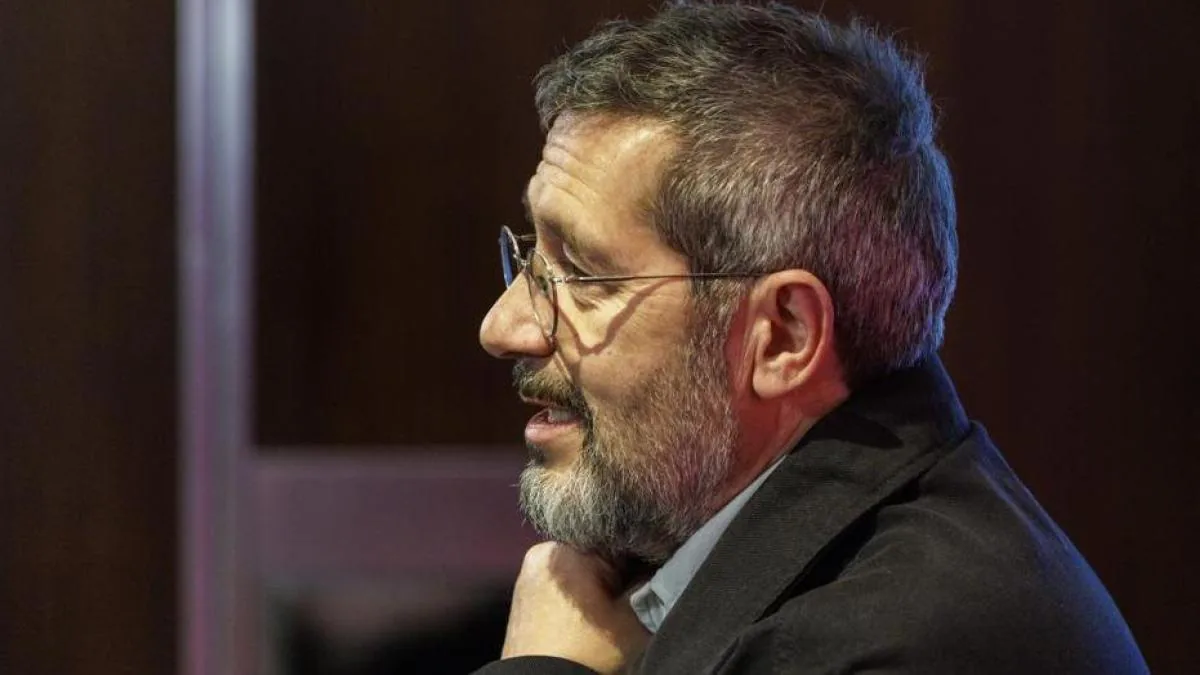
Love is one of Theodor Kallifatides’ most beloved books (Molaoi, Greece, 1938). However, it had never before been translated into Spanish or Catalan. Starting September 16, thanks to Galaxia Gutenberg, readers of both languages will also be able to enjoy this contemporary classic that the author first published in Swedish in 1978. “I wrote it many years ago, but it still feels very heartfelt,” he confesses by phone to La Vanguardia days before this long-awaited publication hits bookstores. It is the first time he has spoken to a Spanish media outlet about the novel. “It is a book that I believe ages well because, when it comes to love, for better or worse, humans haven’t changed much, as we remain the same as in Greek tragedies,” he reflects. The novel follows Laki Sarris, a man about to turn forty, married to Lena and with a son, who falls madly in love with a woman much younger than him, Li. A relationship that will inevitably have dramatic consequences for his life.
Read more Ibex and lobby firms seek to overturn the law regulating their meetings with politicians
Ceuta
The Spanish government has handled the issue sensitively, without violence involved”
Laki wants it all, to keep his marriage with Lena and maintain a passionate relationship with Li. He says he loves both but is it possible to maintain something like that without hurting anyone?
Only in an ideal universe, but not in real life, and anyone who says otherwise will end up discovering over the years that this is the case. Some understanding can be reached but always, to a greater or lesser extent, someone will suffer. Hopefully, only one person, although most likely everyone involved will end up having a hard time. Everyone has something to lose.
Is this an autobiographical story? Were you Laki in the past?
There is always something of mine in everything I write. It would be almost impossible not to base my work on my own experience. And, at the same time, I always use that experience as a starting point to turn it into fiction and mix it with other things I imagine. But yes, I only have one life; if I don’t write about it, what else would I write about?
Laki even wonders if Li is a new love or just an opportunity to become another version of himself.
Both things are compatible. In fact, you can’t start a relationship without something changing in yourself. Sometimes, you might feel jealousy and maybe it’s something you hadn’t felt until then. Or, if you’re luckier, you might meet someone who teaches you what true love is and realize you hadn’t experienced anything like it before.
Although he is attracted to two women and would like to be with both, the protagonist ends up convinced that love is one and that we classify types of love to protect ourselves from it.
I agree with him, and that’s despite having had time to change my perspective over the last forty years. But if someone has had the chance to be truly in love and to live a healthy love, they will know what I mean. Love is much more than simple attraction, fascination, or sexual devotion. It is something unique, a feeling we cannot change. It’s like wanting to change the shape of the moon, it can’t be done.
To love means to care. It is one of the great lessons of his novel. Is care a form of love that our era has underestimated?
Of course it is. You can’t love someone and not care for them. Then it’s not love, even if people insist on calling it that. It’s using someone.
Read more Zapatero prepares a statement to justify the Saudi origin of his jewels
Your text reflects a lot on words and their ability to hide ambiguities.
Yes, and that even though, when I wrote it, I wasn’t so aware that vocabulary could become a weapon, not only on a personal level but also politically. Today we can clearly see it. In my 88 years of life, I had never been in such a situation before. I lived through World War II, the Syrian war, right-wing oppression… but I had never been as aware as now of living through such a frantic stage of war preparation as the current one. Everything used to be cooked more slowly, and now not, and it seems we don’t care. We could, moreover, support the entire world population with half the money we spend buying and selling weapons. However, we prefer conflict. And every conflict starts with the word.
Humans seem not to learn…
Somewhat, because otherwise, humans would have already become extinct. At least, that’s what I want to believe, that despite the planet becoming strange and murky, most of us understand that a new world war would be a mistake. I admit I’m not so sure it won’t happen, which is why I’m scared and have said I think this is the first time I’ve experienced something like this. If something happened, I think it would be the end.
Are you equally pessimistic about immigration? Have we learned anything? This is one of the major themes of your narrative and you already made your position clear with this novel in 1978.
I’m not sure. I’ve been following the Ceuta issue in the newspapers for weeks, for example. Where should the balance be between borders and the protection of human rights? This is the key question. Of course, the latter is paramount, and it’s obvious. But theory is always easy. Ideally, it would be to save their lives, that first, and provide tools so they can later save themselves. It’s not an easy situation to handle, especially with poverty and despair involved. As far as I understand, the Spanish government is handling the issue sensitively, without violence involved. And this, which may also sound obvious, is not so easy to see, even though we are in the 21st century. It must be clear that emigrating, in its basic sense, is leaving your country because you cannot live there. It is not synonymous with tourism.
What would you say to a young immigrant who feels they have to choose between their parents’ culture and the country where they live?
To adapt. And adapting does not necessarily mean losing one of the options. You can keep the first and open yourself to learning new things. It is essential if you want to live in a place. That said, I believe adaptation must be reciprocal, and that doesn’t always happen. There are people who prefer to put a blindfold on and do not accept or tolerate their country changing and people coming from outside. With arrogance involved, from whichever side, it is impossible to move forward.
Did you encounter that arrogance when you emigrated to Sweden?
Arrogance is always present, but one has to know how to move forward despite everything and understand that there is a larger group of people who do good. And see the positive things. I arrived in Sweden and the country opened its doors to me. I studied there and was appointed a university professor. I felt I had to repay the favor and started writing in Swedish. Also because at that time I was convinced that Greek was not a language with which one could tell the truth. I was disappointed. Over the years, I returned to my language. Well, now both are my languages. I have won.
Read more Ceuta faces its next challenge: returning to the classrooms