The forest fire that started in La Mierla, which has already devastated more than 26,000 hectares in the Sierra Norte of Guadalajara, is not only leaving behind a scorched landscape and a long list of confined or evacuated municipalities. It also threatens to destroy the way of life of dozens of livestock farming families who watch helplessly as the fire devours the pastures, forces the displacement of hundreds of heads of cattle, and puts the work of entire generations at risk.
Read more The third heat wave of the year threatens to raise temperatures up to 45ºC
While the firefighting teams continue battling a fire of enormous intensity, the livestock farmers in the region are racing against time to save their animals. Many have had to drive the cattle to already scorched lands, now the only possible refuge against the advancing flames, while others acknowledge having already lost part of their livestock or fear it may happen in the coming hours. “The only thing left for us is to pray.” With that phrase, Fernando Moreno, known as Nano and president of the Livestock Farmers Association of the Sierra Norte of Guadalajara, sums up the mood of a sector overwhelmed by the magnitude of the fire.
Livestock farmers in the region are racing against time to save their animals
As he explained to Europa Press, the situation is “horrible” for the livestock farming in the region and affects practically all professionals in the area, many of whom continue to roam mountains and paths trying to prevent the flames from reaching their animals.
In addition to the direct threat of the fire, another problem now threatens the survival of the farms: the disappearance of the pastures. Where the cattle have managed to take refuge, there is no food left, so the farmers will have to resort to buying feed and forage for months, with the consequent increase in costs for family farms whose viability is seriously compromised.
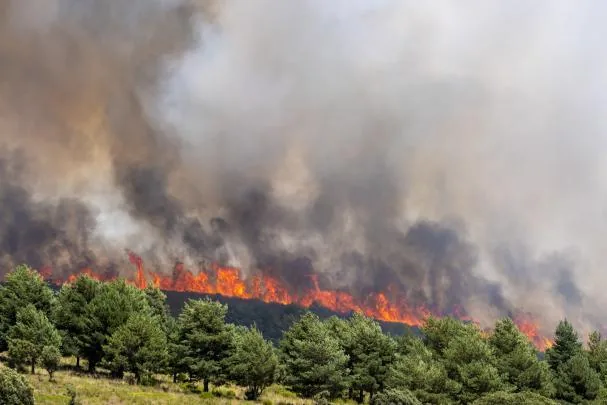
The anguish is also expressed by Pilar, mother of one of the affected livestock farmers, who describes a region where “the town burns, the livestock burns, and life burns.” In her testimony, she calls for more support on the ground to help move the animals and laments that many families watch as the effort of a lifetime can disappear in a matter of hours.
The drama does not end with the evacuation of the livestock. Some animals have gone up to three days without being able to drink water, are increasingly nervous, and continue to be moved from one place to another seeking safe spaces. Even some livestock buildings have already been affected by the flames, further worsening the situation.
Read more PSC and ERC want the purchase of housing to be limited only to large property owners
“Desolate situation”
From Ujados, livestock farmer David Santos sums up another major concern of the sector. Although he has managed to save his sheep by moving them to high areas of the mountain range, he acknowledges that the total loss of pastures will require maintaining artificial feeding for a long time, with the consequent economic impact for farms already facing an uncertain future. “The situation is desolate,” he says, while recalling that many of the destroyed pine forests will take decades to recover.
The fire is also leaving a deep human mark in a region marked by the aging of its population. To the uncertainty of those who remain confined is added the heartbreak of many neighbors, especially elderly people, who have had to temporarily leave their homes or watch the landscape they helped preserve for decades disappear.
Also read
The evolution of the fire forced civil protection measures to be expanded this Monday. The emergency management has ordered the evacuation of Alpedroches and the confinement of Hijes, Miedes de Atienza, Casillas, Bochones, Romanillos de Atienza, and Bañuelos de Atienza, as well as the closure of several roads in the area.
Beyond the figures of the fire, the Sierra Norte now faces a wound that will take years to heal. To the more than 26,000 hectares scorched is added the uncertainty of a livestock sector fighting to save its animals and preserve a way of life closely linked to the territory, aware that the recovery of the forest and many farms will not be measured in weeks or months, but probably in decades.