







Less than two months before the midterm legislative elections, the United States Supreme Court has blocked President Donald Trump’s last-minute attempts to restrict and take control of mail-in voting at the federal level. The emergency ruling, issued this Monday, comes as some states have already begun sending ballots to citizens and means that, in practice, they will be able to continue doing so using the same procedure that has been used for decades. The ruling is significant because approximately one-third of the population uses mail to cast their vote.
Read more Ceuta already has its second Lampedusa
Although the Constitution grants states the power to administer elections, Trump signed an executive order in March attempting to federalize mail-in voting based on an alleged widespread electoral fraud, although this represents less than 1% of total votes according to official data. Specifically, the decree required states to send the Department of Homeland Security lists of citizens considered eligible, which would be compared with federal records, so that the Postal Service could only deliver ballots to those present on both lists.
Also read
Successive lower courts blocked the order, both for being unconstitutional and for the logistical problems it would cause in an election year, and the White House continued to appeal until reaching the Supreme Court. There, the nine judges, with a conservative majority, issued their ruling without extensive arguments, as is common in emergency cases, although with the two dissenting votes of Samuel Alito and Clarence Thomas.
“It is unlikely that the Government will succeed on the merits of its challenge to the preliminary injunction issued by the district court,” states the order, a single paragraph and unsigned. “And the equitable factors applicable to the granting of emergency relief by this court do not justify a stay,” it concludes.
Judge Brett Kavanaugh, nominated by Trump in 2018, sided with the majority, including the three progressive judges, although he noted that, in his opinion, the Trump Administration has “at least a reasonable prospect” of success. However, he chose to block the executive order arguing that implementing it so close to election day would be “arbitrary and capricious.” This reasoning suggests that the legal conflict is not over but could be postponed until after the midterms.
Judge Kavanaugh, appointed by Trump, argues that implementing the decree so close to the elections would be “arbitrary and capricious”
In their dissenting vote, Alito and Thomas accused the plaintiffs, a coalition of Democratic states, of filing the lawsuits late, which caused the Supreme Court to have to rule so close to the elections. “The plaintiff states cannot claim that the timing of the rule’s approval tips the balance of equity in their favor when they, and the courts that have examined their claims, are responsible for much of the delay,” they state.
The Supreme Court’s decision, celebrated by civil rights groups and Democratic congress members, will allow Trump to fuel his narrative that there is widespread electoral fraud, perpetrated by immigrants without voting rights, as well as justify measures he may take on November 3 to prevent it.
Read more AI Alarm, Data Center Fever
Among these, according to members of his government, is the possibility of sending Immigration and Customs Enforcement (ICE) agents and Border Patrol to polling centers, and among the most extreme measures is the possibility of declaring a state of emergency and suspending the elections, especially in states where he believes he might lose.
Senator Chuck Schumer, leader of the Democratic minority in the upper chamber of the Capitol, hailed the Supreme Court ruling as “one of the most important” for “protecting the right to vote.” “Trump’s plan to make voting harder was clearly unconstitutional,” he declared: “The Supreme Court had no choice but to make the right decision. The president’s attempt to tamper with mail-in voting was obscene. Finally, his plan has bitten the dust.”
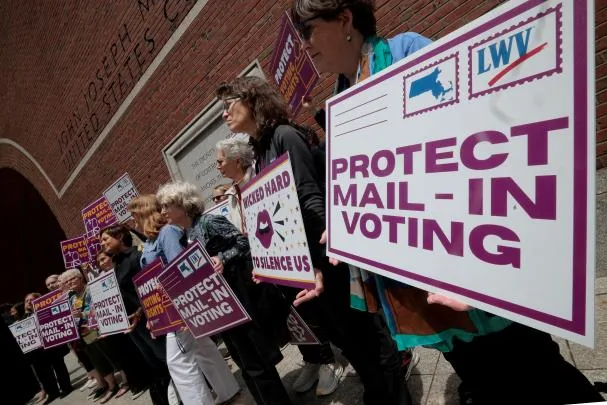
The lawsuit, filed by voting rights groups along with 23 states and the District of Columbia, argued that Trump’s plan was unconstitutional, posed an existential threat to the democratic process, and would only create chaos and confusion just months before the elections.
In a statement celebrating the ruling, the American Civil Liberties Union (ACLU), which represented the voting rights organizations, reminded that, according to the Constitution, “the president does not run our elections, the Postal Service does not decide which ballot counts, and it will be the voters — not the White House — who decide the November elections,” said Sophia Lin Lakin, director of the ACLU’s Voting Rights Project.
Chuck Schumer, leader of the Democratic minority in the Senate
“Trump’s plan to make voting harder was unconstitutional and obscene. The Supreme Court had no choice but to make the right decision”
The Supreme Court has thus blocked one of the pillars of Trump’s battle against free and fair elections in November, but his plan goes much further. On one hand, Republicans have approved manipulated electoral maps in multiple states aiming to gain more representation in the House of Representatives. On the other hand, they are trying to pass in the Senate the so-called SAVE America Act, which, among other measures, would require stricter proof of citizenship to register to vote, including a passport, which only half the population has. Additionally, among other measures this election year, the president fired in July the last three members of a bipartisan commission that assists states in ensuring the proper functioning of elections.
All these policies pursue the same goal, beyond federal control of elections, traditionally administered by the states: to generate confusion and doubts about the electoral process so that, if Republicans lose control of the Senate and the House of Representatives in November, they can claim that widespread electoral fraud occurred. It is the same strategy Trump followed in each of the presidential and legislative elections held in the U.S. since he first won in 2016.
Read more Donald Trump calls Jensen Huang (Nvidia) live: “The danger of AI is a hoax”