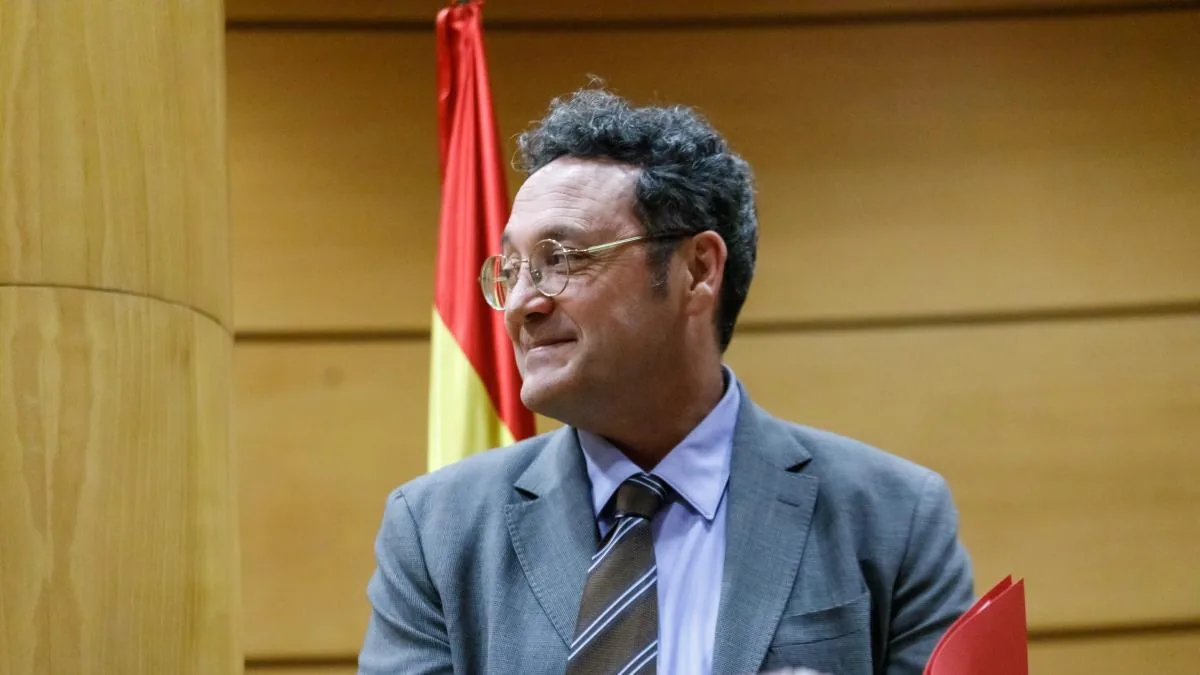
The Prosecutor’s Office supports the partial pardon for the former Attorney General Álvaro García Ortiz, convicted of a crime of disclosure of documents. The report has been submitted to the Supreme Court, which must now issue its own to be delivered to the Ministry of Justice for evaluation. The deputy prosecutor of the high court argues that the conviction has led the former number 1 of the public ministry to “intense and disproportionate extrapenal consequences.”
According to the report, signed by the deputy prosecutor of the Supreme Court, María Ángeles Sánchez Conde, the reasons of justice, equity, or public utility required for granting the measure of grace are met.
The prosecutor, who requested acquittal for García Ortiz, explains that the pardon can only be partial and demands that the disqualification penalty preventing him from serving as Attorney General for two years imposed by the Supreme Court be annulled.
Sánchez Conde argues that it should be taken into account that García Ortiz left his position after learning of the conviction ruling that disqualified him from it and that he has paid the civil liability and fine. “The partial pardon that can be granted to him has limited effects as the criminal conviction remains, producing a reduction in the duration of the special disqualification penalty for the position of Attorney General,” she explains.
Therefore, the sole purpose of the pardon is to shorten the timeframes for the cancellation of criminal records with the “inherent consequences in civil life and professional development.”
In her writing, she explains that the reasons of justice are given because for this the conviction must be “materially unjust or disproportionate” or there must be a disproportion of the penalty in relation to the severity of the act. In the case of equity, it refers to correcting the rigidity of the law in singular cases. Finally, the reasons of public utility refer to considerations of general interest that justify remission or commutation of the penalty.
Also read
The prosecutor recalls that the sentence has complied with the principle of equality before the law, “showing that even the highest authorities of the State are subject to judicial control.”
Read more Marta Vidal, Pere Ventura and Marc Pagès run for president of the DO Cava
Moreover, she indicates that “having left his position as Attorney General after the conviction ruling was known, the extension of the special disqualification penalty is of little relevance, since, on one hand, a new Attorney General has been appointed, whose term lasts four years and can only be dismissed for strict, specified reasons.
Sánchez Conde explains that the pardon, therefore, does not intend for García Ortiz to recover his position as Attorney General nor does it intend to review the sentence. Its aim is to mitigate the extraprocedural consequences that García has suffered due to his “institutional condition,” the absence of criminal records, “that in fact there was a total absence of personal patrimonial benefit, that the case had extraordinary public repercussion.”
The prosecutor believes that the “exorbitant impact on the reputation, professional career, and institutional position” of García Ortiz must be taken into account, who has held his position as Supreme Court Prosecutor after leaving the Attorney General post.
Likewise, Sánchez Conde argues that García Ortiz should be pardoned because the only thing he sought by issuing a press release offering certain data about businessman Alberto González Amador, partner of the president of Madrid, Isabel Díaz Ayuso, was to defend the “good name” of the Prosecutor’s Office. The deputy prosecutor continues to defend that her former boss did not commit any crime but only responded to the “attacks” questioning the professional work of prosecutors in a matter of enormous media interest.
Read more The Government admits the infiltration of mossos in a teachers’ assembly