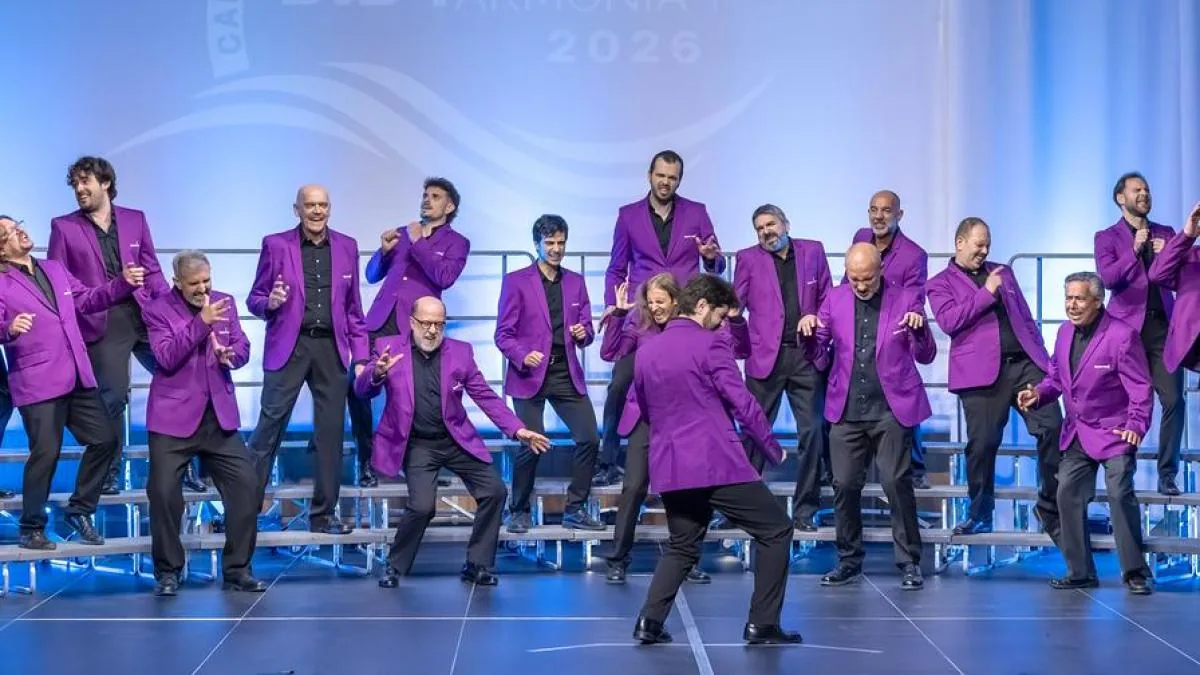
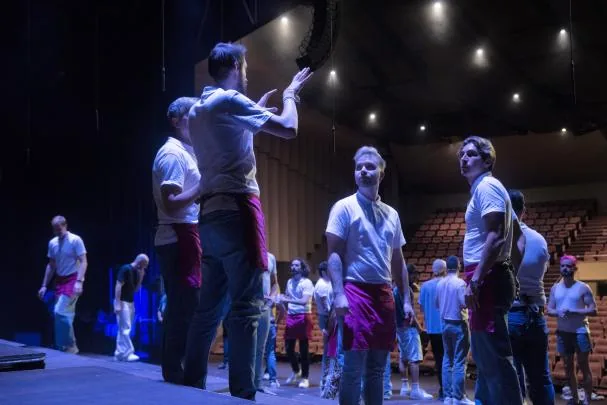
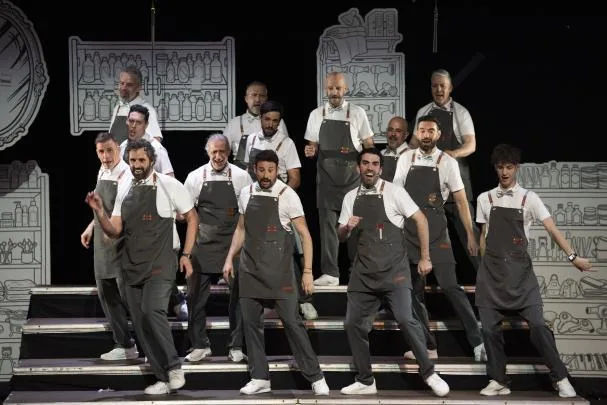
At eight in the evening, in a multi-purpose space of the Federació d’Entitats Calàbria 66 in Barcelona, about fifty men gather every Wednesday to sing. In recent months, they have been preparing Shampoo, a musical with which the Barcelona Gay Men’s Chorus occupied the stage of the Teatre Condal until June 21. Accents from half a dozen countries resonate in the room, a pair of singers rehearse an acrobatic figure à la Dirty Dancing next to a man with a cast on his arm who didn’t want to miss the rehearsal.
Read more European punishment to the Venice Biennale
Several participants arrive directly from the office, some come with shaved heads and sportswear, others with long hair and a pink tutu. Sitting in a corner, Conxita, the sign language interpreter who has accompanied the choir since its inception, assures that this would be her last show before retiring. The warm-up talks quiet down with the arrival of Gerard Ibañez, the director. It’s time to sing.
Singing was a spiritual tool to overcome fear and strengthen social cohesion
Long before becoming a cultural and social aggregation activity, singing was a spiritual tool to overcome fear, strengthen social cohesion, and transform an individual experience into something shared. In Greek tragedy, choruses gave voice to the community and accompanied the narrative as a collective consciousness. Early Christians advanced towards martyrdom singing, and work songs accompanied sailors, slaves, peasants, and soldiers for centuries.
Science has long been investigating the thaumaturgical properties of choral singing. Since February, the Universitat Autònoma de Barcelona has brought together professors, researchers, and workers in a community choir specifically created to study the effects of collective singing on emotional well-being. Once a week, they leave offices, laboratories, and administrative tasks to rehearse together. The initial results are still provisional, but researchers have already detected improvements in relational and emotional aspects, as well as in the feeling of belonging to the group.
British sociologist Emily Falconer reached similar conclusions after studying several male choirs in London. Her interest focused on what happens when dozens of men learn to sound together: harmony requires listening before imposing oneself, coordinating instead of competing, and building something collective by giving up the spotlight. Some participants specifically highlighted that they could feel connected without constantly talking about themselves.
The Barcelona Gay Men’s Chorus was founded in 2014 and today brings together about 60 people around singing and activism. Shampoo told the story of a gay couple who run an inclusive hair salon and a son who tries to understand who his parents really are. “Everything we do is focused on an audience that belongs to the collective or that, without belonging to it, values diversity,” explains Toni Ponce, one of the founders. However, the choir has never been a closed space. “Our director is heterosexual, and Conxita is too. We work with male voices, but a woman can also have that voice.”
The family created on stage
The only thing they ask for is commitment. “Some come because they’ve seen a show and think: “I want to sing there.” Others are looking for singing lessons, a new activity, or simply to meet people. Some even come on the recommendation of a therapist,” says Ponce. Justin landed in Barcelona from the United States nine years ago without knowing anyone: “The choir has helped me find friends, a partner, and a family here.” Manel, a Catalan, recalls something similar: “What struck me was the connection between each member on stage.” After more than ten years, he still uses the same expression to describe the group: “My family, the one I chose.”
The choir organizes excursions, karaoke, and activities outside of rehearsals. There is even a cohesion committee responsible for integrating newcomers, but those who run it insist on clarifying the main objective. “Some arrive thinking this could be a platform to show off,” says the entity’s president, Ángel Hurtado, “but if someone is looking for that, they’d better sign up for Operación Triunfo or for La Voz.” Those who stay, he assures, “end up appreciating the associative and human side.”
It would be a mistake to think that all this belongs solely to the LGTBI universe. Men’s choirs have been exploring very different ways of building community around the voice for decades. In Madrid, Barberidad is the first Spanish male choir dedicated to barbershop, a vocal style born in the United States in the late 19th century and associated with those barbershops where men gathered to chat, wait their turn, and improvise harmonies with several voices.
Read more The fat man and the wise monkeys
Specifically, four voices, four distinct functions, and one indispensable condition: none can impose itself too much on the others. “In a choir, if one voice tries to stand out, the harmony disappears,” explains the collective’s president, Benito Gómez-Cornejo. The result depends on the ability to listen. “You can’t be thinking about your worries while trying to tune a chord, listening to the person next to you, and following the director,” he summarizes.
I wouldn’t say the choir solves anyone’s problems either, but you leave different from how you entered”
Benito Gómez-Cornejo
President of the collective
“If you share a song, you already have a meeting point. That creates a very different relationship between men that is not so much based on competing, pretending, or marking territory, but on helping each other integrate and sound better,” says Benito, who doesn’t want to exaggerate the therapeutic virtues: “I wouldn’t say the choir solves anyone’s problems either, but you leave different from how you entered.”
For many of its members, rehearsals function as a kind of mental harmony break. “For me, singing in Barberidad has a somewhat disinfectant effect on bad moods and worries. For a while, it clears your head, changes your mood, and resets you. Personally, I don’t remember being in such a heterogeneous group of people where such a deep communion was felt,” says one of the singers.
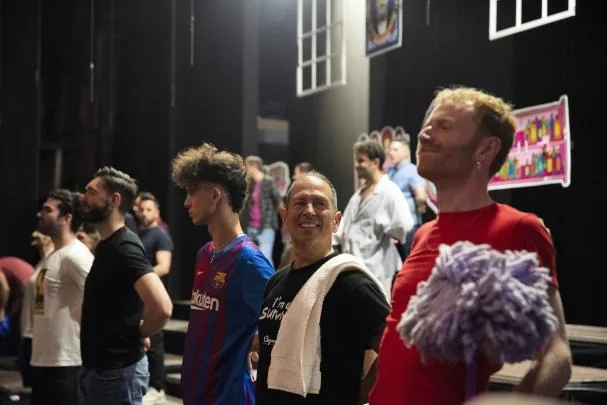
If in Barcelona words like family or community appear and in Madrid chords and harmony are spoken of, the Australian project Gentlemen’s Choir uses expressions more common in the universe of male personal development, such as brotherhood (hermandad), men’s work (trabajo sobre la masculinidad) or rite of passage (rito de paso). For ten weeks, a group of men gathers to sing and finishes the process with a public performance before family and friends.
“We sing in the shower, we sing in the car, we sing along to a song, but we don’t dare to sing in front of other people,” explains Luke Laux, one of the initiators of the project. According to him, many men abandon singing at some point in childhood or adolescence, convinced that they don’t know how or that doing so is not very masculine.
The effect of singing on people
As Falconer’s studies on male choirs confirm, singing exposes. Much more than speaking in a meeting or giving a presentation. “Why does singing make us so vulnerable? Because we’re bad at it,” Luke summarizes with a laugh. But precisely this voluntary exposure to vulnerability is the goal. When his daughters ask him why he spends time with other men instead of staying home, he replies: “Because it’s a way to learn from others and come back better for you.”
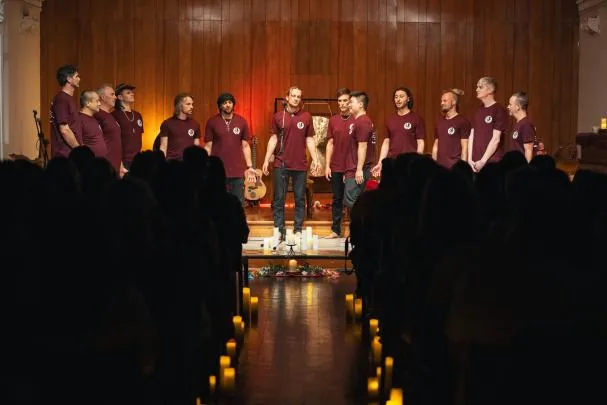
At times, his discourse takes on an almost mystical tone. He speaks of trust, respect, friendship, and the need to create masculine bonds outside of usual spaces. He also mentions bonfires, celebrations, and a longed-for era when singing was part of daily life and the collective voice served to navigate shared experiences. “I thought I came to learn to sing, but I found much more. I thought I came to learn to sing, but I found my voice. I thought I came to learn to sing, but I found a brotherhood.” Luke repeats these phrases as a kind of mantra he has heard many times among participants.
When the rehearsal ends on Calàbria street, Gerard Ibañez gives the final instructions and the room slowly returns to being just another neighborhood space. A faint smell of sweat mixed with cologne remains. No one came there to talk about masculinity or to participate in collective therapy. They have spent two hours listening to the voices of others while looking for a place for their own. The following week, they will sing together again.
Read more Sánchez’s nougats