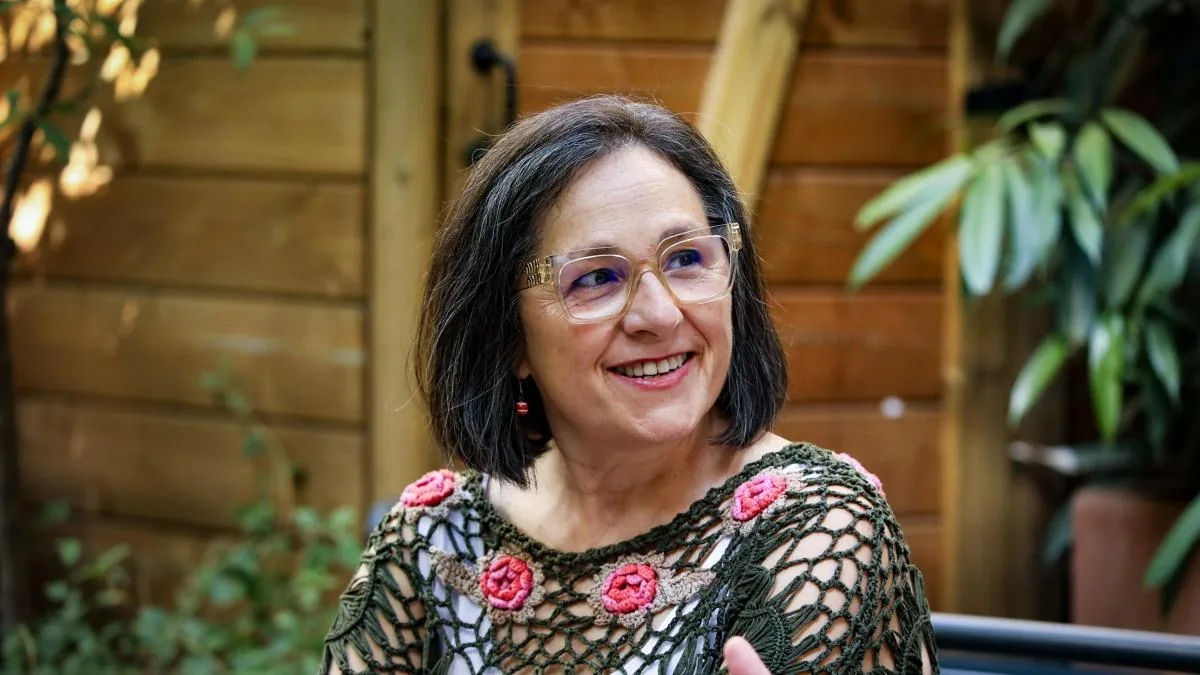
Laura Autonell (Taradell, 1963) had been writing all her life, like many people, without many pretensions. But six years ago her husband passed away and her priorities changed: “The hours I would have spent with him I have dedicated to writing, I have filled his absence with stories. It’s as if I had remarried, but with literature,” she assures, because from that loss first came a self-published novel, Un polsim de sal, and recently a novel that in a few weeks has established itself among the bestsellers thanks to word of mouth, La Llibreria de les Hores Mortes (Columna), alongside authors like Regina Rodríguez Sirvent, Gil Pratsobrerroca, Siri Hustvedt or even Homer himself with the new Catalan translation of his Odyssey.
Read more “I’m always reading”: evicted from his New York apartment for accumulating 10,000 books
In the book, the life of Etna, a young woman from the upper area of Barcelona with a settled life, receives a shock when after her father’s death she is left without an inheritance, her world collapses and she loses the certainties she had. Instead, she inherits from her mother an apartment and a shop in the Raval, where she decides to open a bookstore, a process in which she will discover some family secrets and their consequences. “I have been a shopkeeper for 45 years – I run a sports equipment store in Taradell – and I am a fan of local commerce, which welcomes customers who end up becoming friends, but buying habits have changed a lot,” Autonell says, adding that “a bookstore, moreover, has a magical point.”
Also read
“I published my first book precisely thanks to a bookseller, but then I felt I had to train myself, and I did so at the Escola d’Escriptura del Ateneu Barcelonès, which was very useful for getting down to work,” she explains, and points out that she chose Barcelona and the Raval because “Etna had to fall from very high to very low, and here it was easier,” from her perspective, although now she sees the neighborhood “differently, there are very good people,” she notes, and recalls that when she decided to set her bookstore on Elisabets street, in front of La Central del Raval – “I thought that if there really was one, mine in fiction would be possible” – on the mobile map app she saw a homeless person reading: “I already had him planned as a character, and the coincidence made me believe that in the novel I had to develop him,” and he has a decisive role.
As a shopkeeper, the writer is “a fan of local commerce, but the bookstore, moreover, has a magical point”
Turned into the literary surprise of the summer, Autonell admits that the fact that there is a bookstore in the title and plot may have worked in her favor, as her editor, Glòria Gasch, also believes, because the book is both a “claim for the bookstore as well as for the transformative power of reading, which appears in the book as a way to understand the past and rebuild identity to open ourselves to the new opportunities that life can offer.” Autonell, who plans to retire in December, does not want to waste time and has already written a crime novel set in her town, wants to rewrite her debut and is working on another book: “The circumstances have been what they have been, but at my age, living this is a dream.”
Read more A judge rules against Leitat’s ERE and drives up the cost of the process