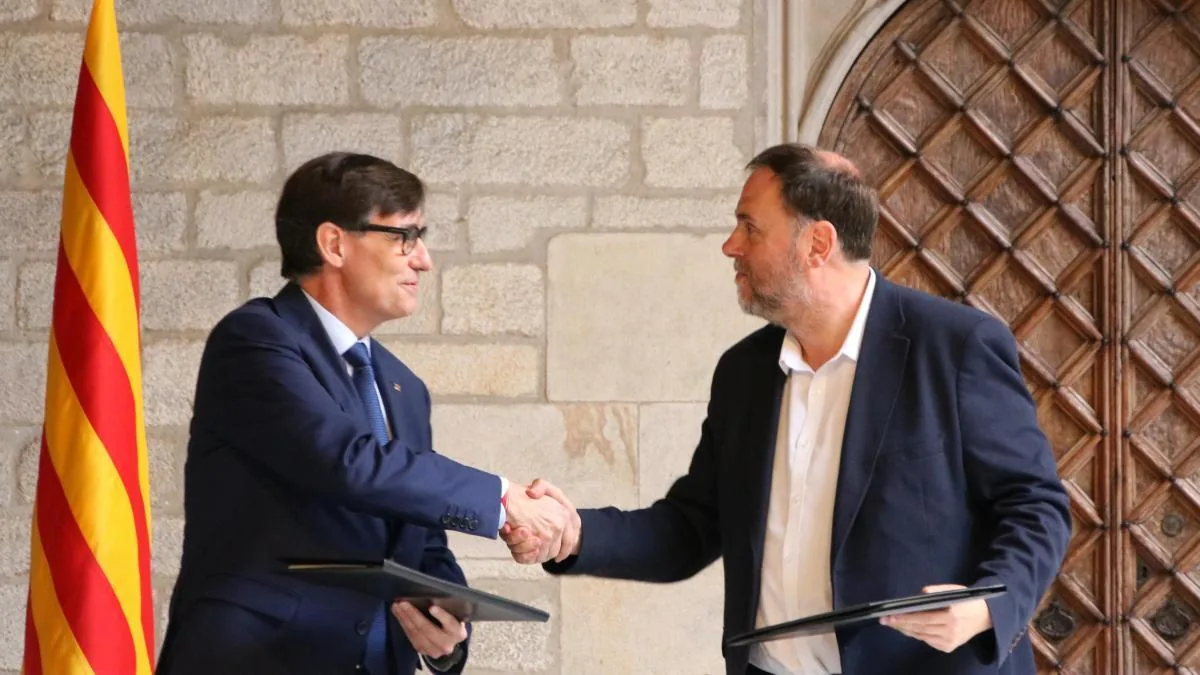
The agreement signed by President Salvador Illa and the leader of ERC, Oriol Junqueras, is no longer just for the 2026 budgets, but is focused on 2027 and beyond. De facto, this agreement will allow for the availability of resources and sufficient political stability to complete the Catalan legislature – which expires in the summer of 2028 – but it will serve as a planning tool for a few more years. At the same time, this agreement reaffirms the Government’s link with its main ally, since the signed document ratifies some of the most relevant investiture agreements, such as unique financing, IRPF collection, airport management, or the cancellation of the FLA debt.
Read more Jonathan Andic, from the failed rise to the management of Mango to his role as a shareholder
The multidisciplinary budget agreement signed today consists of 18 specific areas, some of which – the most relevant – were already known, such as the deployment of the orbital railway line, the configuration of the investment commercial company, the reformulation of the free zone consortium, or the strengthening of the Catalan Tax Agency (ATC). But there are many other commitments detailed below.
The orbital railway line
The new line that will connect Garraf with Mataró without passing through Barcelona, presented this Monday, will require the central Government and the Generalitat to sign a commitment in this Wednesday’s Bilateral Commission meeting. They will commit to signing a collaboration protocol during 2026, which must later be developed into a financing agreement, to guarantee the drafting of studies and projects and the execution of the necessary works for the deployment of the line, prioritizing connectivity with the R8, R4, R3, R2, R1 Rodalies and the FGC network.
Consortium and investment commercial company in Catalonia
Although Junts frustrated the establishment of the so-called investment consortium in Congress, the Government and ERC reaffirm their commitment to “the promotion, planning, monitoring, management and execution” of State investments in Catalonia. And “while the consortium is not established,” the promotion, planning and monitoring of these investments “will be carried out from the Bilateral Infrastructure Commission, which must be convened at least once a year,” the agreement text states. Added to this is the commitment to establish the Catalan investment commercial company, which “will have the purpose of carrying out studies, drafting projects, and guaranteeing the execution of State investments in Catalonia.”
Consorci de la Zona Franca
The change in this 100% state-owned entity will allow it to pass into Catalan hands. A new consortium will be established that will maintain its historical name, but the State will hold 45%; the Generalitat, 40%, and the Barcelona City Council, 15%. To accelerate the Generalitat’s relevant position in the governance of the Consortium until the new one is established, the 1968 statutes will be modified and the composition of its bodies will be adapted to the indicated proportions.
Financing to be effective in 2027
Both parties reaffirm their willingness to “continue prioritizing the legislative deployment of the new financing model, the cancellation of the Autonomous Liquidity Fund (FLA), and the delegation of powers in IRPF collection.” Thus, during the second half of 2026, the necessary legislative initiatives must be approved so that the new financing model agreed with the Ministry of Finance can be effective in the 2027 fiscal year. In addition, “joint work” will be done so that the laws finally approved in the Congress of Deputies incorporate the delegation of powers for IRPF collection. And before the end of the first half of this year, “the parliamentary debate” on the bill allowing the partial cancellation of the FLA debt “must begin.”
Catalan Treasury
As La Vanguardia already published, a program contract will be signed between the Generalitat and the ATC to provide the tax entity with the resources – 527 million until 2029 – and the necessary technical and human means to assume powers in tax collection. An additional contribution of 21 million euros will be made in this year’s budget.
Catalan language: 100 million euros
The reinforcement of social use will be undertaken in various areas. On social networks, with an investment of 50 million over three years, but it will also inject another 35.24 million to the Department of Language Policy to expand the offer of Catalan places, strengthen the Consortium for Linguistic Normalization, promote Catalan in audiovisual media, video games, business, healthcare, health, commerce, sports (10.3 million euros), etc. Two million will also be allocated for a new work line linked to the Casa de Creació (digital content in Catalan) and 3 million for the protection of the Catalan language and culture in artificial intelligence.
Healthcare
An extraordinary fund of 250 million euros will be created in the 2026 budget to gradually reduce the historic deficit in Catalan healthcare financing, “which generates treasury tensions,” admitted the Minister of Economy, Alícia Romero.
Education
The investment plan in educational centers will increase investment to 400 million euros by 2030. The so-called climate plan, for the air conditioning of school centers, will be endowed with 100 million euros for 100 facilities to be executed in the 2026-27 and 2027-28 school years. Also, 50 million will be allocated to the school voucher for primary, secondary, and basic vocational cycles, and 18.82 million for the school libraries plan for the 2,350 public centers. Finally, reception classrooms will be reinforced with 21 million euros, allowing the creation of 250 new such classrooms in public centers (150 in subsidized schools and 50 in basic vocational training).
Rodalies
The agreement includes the need to consolidate the State’s commitment up to 8 billion euros for the Rodalies 2020-2030 plan, through an agreement of the Joint Commission on Economic and Financial Affairs. Also, to consolidate the new Rodalies de Catalunya company with the incorporation of the rest of the management team and to promote the processing of licenses to operate as a railway operator. Furthermore, it is planned to incorporate the Generalitat into the governance of the L’Hospitalet de Llobregat Train Drivers School and to complete the transfer of the R1 this year 2026.
Read more This is how Mango has managed to shield itself from the investigation into the death of Isak Andic
Airport
In the budget measures law, during the amendment process, legislative modifications will be incorporated to create the Catalan Airport Authority, and in a future Bilateral Commission between the State and the Generalitat, the creation of a bilateral body between the two administrations to coordinate the governance of the Catalan airport system will be approved. It also indicates the need to approve a strategic plan for the Catalan airport system with planning in all areas: territorial, urban, natural environment, environmental, accessibility, etc.
Security: Mossos and judges
The Government must complete the 25,000 Mossos agents by 2030, as agreed in the February 2025 Bilateral Commission. The agreement to transfer citizen security powers in all Catalan ports and airports must be fulfilled, and 180 new judge positions will be deployed in Catalonia between this year and 2027.
“Regenerate” housing plan
A plan for the rehabilitation and recovery of the degraded residential park will be approved. The program lasts three years, will have a structure of twenty people, and a budget allocation of 160 million annually, as well as a financing line from the ICF of 50 million annually (210 million in total for building rehabilitation).
Villages plan
This plan until 2030 is endowed with 400 million euros, aimed at the 730 municipalities with fewer than 5,000 inhabitants, the 63 decentralized municipal entities, and the county capitals with fewer than 15,000 inhabitants. It aims to reactivate, protect, and adapt urban centers and economic activity spaces with integrated urban and heritage rehabilitation actions. Another 10 million will go to improving telephone and internet connectivity.
Research and knowledge
Resources for Catalan public universities will be increased, providing 60 million euros in ordinary financing until 2028. Derived from Pedro Sánchez’s investiture agreement, this year the transfer of 150 million euros destined for strategic projects of Catalan research centers must be renegotiated with the Ministry of Science, Innovation and Universities.
Youth
Transformation of the Youth Card. With an investment of 6 million euros in 2026 and 2027, benefits will be increased so that it becomes a tool for information, service, data, and relationship with the Administration. Resources allocated to child and youth mental health will be increased (up to 25 million), and a T-Lleure will be created within T-Mobilitat, financed with 800,000 euros.
Senior citizens
Assistance coverage for the elderly will be strengthened, with new residences and day centers, and more subsidized places. 15 new residences and day centers will be built and 1,000 new residential places will be contracted.
Industry
The Government will increase the budget allocation of the National Pact for Industry to 5 billion euros for the 2026-2030 period, and labor inspection will be strengthened with 20 inspector positions and 40 sub-inspectors.
Climate change
In the climate field, the agreement refers to the protection of the R1 line and the Garraf tunnels, among other railway infrastructures, to continue with the Ebro Delta protection plan and ongoing projects to protect the coastline, but it will also monitor emissions from the Catalan airport system, continue with transfers in coastal management and planning, and consolidate public energy.
Read more The clues against Jonathan Andic: a rare slip, the “hatred” of the father, and the change of will