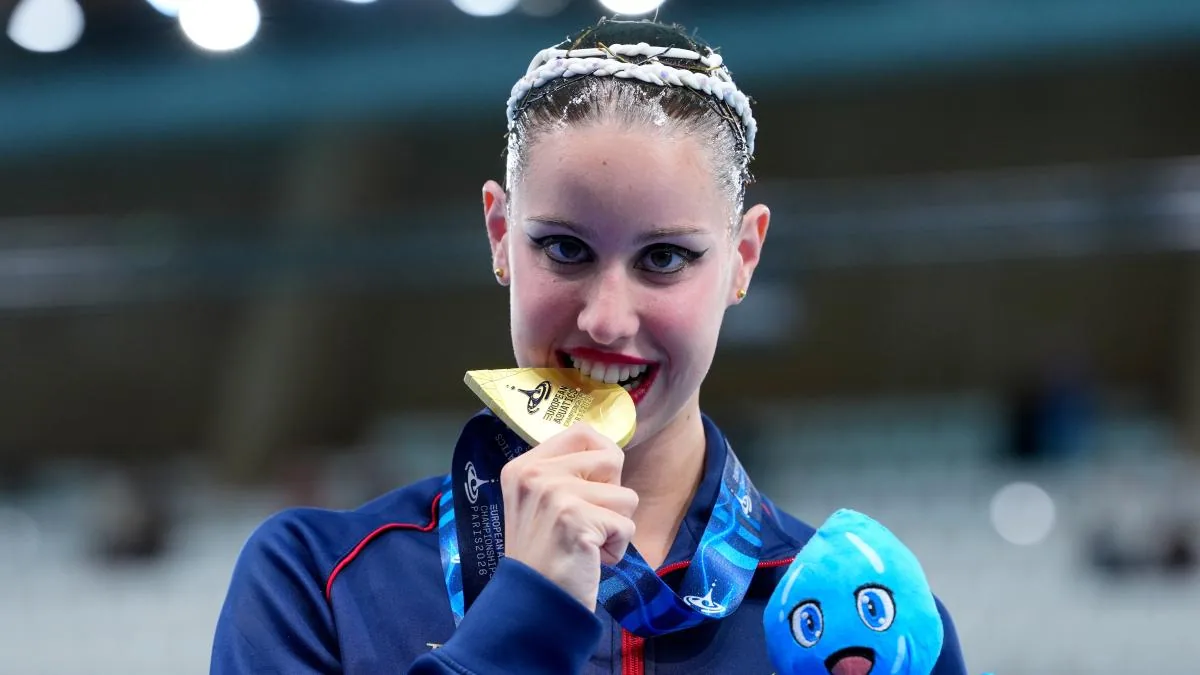
At the Yeomju Gymnasium in the remote Gwangju of South Korea, next to the football stadium where Gamal al Ghandour’s most famous refereeing took place, the Iris Tió phenomenon emerged. It was July 2019 and the Barcelonan, barely 16 years old, attended as the youngest member of the team coached by Mayuko Fujiki, which had the undisputed star Ona Carbonell, who at those World Championships set the record for the most medals won by a woman (22). Beside her, Tió, just a shy teenager with a promising future. Amid the whirlwind that the mixed zone becomes, improvised next to the locker rooms in that inhospitable place, Andrea Fuentes appeared, who at that time was beginning her journey with the United States.
“Iris? She’s the bomb, she’s the best Spain has produced,” she said with the conviction of a visionary.
She wins gold in solo to the rhythm of Rosalía with a two-tenths lead over the Belarusian favorite
Five years after that episode, Fuentes arrived at the CAR in Sant Cugat with a suitcase full of goals. One of them was to boost Iris Tió and make her the best soloist in the world (“I want her to focus there,” she said). In 2025, at the World Championships in Singapore, she won a historic gold (neither Gemma Mengual nor Ona Carbonell had achieved it) in the free solo; and yesterday, at the European Championships in Paris, she repeated a medal in the technical solo after a splendid choreography with music by Rosalía.
The Barcelonan poured all her sensitivity into the pool in Saint-Denis to win her fourth medal. Iris debuted her solo in May, at the Pontevedra World Cup. And in these months she has been refining details and gaining height and control. Tió glided over the surface with smooth figures, great expressiveness, singing the chords of Mio Cristo by Rosalía with her hands, with that ease of feeling the notes like the beats of her heart, coming from a family of musicians. Her grandmother was a composer. Her father Enric was a clarinetist and her mother Laia, a violinist when they met at an English conservatory. Tió plays several instruments and has a special ear for chords.
After the mess with Russia, the soloist and the Spanish team innovate in the technical team and win silver
Fuentes was moved by Tió’s feeling and execution (263.6250), who placed first, warmly applauded by the audience.
Then came the Belarusian Vasilina Jandoshka with music by Marilyn Manson to nail another more mechanical exercise, of greater difficulty, less exciting. And she was just a hair away from gold, which flew into the hands of the exultant Spaniard (263.3817). “I’m very happy with how I did it, I felt great. I connected with the music and was able to enjoy it,” she said poolside. This last point has been key in Iris Tió’s development, who has learned to “enjoy training thanks to Andrea’s methodology.” Added to the advice from Gemma Mengual and the work with biomechanic Andreu Roig, Tió continues to take steps to establish herself as the best soloist in the world for many more years. “She is simple, correct, attentive… She lowers her head as if she were embarrassed to be a champion. Her presence in the water is special, she is supple in her movements. She is unmatched,” explained artistic judge Gabriela Viglino.
Read more Andy Burnham ignores criticism from the right and goes on vacation
Andrea Fuentes already saw in 2019 that she was “the bomb” and in one year she is world and European champion
At just 23 years old, she already has an Olympic bronze, 12 world medals, and 14 European medals. Carbonell ended her career with two Olympic medals, 22 world medals, and 12 European medals, while Gemma Mengual collected another two Olympic medals, 19 world medals, and 15 European medals. Tió glimpses them in a synchro that, yes, has benefited from Russia’s decline and a flood of World Championships due to the pandemic.
Also read
The Barcelonan did not stop there. She won her fifth medal in the afternoon in the technical team routine, where Spain was the most artistic and innovative country.
The Barcelonan, who is the daughter of musicians, has a unique sensitivity in the water: “What she has is unmatched”
And those slogans are what she has pushed to the limit, with a choreography that earned a silver with music by American rapper Nathan John Feuerstein (NF) and a clear message tattooed on the swimsuit: “Hope.” “We go against the current,” said the coach, who has reduced the apneas and difficulty level and has focused on improving transitions between figures and innovating with hybrids, very daring, but prioritizing execution.
The result gave goosebumps, it was a routine full of energy, dynamic, sometimes slower than the speed of other schools, so that spectators could savor each figure, each element. And the judges rewarded it with a score of 296.4299. Russia was a step above with a faster, more demanding routine boasting apneas (303.2467); already in peace mode (they greeted Spain) after the plagiarism the previous afternoon in the free team final.
And today, another highlight. Rosalía’s Berghain in acrobatics. With Lilou Lluís’s most difficult figure ever and the magic of Iris Tió, who pursues her sixth medal and to extend the phenomenon she is becoming.
Read more The Ceuta crisis boosts the French far right in the race to the Élysée