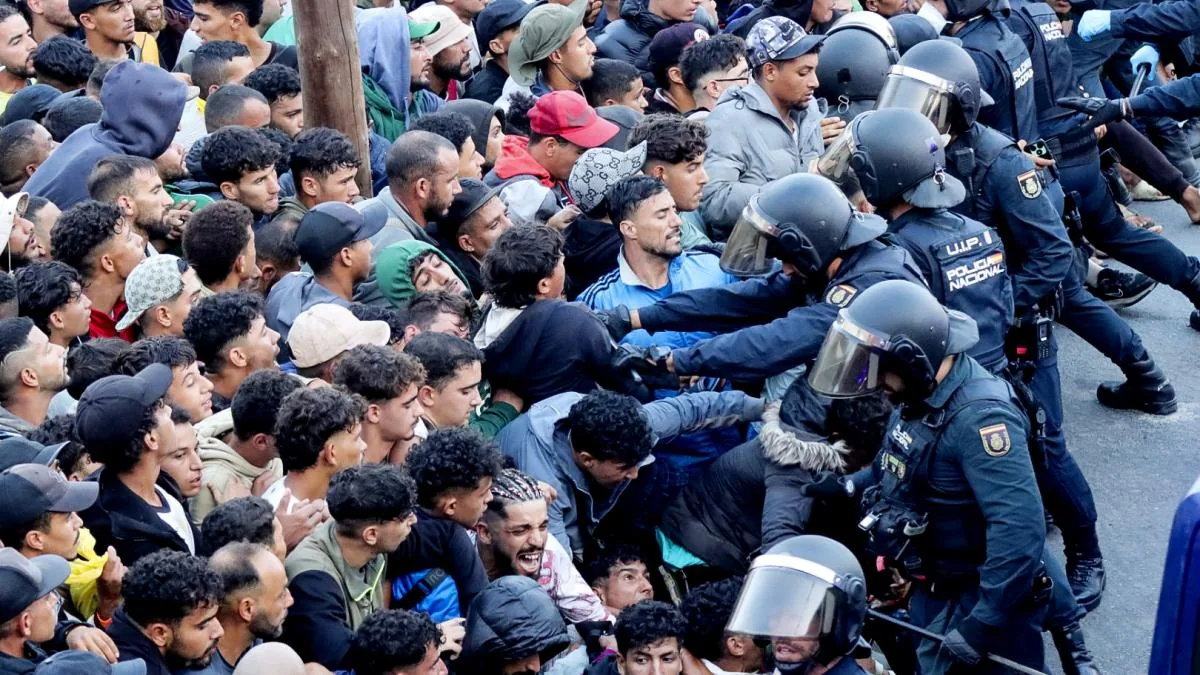
The Government’s solution to the open crisis in Ceuta still does not fit all the pieces. Neither the solemnity of a National Security Council nor the repeated proclamations that “Ceuta is today the heart of Spain” managed yesterday to hide the coordination difficulties that emerge within the coalition Government. Not only between PSOE and Sumar, regarding Morocco’s responsibility, but also within the very socialist core of the Executive.
Read more Smoke signals
Because on the very day the Executive began its appearances on the border crisis, Fernando Grande-Marlaska and Margarita Robles openly disagreed about the prior warnings from the National Intelligence Center (CNI), in a particularly significant clash as they are the heads of the Interior and Defense ministries. The two ministries responsible for security and border control.

Defense says the CNI warned of the massive entry but Interior denies that reports existed
A notable paradox considering that both ministers shared workspace for several hours yesterday, first in the National Security Council meeting and later at the Council of Ministers table. Therefore, the disagreement can hardly be attributed to one of them handling information unknown to the other.

The clash of accounts was staged with barely an hour difference. From Congress, Robles maintained that the CNI performed the work that is “required” of it regarding irregular migrant entries, sharing the information with the State security forces, dependent on Interior, and the Government Delegation in Ceuta, a point that this institution denied yesterday. Marlaska, however, offered a different version at Moncloa by asserting that there was no report, neither from the CNI nor other police services, that foresaw a massive entry of the dimensions that finally occurred.
Robles points out that information is shared in many ways and not always in writing
By the time the minister took the floor, Robles had already been speaking for over an hour and her version was therefore public. But instead of correcting herself, Marlaska reaffirmed his account, deepening the contrast with Defense.
The one who did qualify her version later was Robles. After being warned of the clash, she explained that intelligence operates “in many ways” and that written documents do not always exist. According to her, the CNI, which has 25 agents in the autonomous city, warned the National Police, Civil Guard, and the Government Delegation on July 29 about the call for the irregular swimming entry of migrants from Morocco taking advantage of the Throne Festival. A day later, the avalanche began around the El Tarajal breakwater, where more than 141 lives were lost.
Everything seems to indicate that there was some preventive communication but it may have been imprecise
In any case, the contradiction does not allow concluding, by itself, that the intelligence services failed nor that the information transferred would have been enough to avoid the crisis. But it does project the image of an Executive that, almost a month later, still does not offer a fully shared account of the greatest border crisis experienced in decades.
Meanwhile, the Government deployed a battery of measures to strengthen the State’s response and try to close the crisis. It created a single authority to coordinate action in Ceuta, a formula already considered in the first days and which Juan Vivas would have discarded then by not wanting to completely cede command. It also declared the situation of interest for national security, approved 25 million euros for the care of unaccompanied migrant minors, and also announced that the President of the Government, Pedro Sánchez, will soon appear in Congress.
A huge institutional deployment prepared to turn the page and project greater coordination capacity in future crises that, however, was partially overshadowed. Because while the Government strengthens mechanisms to respond to a possible repetition of what happened, two of its ministers still do not share the same account.
Sánchez will also attend Congress
The President of the Government, Pedro Sánchez, will also attend the Congress of Deputies to explain his position on the Ceuta crisis, as announced by the Government spokesperson, Minister Elma Saiz. However, no date was set for this appearance requested by opposition groups, particularly the PP and Vox. The President of the Government visited the autonomous city on July 31, the day the avalanche occurred, and met with Juan Jesús Vivas, its president. When Sánchez arrived in the city, a large part of the nearly 80,000 people who had crossed the fence were returning the way they came, and the Spanish Government’s discourse was focused on the hypothesis of a quick exit of those who had entered irregularly into Spanish territory. After Sánchez, most of the Government ministers have passed through Ceuta, and the initial message has changed after confirming that some of those who entered do not want to leave. From there, the Government changed its discourse: it began to think that it should prepare reception centers.
Read more The Government prepares a major screening to tackle the ‘boom’ of data centers