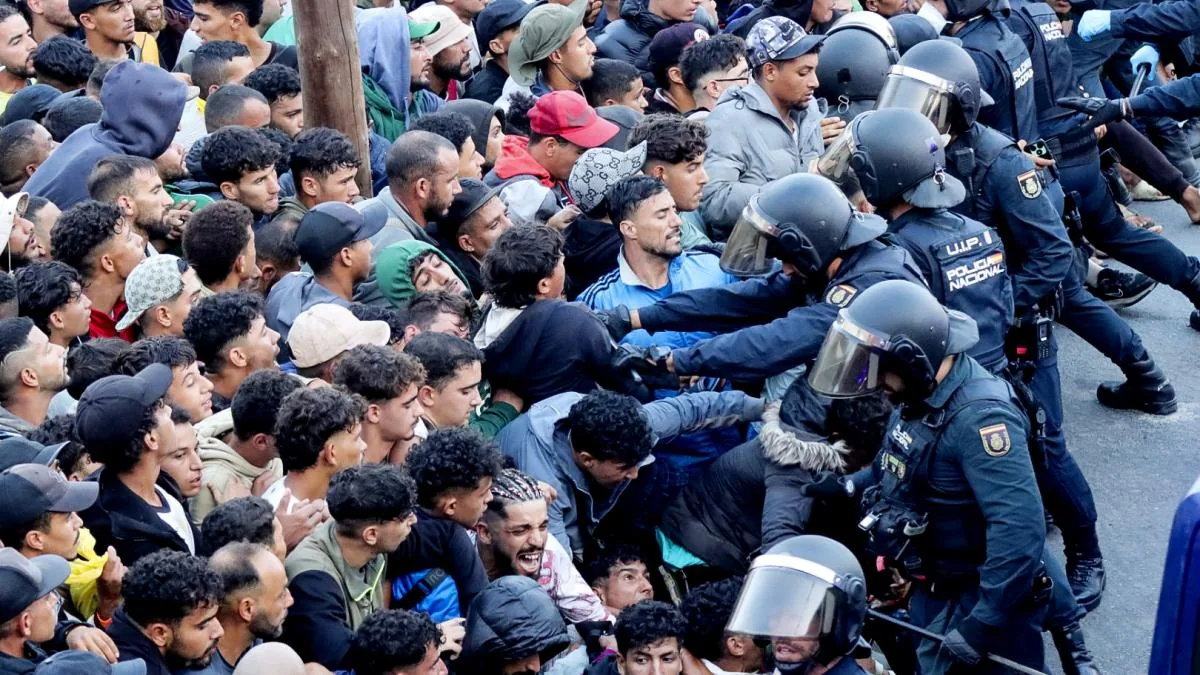
The National Intelligence Center (CNI) warned hours before the massive entry of migrants into Ceuta of a “call” to cross the Tarajal border breakwater by swimming or on foot. The secret services sent this warning via WhatsApp to the Government Delegation in the autonomous city and to the Civil Guard. They did so around 2:00 p.m. the previous day. That same afternoon, the CNI also sent an “urgent note” to Morocco to warn of the existence of a plan to enter on the 30th promoted on social networks. However, the declassified documentation released this Wednesday by the Government does not reflect that the magnitude of what was going to happen was assessed: an assault on the fence, through which more than 80,000 people entered in just 48 hours. Nor does it appear that these alerts were raised to higher authorities to act, even if with little margin.
Read more The Government admits the error in the dossier about journalists due to the inability to justify it
The CNI was not the only one to detect these movements. Both the National Police and the Civil Guard had been issuing internal reports days before about the risk of an increase in entries following the Supreme Court ruling of July 8, which prohibited rejection at the border – that is, return without administrative processing – for migrants who managed to enter Ceuta by swimming. As the days went by and the alerts continued, the reports included movements detected through social networks and instant messaging groups. An increase in neoprene sales for jumping into the sea was even detected. Just in the previous days, entries skyrocketed and this was recorded in various reports. Reinforcements at the border and even collaboration with Morocco were advised, but the now known documentation shows that such an avalanche was not foreseen. Only on the 30th, already with thousands of people entering at once, do the reports speak of “extreme risk of collapse” or “overflow” of the situation.
Also read
The Prime Minister decided to declassify these documents due to the political crisis that arose from the clash of positions between the Interior Minister, Fernando Grande-Marlaska, who assured that there were no alerts of the massive entry, and the Defense Minister, Margarita Robles, who has always staunchly defended the work of the CNI in this matter.
Once the papers became known, which will most likely end up in the case opened in the National Court, interpretations remain varied. Were there alerts or not?; was action taken or not in response to these?; was the magnitude of the entries assessed or not? That is the political reading, but it will also have a judicial reading.
The declassified documents do not show that the alerts were raised to higher authorities
Besides the difference in criteria between both ministries, another key point is Morocco’s role in all this. Interpretations also vary. The declassified papers reveal that the CNI informed what it knew on the 29th about calls for an entry into Ceuta. The Civil Guard leaned towards the thesis that Morocco was collaborating, while the National Police pointed to the Alawite kingdom as a threat with the intent to publicly demonstrate Spain’s dependence and weakness.
8.7.2026
First report. The Civil Guard alerts about the effects of the Supreme Court ruling and proposes reinforcing the Provincial Maritime Service of Ceuta for swimmer detection, as well as enhancing early detection and coastal surveillance technological systems both in Ceuta and Melilla. It is currently unknown whether these requests were attended to.
27.7.2026
Relevant facts communication form from the National Police. “Massive entry of immigrants by swimming,” linked to the Supreme Court ruling. This document alerts that from the resolution until that date, 748 people had irregularly arrived and another 492 were pending a bed at the Temporary Stay Center for Immigrants (CETI). In total, 1,240 irregular entries.
28.7.2026
The National Immigration and Borders Center of the Police (CENIF) issues an internal note. It warns of a possible increase in the risk of mass jumps during the last days of July coinciding with Morocco’s main national festivities, especially Throne Day, celebrated on July 30. This risk was based on three factors. The first, a possible temporary relaxation of Moroccan border control in the days prior to these festivities, “used as a mechanism of political pressure.”
The Government Delegate assures
he did not know about the CNI warning to his office
The second, a will to reinforce, coinciding with Mohamed VI’s main annual speech, the perception of Spain’s and the European Union’s dependence on the migratory control exercised by Morocco. And the third, the knowledge of this temporary permissiveness by migrants concentrated near the border. Although it recognized being in an incipient phase, the Police had also detected a slight increase in posts related to the offering and sale of neoprene suits and swimming fins in social media groups.
29.7.2026
The day before the massive crossing, the CENIF, a National Police unit that prepared the report for the National Court, sent a risk alert about entries in Ceuta and Melilla for July 30, coinciding with Throne Day. In the table of possible scenarios, it limits to a “medium-low” probability that both swimming entries and a coordinated jump over the fence would occur simultaneously. The CENIF transferred this information “exclusively” to the border posts of Ceuta and Melilla but qualified that it “could not be assured” that it would materialize. That same day the CNI made several warnings. To the Government Delegation Office in Ceuta, the secret services transferred, via WhatsApp, the “call for assault by fence and sea” that was being organized in two Facebook groups with a total of 180,000 followers. “To give you an idea of the scope of the dissemination,” warned the CNI member. This Wednesday, the Government Delegate, who ruled out resigning after the declassified documents came to light, assured that his trusted man did not convey the warning. Miguel Ángel Pérez Triano framed the conversation as an “informal communication exchange.” Similarly, the Civil Guard in Ceuta was informed that there was information about the attempted entries being encouraged on social networks.
At 6:26 p.m., the CNI also issued an “early alert,” but directed to Moroccan services. In it, Spanish intelligence put in black and white the identification of some “especially active” profiles in planning calls for an “assault” on the Ceuta fence, both by swimming and on foot. The CNI alert to its Moroccan counterparts included a post encouraging anyone who wanted to cross to take the Throne Day as the “last opportunity,” since the authorities would be “distracted with celebration and parades.”
30.7.2026
At 11 in the morning, the massive entry begins, reaching nearly 80,000 people in two days. The Civil Guard had arrived at July 30 with a radiography of migratory pressure on Ceuta that already pointed to an exceptional scenario. A report from the General Staff that day had confirmed that the situation had reached a critical peak during the previous days, coinciding with the call effect generated by the Supreme Court ruling and Throne Day. Not surprisingly, between July 13 and 26, 1,380 entry attempts had been counted, 201% more than at the end of June, and 253 completed entries, 837% more.

The Civil Guard itself already considered then that the situation was of “extreme seriousness” and entailed an imminent risk of a humanitarian crisis due to the possible saturation of the autonomous city’s resources. The report warned, however, that the deployment was “overwhelming” the ordinary capacity and was “insufficient” by itself.
The CNI warned its Moroccan counterpart a day before the avalanche about the calls on social networks
In parallel, the Civil Guard intelligence ruled out as a probable hypothesis that Morocco was using migratory pressure as an instrument of blackmail or retaliation against Spain, contrary to the Police’s position. The Information Headquarters report concluded that it did not see it likely that in that specific case the massive passage of swimmers had been “allowed or encouraged” by Rabat.
That day, several Civil Guard reports establish a situation of extreme seriousness or overflow as groups of people were managing to access directly through the border breakwater.
31.7.2026
The CENIF already speaks of “extreme risk of collapse.” Meanwhile, the CNI warns of Morocco’s “non-proactive” attitude, contrary to what the Civil Guard detects, which in a final report acknowledges that they expect from that day on a “proactive attitude” from the Moroccan Security Forces to help ease the situation.
Read more Mediapro reinvents itself and maintains its commitment to Barcelona