Long before the Earth existed and the first living beings began to populate it, the universe was already capable of producing some of the molecules that, billions of years later, would become part of the chemistry of life on our planet. This is the main conclusion of an international study led by the Center for Astrobiology (CAB-CSIC/INTA), in Torrejón de Ardoz, with broad participation from Spanish institutions and collaboration from research centers in the Netherlands, Italy, Germany, and the United States.
Read more Leaving your house because it has been occupied by a colony of protected bats
The work, published in Nature Astronomy, describes the first detection of erythritol in a molecular cloud, a sugar made up of four carbon atoms. “The significance of this discovery is that sugars are fundamental compounds for life because they form the backbone of RNA and DNA,” explains Izaskun Jiménez-Serra, researcher at the Center for Astrobiology and lead author of the study, to La Vanguardia. Although it does not play a direct role in human metabolism, as glucose does, it holds notable interest from the perspective of prebiotic chemistry because it can be transformed into other sugars involved in the formation of the first nucleic acids, the molecules responsible for storing the genetic information of all living beings.
In recent decades, researchers have discovered dozens of organic molecules in space related to the processes that preceded life. However, until now, no sugar had been unequivocally identified. The paradox was that compounds like ribose or glucose had appeared in primitive meteorites and even in samples from the asteroid Bennu, suggesting they must have originated before the formation of these bodies. The new study places this scenario in the vast regions of interstellar gas and dust where stars and planetary systems are born.
The footprint of a sugar among the stars
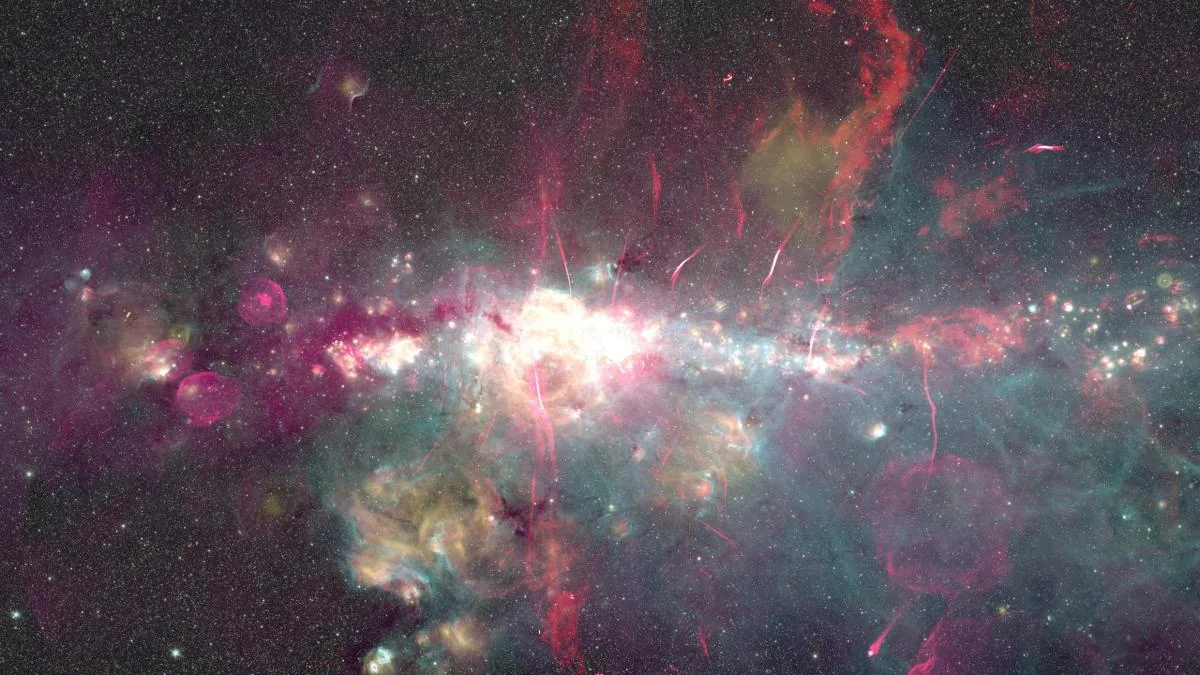
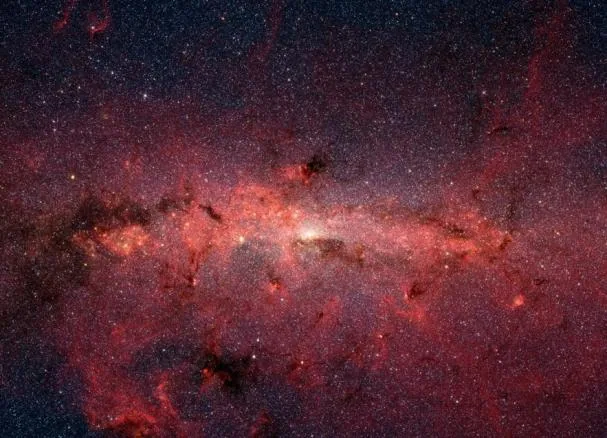
Erythritol was detected in G+0.693−0.027, an extensive molecular cloud located near the center of the Milky Way, about 27,000 light-years from Earth. Far from being an empty environment, these regions host intense chemical activity and constitute some of the best natural laboratories to study how increasingly complex molecules form in space.
This cloud is not surprising for the first time. In recent years, prebiotic interest compounds such as ethanolamine, a component of cell membranes, have been identified there.
To identify the sugar, the researchers used the Yebes 40-meter and IRAM 30-meter radio telescopes, in Guadalajara and Sierra Nevada respectively. These instruments do not observe the universe through images but record the radio waves emitted by molecules as they rotate. Each produces a unique combination of frequencies, a kind of fingerprint that allows recognition even thousands of light-years away.
The team compared that signature obtained in the laboratory with the signals recorded by both radio telescopes. The match was so precise that it allowed the identification of 17 spectral transitions of erythritol, six of them practically free from interference from other molecules. The authors calculate that the probability of this match being due to chance is only 0.2%.
Read more The TS points out that Spanish cannot be excluded from the signage of Catalan schools
An unexpected abundance
It is usual for molecules to be less abundant the larger their size. However, erythritol breaks this trend. Based on the detection limits obtained by the radio telescopes, the researchers conclude that this sugar is at least eight to seventeen times more abundant than two simpler three-carbon sugars, which were not even detected.
To understand this result, the team used quantum chemistry models and computer simulations. Their hypothesis is that erythritol forms on tiny dust grains covered by a thin layer of ice. There, much simpler molecules react with each other to build a more complex sugar. The simulations reproduced quantities very similar to those observed with the telescopes, supporting that this complex sugar can be synthesized spontaneously in the interstellar medium.
One more piece in the origin of life
“Our result shows that complex compounds like sugars could form in the parent nebulae of planetary systems, even before stars and planets formed inside them,” clarifies Jiménez-Serra. This possibility fits with the presence of sugars detected in some primitive asteroids but does not by itself prove that these compounds ended up participating in the origin of terrestrial life.
This interpretation aligns with the caution requested by César Menor Salván, astrobiologist and professor of Biochemistry at the University of Alcalá. In statements provided by Science Media Centre España, he recalls that the study only demonstrates the presence of erythritol in a molecular cloud and not that this sugar reached Earth or participated in the origin of life. “Just as seeing people get off a plane at an airport does not imply that all the people in the city arrived by plane,” he exemplifies.
After this discovery, the team’s next goal is already defined. “We want to continue searching for other sugars, such as ribose, which is part of RNA,” Jiménez-Serra previews. “We also want to understand how these sugars behave under the extreme conditions of interstellar nebulae, with ultra-low temperatures and in an almost absolute vacuum.”
The finding does not resolve how chemistry made the leap to biology, but it does push back the origin of some potentially relevant ingredients for life by one step. If some sugars could already be synthesized in the interstellar clouds where stars and planets are born, the raw material necessary for the development of life could have been available even before the formation of the Solar System.
Read more Former mayor of Sant Feliu de Guíxols arrested for masturbating in a hotel pool in Santa Susanna