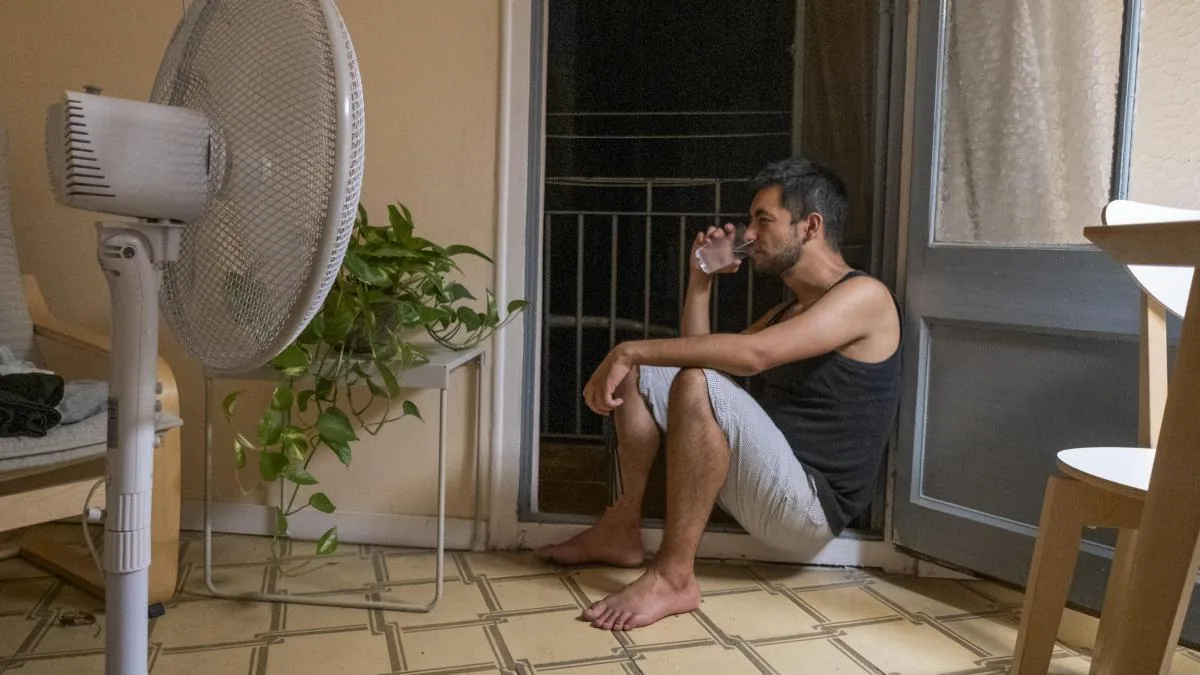
A Climate Central analysis calculates that, between 2020 and 2025, nighttime heat caused the average person to lose about 56 hours of sleep per year. Of that time, about six hours — roughly equivalent to a full night of rest — are directly attributable to global warming caused by human activity.
The report analyzes 1,338 cities worldwide and concludes that this footprint of climate change on sleep continues to grow. In Barcelona, for example, residents lose an average of 39 hours of sleep per year due to high nighttime temperatures. Five of those hours — 12% of the total — would not exist on a planet without anthropogenic warming.
Although six hours a year may seem few, researchers remind that they approximately equal a full night of sleep lost solely due to the effect of climate change. Moreover, this effect accumulates with other factors that usually impair rest, such as stress, work schedules, exposure to screens before sleeping, or certain illnesses.
A problem affecting the health of millions of people
To fall asleep, the body needs to cool down. During the hours before rest, the core body temperature drops by about one degree thanks to the dilation of blood vessels, which facilitates heat release to the environment. When the air remains too warm, this mechanism loses effectiveness and increases the likelihood of awakenings and more fragmented sleep.
The American Academy of Sleep Medicine considers that, for most adults, the most favorable bedroom temperature is between 16 and 21 ºC, although there is variability among individuals.
Sleeping less than seven hours regularly not only causes tiredness the next day. It is also associated with immune system disorders, poorer physical and intellectual performance, a higher risk of accidents, and, in the long term, obesity, diabetes, hypertension, cardiovascular diseases, and increased mortality.
How to calculate lost sleep hours
To estimate this impact, researchers used a mathematical relationship developed by Kelton Minor’s team and published in 2022 in the journal One Earth. That study analyzed hundreds of thousands of nights recorded via sleep monitoring bracelets and calculated how sleep duration changes as the minimum nighttime temperature rises. The Climate Central team subsequently applied that relationship to temperature records from the ERA5 climate reanalysis, produced by the European Centre for Medium-Range Weather Forecasts (ECMWF), which reconstructs daily weather conditions worldwide.
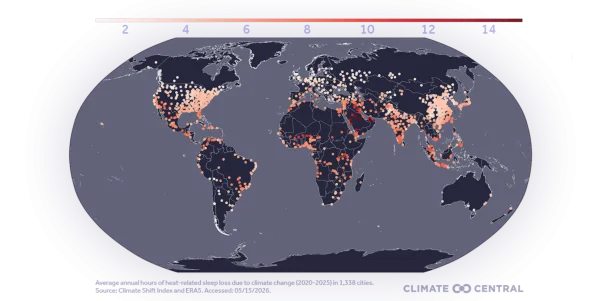
The key to the work was to perform the calculation in two scenarios. One with the temperatures actually observed and another with counterfactual temperatures, those which, according to climate models, would have existed in a world without warming caused by human emissions. The difference between both scenarios allowed estimating what part of the sleep loss can be specifically attributed to climate change.
Read more These are the reasons why David Sánchez does not have to return the money despite his conviction
The analysis shows that the contribution of climate change to sleep loss has doubled globally in the last 50 years. In the early 1970s, global warming explained about two hours of annual sleep loss per person. Between 2020 and 2025, that figure is already around five or six hours per year. In 1,335 of the 1,338 cities studied, that contribution has at least doubled, and in 840 it has even tripled.
Nights warm faster than days
One of the most striking aspects of the report is that nighttime temperatures are increasing even faster than daytime ones. The problem worsens in cities, where asphalt, buildings, and other urban surfaces absorb solar energy during the day and release it slowly at night, fueling the well-known urban heat island effect. Barcelona is an example of this trend. Tropical nights, those in which the thermometer does not drop below 20 ºC, are increasingly frequent and make it difficult for homes to recover a comfortable temperature before dawn.
The consequences of all this are especially marked among people over 65 years old, those living in middle-low income countries, women, and those residing in regions that already have high temperatures.
Where sleep is worse due to heat
The greatest sleep losses related to climate change are concentrated in the Middle East. “In cities like Djibouti, Aden, or Al Hudaydah, the population loses on average more than 90 hours of sleep per year due to high nighttime temperatures. That roughly equals one night of lost sleep each month,” explains Kristina Dahl, Vice President of Science at Climate Central, to La Vanguardia. Between 2020 and 2025, residents of cities in Saudi Arabia, Oman, and the United Arab Emirates lost between 55 and 87 hours of sleep per year due to high nighttime temperatures, of which 12 to 16 hours are attributable to global warming. High losses are also recorded in cities in southern India, Southeast Asia, and West Africa, where nights were already very warm before climate change. In America, the greatest impacts are observed in the southwestern United States, Mexico, Guatemala, Colombia, and Venezuela.
The authors warn that their figures are probably underestimated. The use of air conditioning can reduce part of the problem but still largely depends on income level. Additionally, it consumes energy that still largely comes from fossil fuels and expels heat outside, reinforcing the urban heat island effect, which in turn feeds global warming.
Looking ahead, Dahl predicts that Europe — the continent warming the fastest — and tropical regions will experience some of the greatest increases in heat-associated sleep loss. In the latter, she explains, “relatively small increases in nighttime temperature can cause much greater sleep losses because they already start from very warm nights.” Warm nights have always existed; what is changing is their frequency and intensity. Climate Central’s analysis suggests that global warming is turning what was once an occasional phenomenon into a new daily pressure on health.