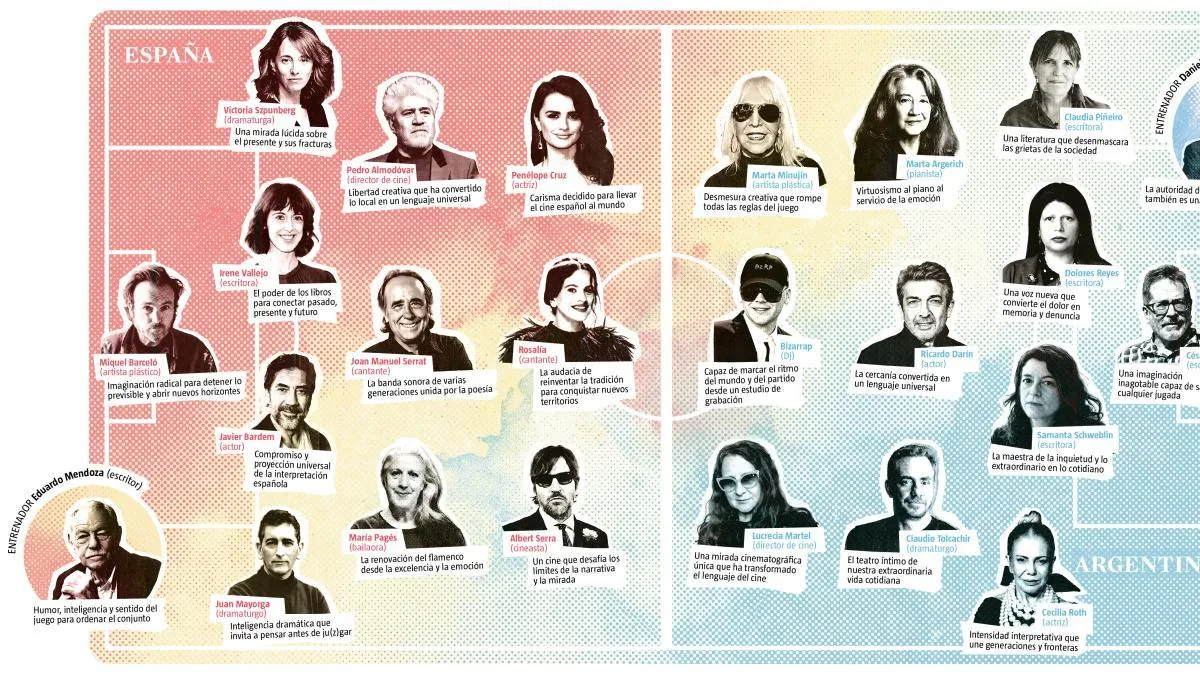
Sports rivalry has no parallel in culture, as in creativity there are usually no winners or losers and the boundaries are increasingly blurred in a culturally global world. However, today’s match between the football teams of Spain and Argentina serves as a pretext to compare, without any claim to exhaustiveness, the current situation of both nations in the literary, artistic, cinematic, theatrical, or philosophical fields.
Read more France wakes up too late but Mbappé is already touching the Golden Boot after a double.
With traditions showcasing overwhelming names such as Cervantes and Lorca or Borges and Pizarnik, those of Astor Piazzola and Carlos Gardel or Paco de Lucía and Manuel de Falla, those of Luis Buñuel or Adolfo Aristarain, those of Velázquez and Goya or Antonio Berni, Spain and Argentina continue to maintain a unique conversation on both sides of the Atlantic.
They share language, literary tradition, and a history of mutual influences and disagreements. Alongside all those names from the past, the current generations of writers, filmmakers, actors, musicians, and visual artists once again demonstrate that the dialogue between these two Spanish-speaking cultural powers remains alive, with numerous examples of creators who could also choose the jersey of either team, from writer Andrés Neuman to playwright Victoria Szpunberg.
Among the most notable current phenomena, we can mention – in a list that would never end – writers Mariana Enríquez or Irene Vallejo, singers Rosalía or Nicki Nicole, series like La casa de papel or El encargado, artists Cristina Iglesias, Marta Minujín or Jaume Plensa, filmmakers Pedro Almodóvar, Lucrecia Martel or J.A. Bayona, playwrights Angélica Liddell or Claudio Tolcachir… Any of them – and many others – could have been in our starting elevens.
Argentina
Cinema
Argentine cinema has found one of its greatest strengths in the observation of everyday reality. From Leopoldo Torre Nilsson to the new Argentine cinema of Lucrecia Martel, author of La ciénaga, Pablo Trapero or Lisandro Alonso, Argentine films have developed a perspective deeply linked to characters, social contradictions, and the wounds of recent history. Works like La historia oficial by Luis Puenzo or Argentina, 1985 by Santiago Mitre show how cinema has become a privileged space to reflect on dictatorship, memory, and the democratic construction of the country.
The great virtue of Argentine cinema perhaps lies in its ability to combine dramatic depth and narrative ingenuity. Films as different as El hijo de la novia and El secreto de sus ojos by Juan José Campanella; Nueve reinas by Fabián Bielinsky; Relatos salvajes by Damián Szifron; or the now classic Esperando la carroza by Alejandro Doria, share the same skill in portraying the passions, contradictions, and obsessions of Argentine society. They are deeply local stories that, without renouncing their identity, have managed to connect with audiences worldwide. Aitziber Azpeitia
Thought
Perhaps the most appropriate figure of Argentine thought for the occasion of a World Cup final is Darío Sztajnszrajber, the philosopher who fills stadiums and sports centers with his sessions on the subject, becoming a great popularizer with books like Filosofía en 11 frases or El amor es imposible. After the disappearance in recent years of thinkers like Ernesto Laclau, Enrique Dussel, or José Pablo Feinnmann, who reached nine seasons of his program Filosofía aquí y ahora, today one of the country’s thinkers with the greatest international projection – albeit from Brazil – is anthropologist Rita Segato, a scholar of power and domination relations between genders. Diana Maffia is also a reference in gender theory. Dardo Scavino won the Anagrama essay prize with El sueño de los mártires, about Islamist terrorism, or Máquinas filosóficas, about how philosophy has linked the problem of freedom and equality with the issue of machines so topical today. Other thinkers include Ricardo Forster, with essays like La sociedad invernadero, or art historian José Emilio Burucúa, whose essay Civilización. Historia de un concepto has been one of the most celebrated in recent years. Justo Barranco
Art
No one doubts the power of Argentine art, but unlike literature or cinema, its lack of visibility on this side of the Atlantic is somewhat puzzling. “They don’t need the rest of the world to exist, they have that Argentine self-love and are so self-sufficient that their own scene serves as their engine,” points out historian and curator Ferran Barenblit, a Buenos Aires native who has spent practically his entire life in Barcelona. From Lucio Fontana to León Ferrari, Xul Solar, Víctor Grippo, Lidy Prati or Yente, what has historically characterized their artists is their irreducible nature and independence from international market mandates. Something inherited by Leandro Erlich, Julio Le Parc, Eduardo Stupía, Liliana Porter, Villar Rojas, Horacio Zabala, Ignacio Liprandi, Mirtha Dermisache or Marta Minujín, their main star. But if there is one area where they beat us hands down, it is in collecting, with figures like Eduardo Costantini, thanks to whose donation of more than 200 works, Buenos Aires enjoys the best Latin American art museum in the world, the Malba. Teresa Sesé
Theater
Since the times of Margarida Xirgu, who lived between Uruguay and Argentina, Argentine theater has established connections with that on this side of the pond, which still remain today. Playwright and director Claudio Tolcachir, for example, who founded the company Timbre 4, collaborates with Temporada Alta in the Ibero-American version of the festival. His play La omisión de la familia Coleman has been a great success, performed in its Catalan version on several stages. Recently, Lola Herrera and Natalia Dicenta have toured the Peninsula with their version of Camino a la Meca, which he himself directs. Nelson Valente is another playwright and director who often works with Catalan companies, as in the case of the latest play by T de Teatre Avui no ploraré, written and directed by him, or the direction of Primera llei de Newton by Eu Manzanares, and Vània performed solo by Joel Joan. In the field of acting, Ricardo Darín has been prolific on Spanish stages, as a few years ago with Art by Yasmina Reza, an extraordinary success, or currently with his intermittent visits with Escenas de la vida conyugal, which he performs with Andrea Pietra. Magí Camps
Literature
If one author stands out in current Argentine literature, it is Mariana Enríquez, who has become a star with international tours with readers of all ages, many of whom are young. She has turned horror into high literature – if it wasn’t already – as shown in Nuestra parte de noche (Anagrama, Herralde prize), a road trip with an order with bloody rituals without avoiding historical criticism of the dictatorship.
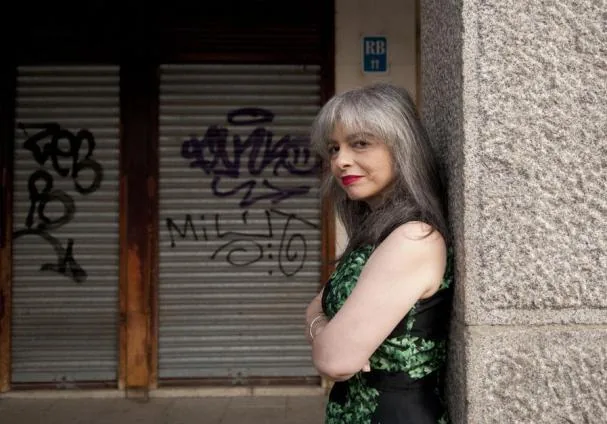
On the other hand, César Aira is one of the most prolific writers today, with a literary production idea that brings him closer to contemporary art, besides publishing both with major publishing houses and humble cartoneros. Claudia Piñeiro, a master of noir literature – though not only that – winner of major genre awards like Pepe Carvalho or Dashiel Hammett, is also notable. One of the surprises in recent years is Dolores Reyes with Cometierra (Alfaguara) and its sequel Miseria (Alfaguara), which crosses the theme of femicides and violence against women with supernatural phenomena.
And we must not forget the great tradition of journalism with a literary breath in the wake of Rodolfo Walsh, with essential exponents like Leila Guerriero or Martín Caparrós. Francesc Bombí-Vilaseca
Read more Lamine Yamal versus Messi, the triumph of La Masia
Music
The land of Gardel and Charly García has long been at the forefront of new sounds, with Bizarrap, María Becerra or Trueno leading the new sounds. However, it has not been a chainsaw transition but a progression where trapper Duki tours with guitar, bass, and drums, and gifts cuts from Rage Against the Machine to remind that he comes from rock. The same can be said of Ca7riel & Paco Amoroso, a duo that adds Latin sounds live or travels to Sting’s refuge to get inspired for their latest album. Not forgetting the classical virtuosity of pianist Martha Argerich. In any case, the current music scene is marked by football as shown by the list of the most listened to songs on Spotify by Argentines. La cuarta estrella by Palmito stands out at the top of a list where titles like Pa’ la selección, Argentino soy yo, Hoy juega la selección, La Scaloneta ya llegó or La mano de Dios can be found, as well as the very patriotic Marcha de las Malvinas, composed in 1940 and now recovered to support the same claim that the albiceleste players took to the field after beating England. Sergio Lozano
Spain
Thought
With books like El futuro de la democracia or Una teoría crítica de la IA, Daniel Innerarity has become a reference figure alongside thinkers like Javier Gomá and his Filosofía mundana. An internationally influential thinker is Paul B. Preciado with books like Manifiesto contrasexual or Dysphoria mundi, in which he rewrites gender theories and the upheavals of the end of patriarchal-colonial capitalism. Marina Garcés is a key figure with her thought of action and conscious emancipation of our interdependence in books like Ciutat princesa, Filosofía inacabada or Nueva ilustración radical. The philosophy of language, memory, and humanism of Emilio Lledó coexist with the ethical reflections of Victòria Camps and Adela Cortina. There are more classic names, such as José Luis Pardo, Santiago Alba Rico, Fernando Savater or José Antonio Marina. Not forgetting Remedios Zafra and her reflections on the conditions of intellectual work, the philosophy intertwined with music of Ramón Andrés, the exposed thought of Josep Maria Esquirol (La resistencia íntima) and that of the human being as heir of the world but about to lose it in the empire of haste by Joan-Carles Mèlich (La fragilidad del mundo). J. Barranco
Literature
From La verdad sobre el caso Savolta in 1975 to the recent La intriga del funeral inconveniente (Seix Barral), Eduardo Mendoza remains one of the most prominent Spanish writers, among whom at least another Barcelonan like Enrique Vila-Matas stands out, with a work always surprising that mixes reality and fiction as in his great Historia abreviada de la literatura portátil (Anagrama, 1985).
Fernando Aramburu started as a poet and then moved to narrative, but his work became popular especially from Patria (Tusquets, 2016). Rosa Montero or Sara Mesa should also be highlighted, and especially the latest literary phenomenon, David Uclés, since he published La península de las casas vacías (Siruela, 2024) and continued with La ciudad de las luces muertas (Destino, 2026), although in recent months Lucía Solla Sobral and her Comerás flores (Asteroide) have also stood out a lot.
But not all authors with Spanish identity documents write in Spanish, and to mention just a few, in Catalan there is the great work of Quim Monzó, or that of Sergi Pàmies, but also the more current works of Irene Solà or Eva Baltasar; in Basque, besides the already classic Bernardo Atxaga, we can count on Eider Rodríguez and Miren Amuriza; and in Galician we can mention the tireless Manuel Rivas or Suso de Toro. F. Bombí-Vilaseca
Art
If Spanish and Argentine art had to face off in a final, the match would surely end in a draw if that is even possible. In the country of Picasso, Miró, and Dalí, artists are divided between those who cause a sensation at auctions, with Miquel Barceló and Antonio López at the forefront; those who enjoy great international projection, such as Cristina Iglesias, Jaume Plensa or Antoni Muntadas, to name three examples of creators playing in very different leagues, and then there are those who more discreetly, without stridency, set the general tone and whose works are coveted in major international collections: Ester Ferrer, Luis Gordillo, Isidoro Valcárcel Medina, Joan Fontcuberta, Dora García, Ignasi Aballí… Obviously many are missing and practically all have learned to play on a rocky terrain where, in the absence of strong and determined collecting, it is the public museums and art centers that set the pace. Their role has been decisive in the existence and consolidation of several generations of artists. T. Sesé
Cinema
Spanish cinema has historically lived between two complementary impulses: the will to portray the country’s social reality and a constant search for new forms of expression. From Luis Buñuel to Pedro Almodóvar, passing through Carlos Saura and Víctor Erice, it has built a filmography capable of combining the auteur’s gaze with remarkable international projection. Films like El espíritu de la colmena, Cría cuervos, Todo sobre mi madre or Mar adentro not only rank among the great titles of its recent history but have also served to explore issues related to historical memory, social transformations, and identity conflicts. That ability to reinvent itself remains one of its great strengths. If Almodóvar turned the cultural explosion of the transition into a universal brand, directors like Alejandro Amenábar, J.A. Bayona or Rodrigo Sorogoyen have consolidated an industry capable of dialoguing with the general public and international festivals. More recently, filmmakers like Carla Simón and Oliver Laxe have reinforced the prestige of auteur cinema, while Javier Ambrossi and Javier Calvo represent a new generation that has expanded the creative boundaries of the industry. Their award for best direction at Cannes for La bola negra confirms the excellent moment Spanish cinema is going through. A. Azpeitia

Theater
The theater world has numerous figures who succeed internationally. Among playwrights, Juan Mayorga has seen some of his works, like El chico de la última fila, which has a French film version by François Ozon, performed in about thirty countries, as well as Himmelweg (Path to Heaven), with versions in about twenty. In contrast, Jordi Galceran raises the stakes to 60 countries with El mètode Grönholm, a comedy about personnel selection that remains very much alive and also had its film version. A playwright and director with dual nationality but who writes in Catalan is Victoria Szpunberg, who was the first author to direct her own text in the main hall of the TNC, La tercera fuga. The theatrical connection established with Greece should also be mentioned, thanks to the translator from Catalan to Greek Maria Chatziemmanouil, who has facilitated the premiere in Greece of works by Marta Buchaca, Josep M. Miró, Marta Barceló, Cristina Clemente, Pau Miró, Sergi Pompermayer or Guillem Clua, among others. M. Camps
Music
Although rock and pop continue to be the most listened to music by the majority of the population according to surveys, Rosalía has become the queen of the genre with an album, Lux, that has literally elevated her to the altars and put Spanish music in a position it hadn’t reached since Los del Río’s Macarena – less praised but infinitely more danced – or Massiel’s La, la, la. Incidentally, the one from Sant Esteve Sesrovires certified that for some time now it is imperative to sing music in Spanish (although she uses a dozen languages) to sneak into the most listened to, no matter if one is Canarian like Quevedo, Puerto Rican like Bad Bunny, or Colombian like Shakira.
Below the big sales figures, there is a substratum of guitar bands populated by Carolina Durante, Alcalá Norte or Viva Suecia, fueled by the thousand festivals organized in the country, as well as the rise of live music that also reaches Oques Grasses with their four Olympic stadiums in October or, more recently, the massive concerts of ETS and Zetak, spokespersons of the new music in Basque. Tanxugueiras could also be included here, without such mass success but champions of a folk recovery current where new sounds appear like those promoted by the irreverent Rodrigo Cuevas or the root electronic music of Baiuca. S. Lozano
Read more Communicating vessels