
Isabel Díaz Ayuso’s visit to Mexico continues to chain episodes of tension and verbal clashes with President Claudia Sheinbaum, who has accused her of displaying “ignorance” and a lack of historical knowledge about the figure of Hernán Cortés in what is already the third clash between them in just three days.
Read more Orriols and the Catalans, first
In this latest confrontation around the Extremaduran conqueror, Sheinbaum reacted by recalling that the violence exercised by Cortés against indigenous peoples was documented in Spain itself at the time, where, she emphasized, “they did not want him.” This has contributed to raising the tension to the point of transforming a tour initially presented with an economic profile into an ideological confrontation with international repercussions.
The Madrid opposition has been describing the political formula of the popular leader in similar terms for years. “She seeks provocation to then victimize herself with the reaction,” agree sources from Más Madrid and PSOE-M. And they maintain that this is exactly what has happened during this week. The regional president has taken advantage of her institutional trip to claim the Spanish conquest, defend mestizaje against “hate speeches,” and attack Morena, the ruling Mexican party, warning, as she has done in recent hours, that the country is “two steps away from going down the path of Venezuela.”
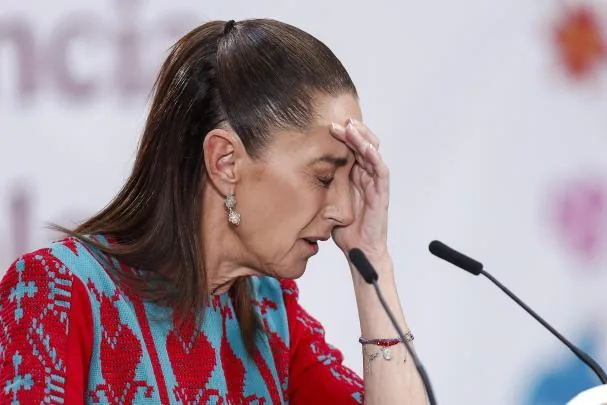
The statements have found a strong response from Mexico City, to the point that Sheinbaum herself has publicly questioned the political sense of the visit and has attacked those who have supported it. “Why is this person coming to Mexico? What are they bringing her for?” asked the Mexican president, who accused the right of seeking legitimacy through Ayuso’s figure and even called those who organized her agenda “outdated.”
This frontal clash with the Mexican leader has automatically raised the political profile of a tour that, otherwise, would probably have remained on the margins of international news. And it is precisely there that the Madrid opposition places the true political objective of the trip: to project Ayuso’s figure internationally as one of the main conservative references against the Latin American left and the government of Pedro Sánchez.
The succession of Ayuso’s international trips during her three terms outlines, according to her political adversaries, “an increasingly evident attempt to consolidate her own external projection, especially in conservative and ultraliberal spaces in Latin America and the United States.” The Madrid leader has traveled up to five times to the U.S. in just four years, cultivating political and ideological ties with sectors close to the new international right. She has also tried to dispute Vox part of the symbolic ground of the so-called “culture war,” presenting herself before leaders like Javier Milei — whom she decorated with Madrid’s gold medal — as one of the Spanish references of that conservative offensive.
Read more A tourist from the United States on vacation in Mallorca requests political asylum for fear of Trump
Mexico has now become the latest stage of that strategy after Ayuso has led tributes linked to the figure of Hernán Cortés, defended the “purity” of Hispanic-American mestizaje, and denounced attempts to “rewrite history.” From Más Madrid, the tour is described as a “colonialist performance” aimed more at feeding an ideological narrative than closing useful agreements for Madrid.
That criticism connects with another recurring accusation from the opposition: the opacity and scant institutional balance of the Madrid president’s international trips. PSOE-M and Más Madrid maintain that neither the trips to the United States nor the current Mexican tour have materialized in relevant agreements or tangible investments for the region. In return, they denounce, Ayuso has indeed managed to strengthen her international political brand as the main antagonist of Pedro Sánchez.
The controversy escalated even more after the images recorded in Aguascalientes. There, a Morena leader interrupted an institutional event where Ayuso was to receive an official recognition and unfurled a protest banner before being removed. Concentrations and protests have also followed at some of the public events of the Madrid president. Scenes that, according to the opposition, fit perfectly into the political narrative Ayuso pursues: that of a leader harassed by the international left and turned into a symbol of ideological resistance.
The controversy has also ended up moving to the Madrid Assembly, where the entire opposition — including Vox — took advantage of Thursday’s plenary session to attack the regional president for her Mexican tour and for her absence from the chamber. Más Madrid has even called her “ridiculous” and “fanatic” for claiming the figure of Hernán Cortés, while PSOE-M has criticized the cost of the trip and questioned the lack of transparency in the figures, as well as accusing her of using public resources for a personal political agenda.
Even Vox, a usual parliamentary ally of the Madrid PP, has reproached the president for “campaigning” in America and demanded that she clarify “the objective of her permanent” international tour. From the PP, however, their spokesperson defended that Ayuso acts as “the best ambassador” of Madrid and claimed her foreign policy as a tool to attract investment and talent to the region.
Read more Trump and Lula smooth over differences in a low-profile meeting at the White House