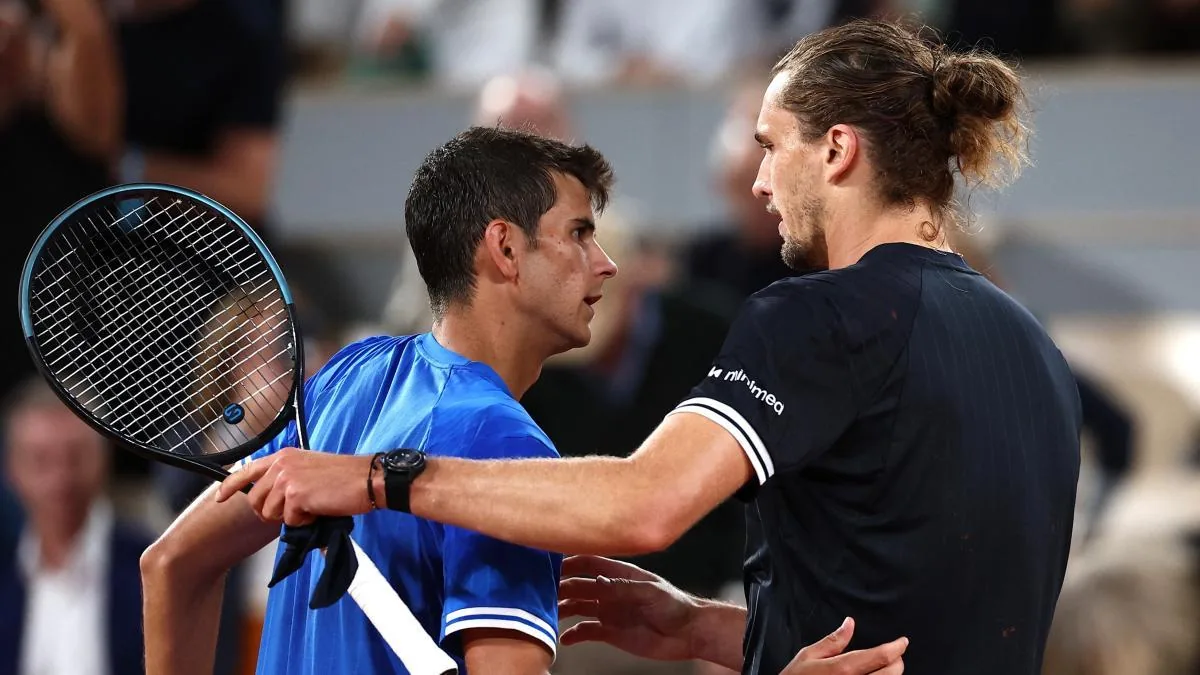
Closing the first set in his favor, in 63 minutes, Sasha Zverev must have felt relief.
Read more “The great advantage of Sánchez is that almost no one benefits from elections”
Suddenly, the road was downhill. Rafa Jódar (19) was bending. Pressured, the Madrid talent was shrinking. His forehand was losing effectiveness. The serve was not giving him free points. The long rallies were going to the German’s side.
Alea jacta est: his dream was turning into a nightmare.
And with Jódar’s decline, Zverev took off. An hour and a half later, he closed these quarterfinals of this bewildering Roland Garros.
What a relief!, the German must have said to himself.
At 29 years old, the doors of Paris are opening for Zverev. His time has come to shake off the stigma that, behind the scenes, detractors have hung on him: according to them, Zverev is the best tennis player in history who has never won a Grand Slam.
His time has come, or so it is believed in the tennis world.
This is his moment, he says quietly and the observers shout. Perhaps, this Sunday, Zverev will proclaim himself king in chaos. King in chaos: after all, no one understands this tournament.
Cobolli, Arnaldi, Berrettini, Mensik, even Jódar… very few would have named these in the list of quarterfinalists of the tournament. What happened to Sinner, Djokovic, Medvedev, Ruud, Tsitsipás…?
The usual classics have been falling with their boots on, executed by the Indians.
The Indians are this string of unexpected names among which Zverev stands out, well by himself.
Read more PSOE raises payments to Leire Díez for communication consultancy from 15,612 euros to 44,859 euros
The moment is this one and no other, the gods will not always conspire in his favor as they are doing this June, betting on him, and that is why Zverev, frowned and cursed because of past episodes (not least, the domestic violence case from which he was acquitted in 2024 after paying 200,000 euros to his ex-partner), feels relief when the first set, decided in the tie break, goes his way.
The road goes downhill: all shots flow for Zverev. The forehand is a sledgehammer and the two-handed backhand down the line, a delight. Up to that point, Zverev endured Jódar’s start, a charging start, as young players like, especially Alcaraz, and having overcome that moment, he settled in. If Zverev feels anything after these years of uncertainty, it is confidence. And relying on confidence, he stuns Jódar.
From his box, Rafa Jódar Sr., this time accompanied by Dr. Ignacio Pérez Buendía, doctor of the Spanish Tennis Federation, watches the events in silence. There is little he can do now: he can only see that Zverev, at this point, is a wall too high for his son.
Soon, Jódar sees the second set slip away from him.
Now it is Zverev’s party, this giant who places the first serves, often above 200 km/h, and relying on those fundamentals, dispatches Jódar: now a serve-and-volley, now an angled serve followed by a down-the-line backhand, Jódar always cornered, Jódar always feeling the superiority of his opponent.
For now, Zverev is stronger, more physical, and more technical: he moves within parameters superior to those of the Madrid player, a newcomer to professional tennis who just a year ago was still training on the synthetic courts of Virginia University, barely ranked in the Top 200 worldwide and, certainly, not considered by anyone in the popular imagination.
The news is an interruption for Spanish tennis, but also a consolation. It is interpreted that there is life beyond Nadal and Alcaraz, musketeers who for years have kept the discipline in premium territory. Jódar arrives and the silhouette of Martín Landaluce, an advanced student of the Rafa Nadal Academy, also appears, an octofinalist these days in Paris. While the Spaniards lay down their arms, Zverev sharpens his sword. If he plays as he did this Tuesday, he looks unstoppable.