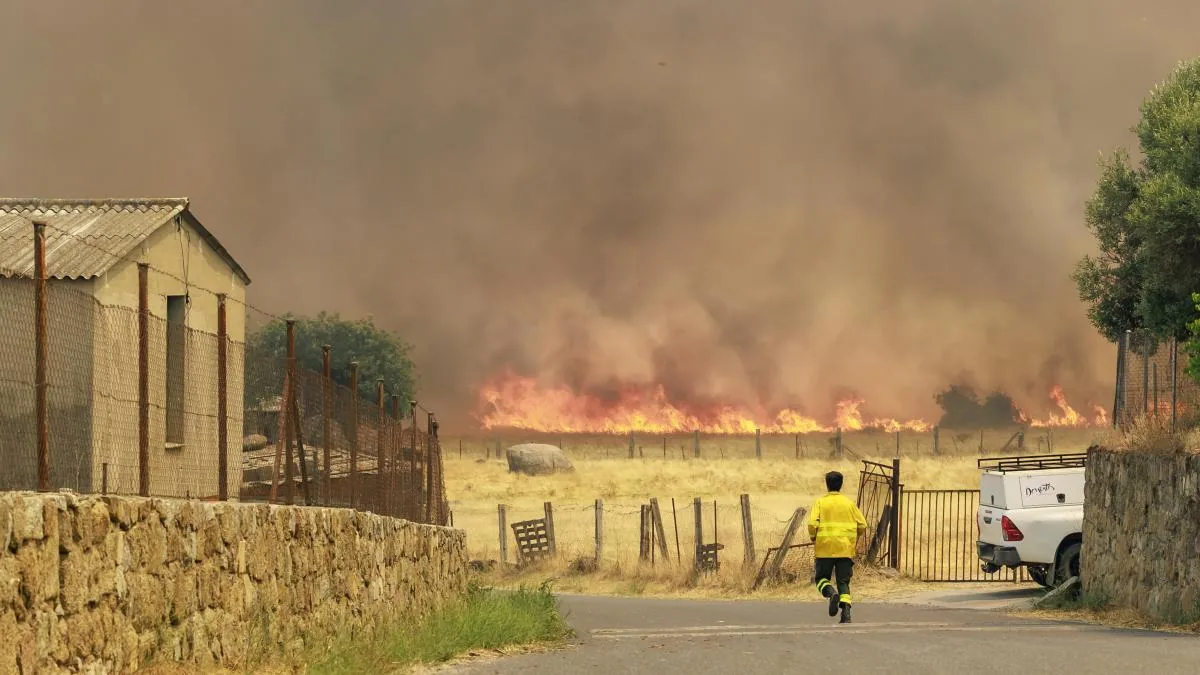
The Government takes control of Madrid as a huge fire advances (the two fronts, Villa del Prado and San Martín de Valdeiglesias, joined forces this midday) threatening the lives of the numerous population living in the western mountains of this region.
Read more Fires have already burned almost five times more hectares than in 2025 by this time
It is no longer a question of saving the wonderful landscapes of the area, chosen by Madrilenians, many wealthy and renowned, as a summer residence, but of saving the lives of tens of thousands of people who live there at this time of year.
Madrid had never suffered a fire of this category, says the regional president, Isabel Díaz Ayuso, who acknowledges that the only priority was to save lives from a literally “unstoppable”, “unstoppable” and “unextinguishable” fire.
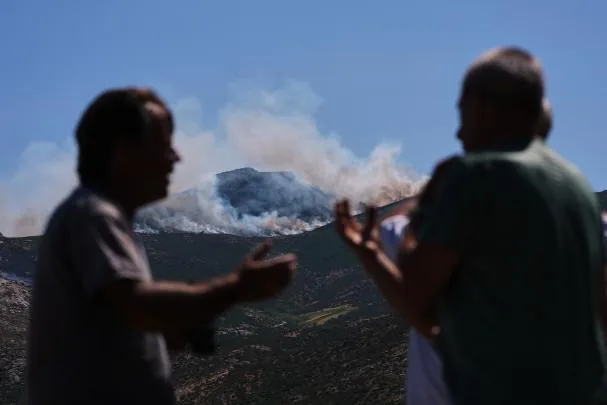
This is how extinction technicians define it, acknowledging to this newspaper that the only objective in this scenario is to prevent the fire from taking lives and to hope that the wind stops pushing (exceeding 50 kilometers per hour) and feeding the fire, that the temperature drops, and humidity increases. Looking at the sky, they admit, is all they can do, while they watch the also unstoppable advance of the Burgohondo (Ávila) fire, in the beautiful Sierra de Gredos, another of the places chosen for second homes, children’s camps, and elderly residences.
The fear is that this fire will join the one in Madrid, turning the center of the peninsula into a “huge tongue of fire,” although for other technicians that would not be “bad,” because it would allow its speed to be reduced by the head of the Ávila fire joining the tail of the Madrid one. “We could, perhaps, concentrate on the flanks,” they acknowledge.
In the hands of the UME, and with all national and autonomous community resources available, the flames have so far forced the evacuation of at least eight municipalities, far from being villages. About 20,000 people have had to leave with only what they were wearing to towns like Villamanta, Leganés, Las Rozas, Alcorcón… And another 20,000 are confined to their homes. All municipalities have made their sports centers available to house the evacuees, who will surely have to spend long days away from their homes.
It is known who has been rehoused because they keep talking on the phone: “I need to hear my loved ones”
One of the sports centers is in Villamanta, which has hosted residents from Villa del Prado, Aldea del Fresno, Colmenar de Arroyo, among others. Israel, owner of La Muni bar, is there; he has offered his facilities for users to charge their phones, lowered the menu to 9 euros, and enjoy a moment of relaxation in his premises. “We are all helping, there’s no other option.” In front of him is a group of friends, in their thirties, residents of Aldea del Fresno, who haven’t lost their humor and joke about anything. They can’t imagine, they say, that the flames will enter their town, much less damage their homes or vehicles.
Read more Spain asks Brussels to activate the European response mechanism for the Madrid fires
But that can happen, points out one of the civil guards who are preventing circulation to the huge area taken by the fire. “We have seen how in a matter of minutes the flames have entered urbanizations in Villa del Prado,” he explains. Next to him, Juan. He cannot access with the Verduras Curro truck, a company dedicated to the cultivation, handling, and distribution of fresh vegetables and greens, and one of the main producers of the so-called Huerta de Madrid. The tomatoes from Villa del Prado are famous.
Has the company suffered damage? No one knows for sure the extent of the damage, except in some specific cases, such as 43 houses – so far -, cars, and warehouses in the Villa del Prado area, or entire campsites in the San Martín de Valdeiglesias or Pelayos de la Presa area. Esteban, one of the workers from the former, is devastated: “Nothing, nothing is left. Only ashes and desolation,” he laments. It was one of the most prestigious on the so-called Costa de Madrid: “we were located near the San Juan reservoir,” considered Madrid’s beach.
Villamanta’s sports center is packed. Hundreds of people are sheltering from the heat inside, while outside are, above all, pet owners (pets are not allowed inside). Dozens of dogs, cats, and cages with parrots and birds, along with their owners, waited patiently in the shade. Food and drink have also been provided for them by Red Cross, Civil Protection personnel, and numerous volunteers.
The animals at Aldea del Fresno zoo, Safari Madrid, a long-standing space for animals in semi-freedom, including lions, tigers, giraffes, zebras, and bears, are also safe. The keepers stayed with them on Thursday night, prepared to leave “as best they could,” says María, whose son works there. “So far, they have been spared,” the woman indicated. Her son is still at the zoo.
“Nothing is left of the campsite, only ashes and desolation,” says a worker from the Costa de Madrid
The afternoon is drawing on and spirits are waning. The wind continues to blow, and smoke and the smell of burning spread unstoppably across the region. Navas de Rey has been evacuated, says one of the women sitting on a folding chair under a fig tree. She knows because one of the evacuees is her sister-in-law, who asks her where she is to see if they can be together. Mobile phones, more than ever, perform the task for which they were initially conceived: communication. Journalists know who has been rehoused because they are talking on the phone and not sending instant messages. “It’s just that with the nerves I can’t write, and because I need to hear the voices of those I love,” recounts Francisco.
Another custom that reappears is watching television in company, under the Spanish World Cup flags still hanging in Casa Judas. Neighbors watch on screen as their land is engulfed by fire, with tears in their eyes and heavy hearts. “Please, please, let the town stand,” they pray.
Read more The new ‘diamond jaw’ of Vinicius sparks speculation about several Hollywood stars